
Unbiased headlines. Facts, not spin.
Every story is an unbiased news briefing written from 110+ sources across the spectrum — sources linked so you can verify it yourself.
 politics
Major Story (7/10)
July 23, 2026 at 09:40 AM
politics
Major Story (7/10)
July 23, 2026 at 09:40 AM
House Passes $1.15 Trillion Defense Bill With Voter ID Measure Attached, 216-212
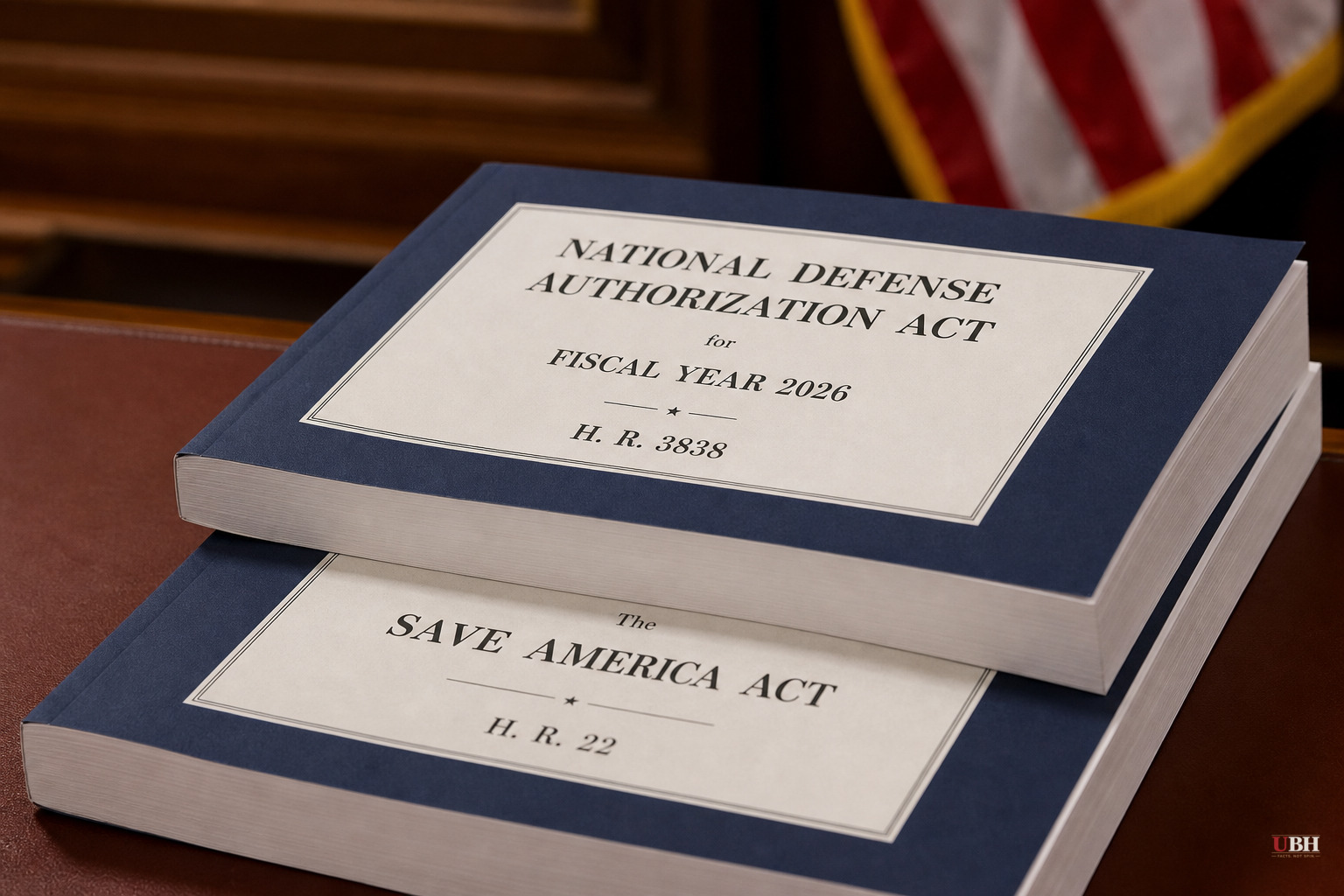
The House of Representatives passed a $1.15 trillion defense policy bill on July 22, and Republicans used it to carry a voter ID measure they couldn't pass on its own.
The vote was 216-212, according to The Epoch Times. Six Democrats crossed over to vote yes. Six Republicans voted no, including Reps. Eli Crane of Arizona and Chip Roy of Texas.
Some Republicans think the bill still doesn't cut enough. Some Democrats decided defense funding was worth breaking ranks for.
What's Actually In It
The National Defense Authorization Act sets policy and funding levels for the Pentagon. House Republicans attached the Safeguard American Voter Eligibility Act, known as the SAVE America Act, to the defense bill before final passage.
This is not the first time House Republicans have done this. They've attached the SAVE America Act to other major bills that passed the House this month and got sent to the Senate, according to The Epoch Times. The strategy is clear: if a standalone voter ID bill can't get through the Senate on its own, staple it to something Democrats don't want to be seen killing.
The SAVE America Act, championed by President Trump, would require proof of citizenship to register to vote in federal elections. Supporters say this is common sense. Americans already need ID to open a bank account, board a plane, or buy alcohol. Requiring proof of citizenship to vote in federal elections is not a radical ask, and it's a position most voters across the political spectrum have told pollsters they support in the past.
Critics of voter ID and proof-of-citizenship requirements argue these laws can create paperwork burdens for people who lack easy access to birth certificates or updated documents, particularly married women who've changed their names or elderly voters born without hospital birth records. That's a legitimate logistical concern raised by voting rights advocates, and it deserves to be weighed against the integrity rationale, not dismissed outright. Whether that burden is severe enough to outweigh the verification benefit is a genuine policy dispute.
The Audit Amendment
Buried in the amendment process the night before final passage was a provision cutting the defense budget by 0.5 percent if the Pentagon fails a financial audit.
It passed by voice vote. The Pentagon failed its eighth consecutive audit in 2025, according to The Epoch Times, so this isn't hypothetical. It's a direct penalty tied to a track record of failure.
The cut would hit funding that flows to the Treasury Department. Military personnel, reserve and National Guard troops, and Defense Health Program accounts are exempted, so the penalty is aimed at bureaucratic and administrative funding streams, not troop pay or health care.
Eight straight failed audits at an agency spending over a trillion dollars a year represents a documented pattern of poor financial accountability. An automatic funding penalty tied to that failure serves as a taxpayer-protection measure.
The Senate Problem
None of this means the bill is law. It still has to get through the Senate, and that's already proven difficult.
A week before the House vote, Senate Democrats blocked a procedural motion to advance the NDAA, with the tally at 50-46, according to The Epoch Times. Senate Majority Leader John Thune of South Dakota switched his own vote from yes to no purely as a procedural maneuver, allowing him to bring up the cloture motion again later. Advancing the bill past a filibuster requires 60 votes, and Republicans don't have that margin on their own.
The Senate Armed Services Committee had already advanced its version of the bill in a bipartisan 18-9 vote back on June 11. But that committee-level agreement broke down once it hit the floor, because Republicans and Democrats couldn't agree on top-line defense and non-defense spending numbers.
Senate Minority Leader Chuck Schumer of New York pointed to renewed hostilities involving Iran as a reason for Democratic opposition to moving the bill forward, saying on the floor that "the White House has formally notified Congress that hostilities have resumed, that American strikes are underway again and our forces remain positioned for more."
What Happens Next
The House-passed version, with the SAVE America Act attached, now heads to the Senate. Given that Senate Democrats already blocked the bill once over spending disagreements and now cite the Iran situation as an added complication, there's no clear path to 60 votes yet.
If the Senate strips out the SAVE America Act language, or amends the bill in ways the House won't accept, the two chambers will need a conference process to reconcile differences before any final defense authorization becomes law. Whether Republicans can keep using unrelated must-pass legislation as a vehicle for voter ID policy, without it costing them votes on defense funding itself, is the open question going into that negotiation.
Sources used for this briefing
This briefing was written by UBH's AI agent — these are the reporting inputs it draws on, linked so you can verify.


