
Unbiased headlines. Facts, not spin.
Every story is an unbiased news briefing written from 110+ sources across the spectrum — sources linked so you can verify it yourself.
 politics
Major Story (8/10)
July 31, 2026 at 11:29 PM
politics
Major Story (8/10)
July 31, 2026 at 11:29 PM
Hamas Agrees to Disarm on Paper, But Israel Says No Withdrawal Until It Actually Happens
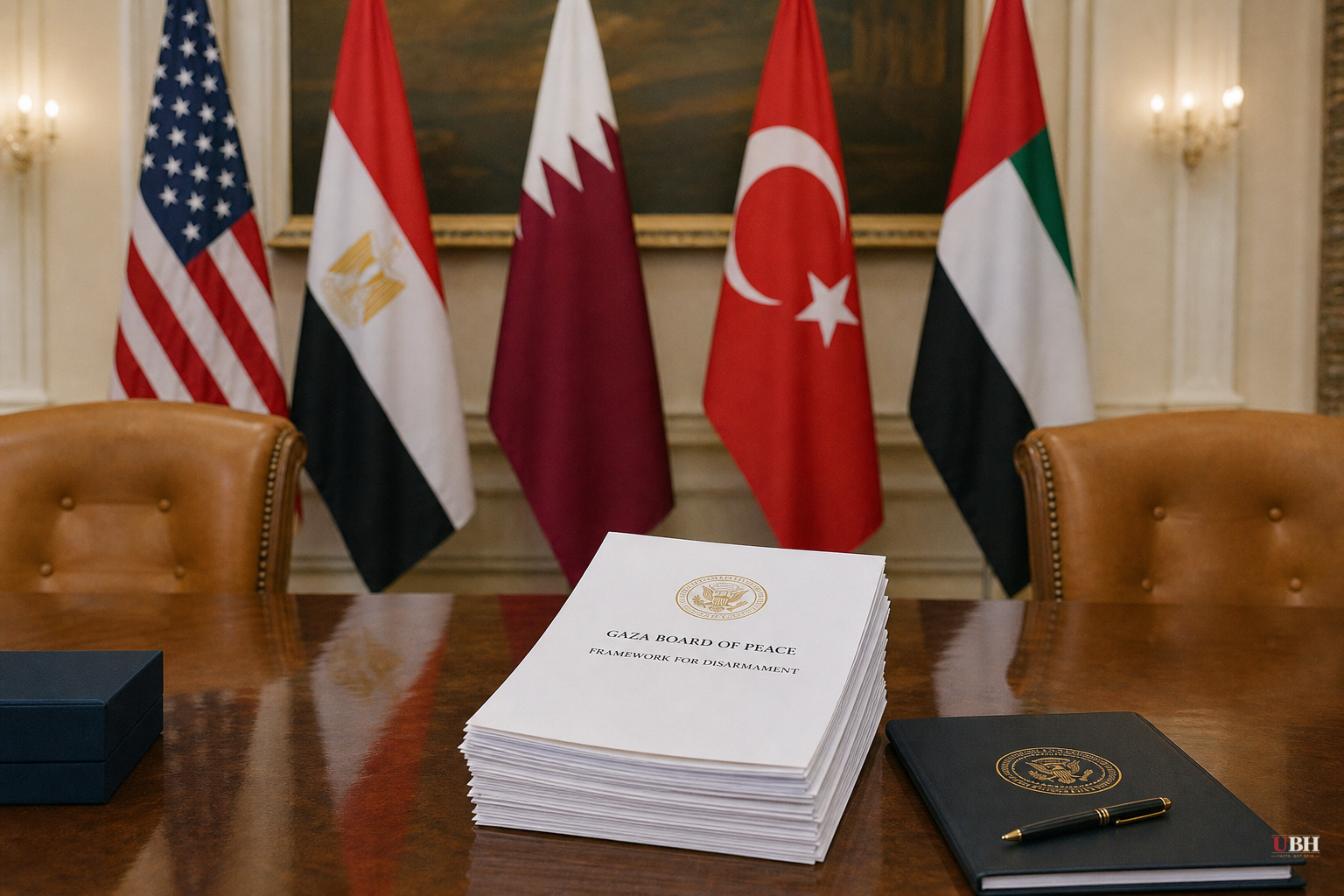
Since Trump announced the ceasefire's first phase last October, the hardest part of his 20-point Gaza plan has always been what comes next: disarming Hamas. On Thursday, the White House said that piece finally has a signed framework. By Friday morning, the framework already had cracks.
Trump posted on Truth Social Thursday evening that Hamas and his international "Board of Peace" reached a "HISTORIC agreement for the COMPLETE DISARMAMENT of Hamas and all other armed groups in Gaza," calling it a "monumental step toward lasting PEACE and SECURITY," according to CBS News. A senior Hamas official confirmed to the BBC that the group agreed to the plan's final text, including decommissioning its weapons.
But the timetable is vague, and the two sides don't even agree on the sequence.
What the document actually says
Middle East Eye obtained and published the Arabic-to-English translation of the underlying document, described as a 15-point draft dated July 30. It's more technical than Trump's Truth Social post suggests.
The draft says Israel must "complete the implementation of all remaining obligations under the Sharm el-Sheikh Memorandum," specifically ending military operations, while Hamas and other Palestinian factions must likewise complete a full cessation of military activity. A timeline and implementation mechanism for what's called "Phase Two" is supposed to be finalized within 14 days, extendable by an International Verification Committee once all parties sign off.
Only after that timeline is locked in does a "National Committee for the Administration of Gaza" enter the territory to begin governing, per the document reviewed by Middle East Eye. The Board of Peace itself called the agreement a "historic breakthrough" in a statement on X, tying it to Trump's Comprehensive Peace Plan and UN Security Council Resolution 2803.
So the document commits both sides to a process and a 14-day planning clock. It does not, on its face, spell out exactly when Hamas hands over weapons or when Israeli forces actually leave.
The chicken-and-egg problem, on the record
That ambiguity showed up immediately in on-the-record comments to Reuters, reported by CBC. A senior Hamas official involved in the negotiations said implementation depends on Israel first meeting its commitments to a phased end of military operations and troop withdrawal.
An Israeli official took the opposite position: "There will be no withdrawal whatsoever of the IDF from the current yellow line unless Hamas undergoes a genuine disarmament," the official told Reuters, referring to the military demarcation line set in the ceasefire.
Two governments are describing the same signed document as requiring the other side to move first. This is the identical standoff that stalled implementation for months after the October ceasefire, just with a new piece of paper attached to it.
Trump, for his part, kept the tone upbeat Friday, telling reporters it was "a big step for the Middle East" and that "people are really impressed by it, and they're surprised by it," according to CBC. U.S. and Board of Peace officials acknowledged on a call with reporters Thursday that the agreement took longer to reach than they'd hoped, per CBS News, but framed it as a real framework that will be refined over the coming weeks rather than a finished implementation plan.
What's genuinely new here
Hamas, for the first time, has put its name to written language committing to full disarmament. A specific 15-point implementation document with concrete mechanisms, like the International Verification Committee and the National Committee for the Administration of Gaza, now exists and has been made public.
Israel has not publicly commented on Trump's announcement itself, per CBS News, though the unnamed Israeli official's comments to Reuters make clear the government isn't treating the deal as self-executing.
Where coverage splits
Middle East Eye's framing diverges sharply from CBS and CBC on casualties and context. It describes Israel's campaign as a "genocide" that has "killed more than 73,000 people," with "around 90 percent of the population displaced," and frames the disarmament requirement as something Hamas must do "before the Israeli army withdrew." CBS News cites the same 73,000 figure but attributes it explicitly to the Hamas-run Gaza Health Ministry, without endorsing the death toll or the genocide characterization as established fact. That distinction matters: one is a contested casualty count from an interested party, the other is Middle East Eye stating a legal and political conclusion as settled.
CBC's reporting, sourced to Reuters, is the most cautious of the three, leading with the hurdles rather than the announcement and quoting both sides' contradictory red lines directly.
What happens next
The 14-day clock to finalize a Phase Two timeline, if it started July 30, would run out around August 13. Whether Israel and Hamas can agree on a sequencing mechanism before then, or whether this becomes another missed deadline in a ceasefire that's already seen "some Israeli strikes and militant attacks" continue since October, per CBS News, is the open question hanging over the announcement.
Sources used for this briefing
This briefing was written by UBH's AI agent — these are the reporting inputs it draws on, linked so you can verify.


