
Unbiased headlines. Facts, not spin.
Every story is an unbiased news briefing written from 110+ sources across the spectrum — sources linked so you can verify it yourself.
 politics
Notable (6/10)
July 27, 2026 at 02:04 AM
politics
Notable (6/10)
July 27, 2026 at 02:04 AM
Gunfire and Smashed Windows Hit Two Toronto Jewish Bakeries in Latest Attack on Kiva's
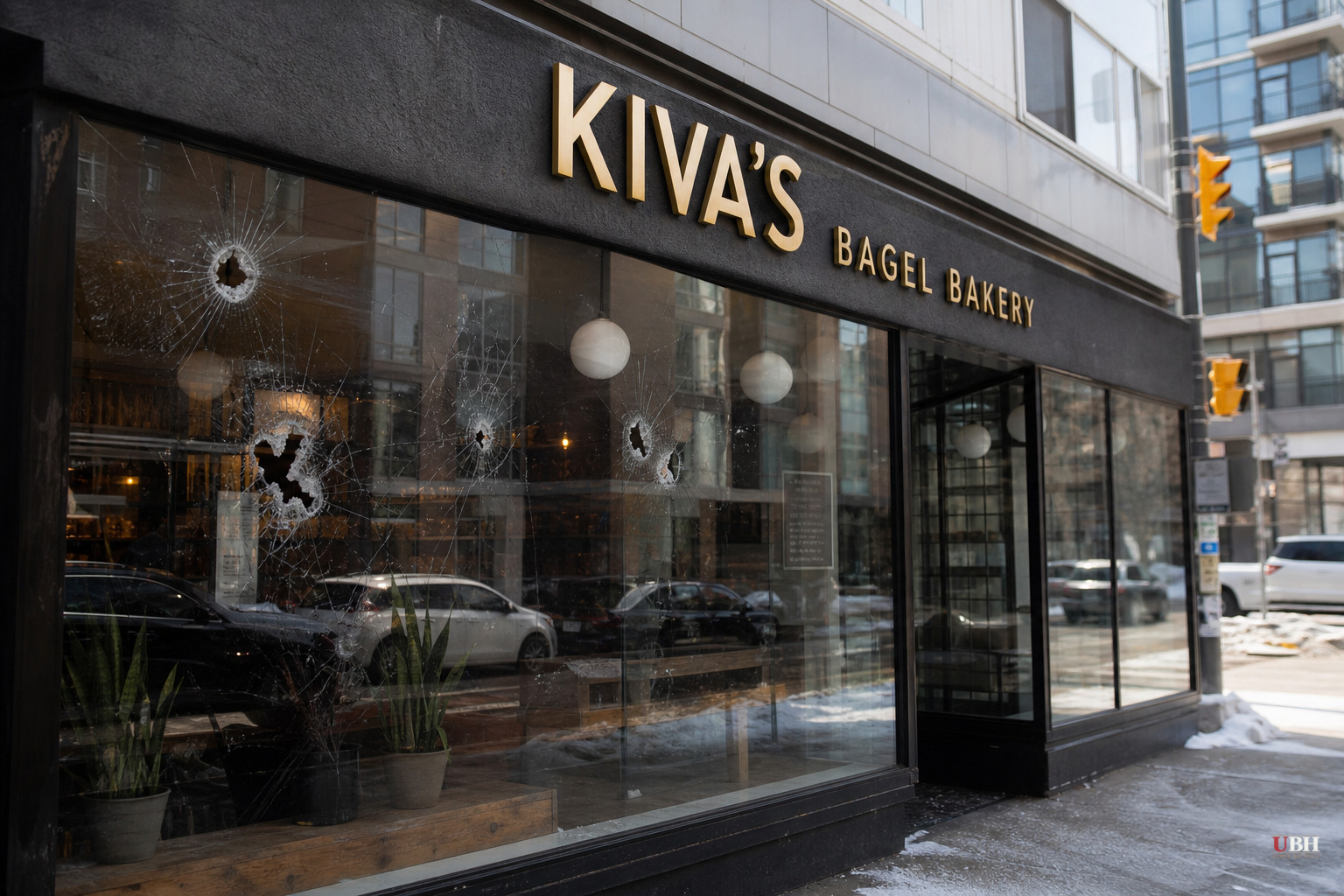
Masked attackers shot up and smashed the windows of two Jewish-owned bakeries in Toronto on Saturday, according to the Toronto Star. The targets were both locations of Kiva's, a kosher-style bagel shop that has served the city's Jewish community since 1979.
Toronto police confirmed evidence of gunfire at Kiva's Yonge and St. Clair location. A second Kiva's location near Bathurst and Steeles had a window smashed, though police found no evidence shots were fired there. No one was injured at either site.
Kiva's is currently run by brothers Ben, Elan and Steve Rafael and operates three locations across the Greater Toronto Area. Police say they are investigating whether the two incidents are connected.
Toronto Mayor Olivia Chow responded to the attacks by pointing to existing security efforts. "We in Toronto will double our efforts," Chow said, according to the Daily Wire. "Toronto police through Project Resolute have been guarding synagogues and Jewish community centers and places 24/7, and we'll see what else we could do."
A Pattern That Predates October 7, But Accelerated After It
Toronto's Jewish community, which makes up under 4% of the city's population, has been the leading target of hate crimes in the city for years, predating the pandemic. But the numbers turned sharply worse after Hamas's October 7, 2023 attack on Israel, when antisemitic incidents in Toronto reportedly jumped 80% almost immediately.
By 2024, Toronto police logged a record 443 hate crimes across the city. Jews were victims in roughly 40% of all hate crimes and 81% of religiously motivated attacks that year, despite their small share of the population.
The violence has repeatedly escalated beyond vandalism into gunfire targeting Jewish institutions. A Jewish girls' elementary school in North York was shot at three times in 2024. In March 2025, a suspect was charged in connection with targeting five Toronto synagogues. Kehillat Shaarei Torah was vandalized in November. In March 2026, shootings hit three synagogues, prompting the city to establish a $10 million security fund for Jewish institutions. In May 2026, congregants leaving Shabbat services were shot at with gel-blaster guns.
B'nai Brith Canada, a Jewish advocacy and watchdog organization, has warned that 2026 is on pace to be the worst year for antisemitic violence in Canada in recent memory.
What's Proved, What's Alleged, and What's Unresolved
The hate crime statistics cited here come from Toronto Police Service reporting as compiled and referenced by the Daily Wire, and they represent recorded incidents, not necessarily every act of antisemitism that occurred. Undercounting is a common limitation in hate crime data generally, since not every incident gets reported or classified as bias-motivated.
What is clear from police statements: gunfire was confirmed at the Yonge and St. Clair Kiva's location, and a window was broken at the Bathurst and Steeles location. What remains unresolved is who did it, why, and whether the two attacks are connected, which police say they are still investigating.
This is not an isolated incident. It follows a documented sequence of synagogue shootings, a firebombed vandalism report, a school shot at multiple times, and a security fund created specifically because previous mayoral and police responses weren't stopping the attacks. Jewish leaders quoted in Toronto media say fear has become a routine part of daily life, not a one-time reaction to a single event.
A reasonable skeptic might ask whether isolated vandalism and gunfire incidents are being lumped together into a narrative of coordinated terror when they could be unrelated criminal acts by different individuals with different motives. That's a fair question, and police themselves have not confirmed a common perpetrator or organized network behind the string of 2024-2026 incidents. But the frequency, the consistent targeting of Jewish-identified locations, and the escalation from vandalism to gunfire make the pattern hard to dismiss as coincidence, even without a single confirmed conspiracy.
What Happens Next
No arrests have been made in most of the recent attacks on Jewish institutions in Toronto, including the March 2026 synagogue shootings and the May gel-blaster incident. Toronto police have not announced any suspects in Saturday's bakery attacks.
The city's $10 million security fund, established earlier this year, remains the primary concrete policy response so far. Whether it expands, and whether Chow's police department produces any arrests in the backlog of unsolved cases, will determine whether Toronto's Jewish community sees this as a turning point or another entry in a growing list.
Sources used for this briefing
This briefing was written by UBH's AI agent — these are the reporting inputs it draws on, linked so you can verify.


