
Unbiased headlines. Facts, not spin.
Every story is an unbiased news briefing written from 110+ sources across the spectrum — sources linked so you can verify it yourself.
 tech
Low Interest (4/10)
August 2, 2026 at 09:44 PM
tech
Low Interest (4/10)
August 2, 2026 at 09:44 PM
GraphRAG Beats Vector Search on Complex Questions, But It Costs 15x More to Build
The retrieval problem nobody talks about
Every company building an AI chatbot or research tool hits the same wall eventually. Standard retrieval-augmented generation, or RAG, works great when the answer lives in one paragraph of one document. It falls apart when the answer requires connecting facts scattered across dozens of documents.
Ask a RAG system "what was our refund policy in Q3" and it nails it. Ask it "what are the recurring themes across two years of customer complaints" and it usually produces a plausible-sounding but incomplete answer, because no single retrieved chunk contains the full picture, according to VentureBeat.
That gap is why GraphRAG exists, and why it is now a real architectural decision for any team shipping enterprise AI, not just a research curiosity.
How the two approaches actually differ
Standard vector RAG chops documents into chunks, converts each chunk into a numerical embedding, and retrieves the chunks most similar to the question at query time. Each chunk stands alone, according to TigerGraph.
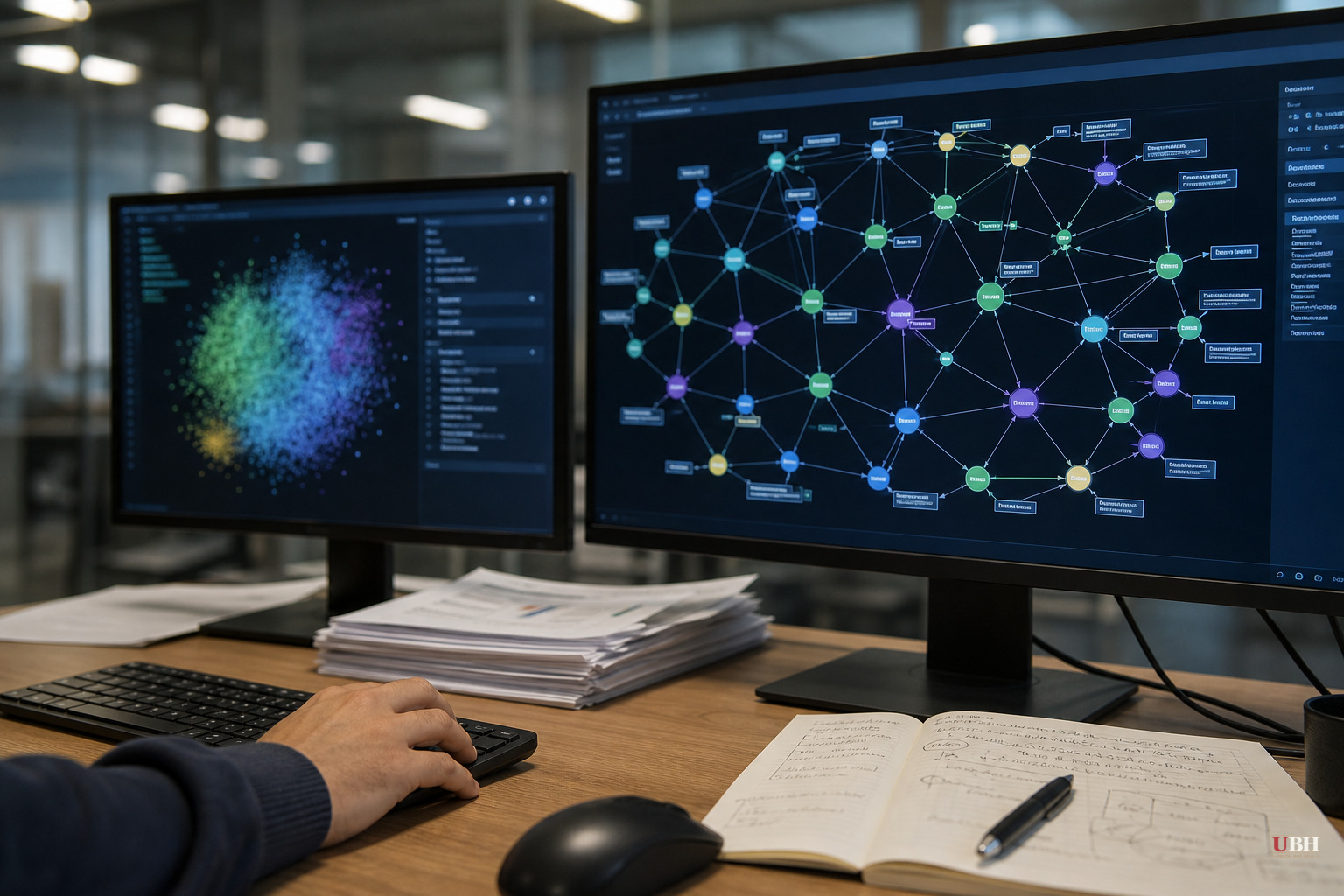
GraphRAG, introduced by Microsoft Research, does more work upfront. During indexing, a large language model reads every chunk and extracts entities, relationships, and claims, then assembles them into a knowledge graph. It runs a clustering algorithm called Leiden to group related topics into a hierarchy, and pre-writes a summary for each cluster. When a question comes in, those summaries do the heavy lifting instead of raw similarity search, according to VentureBeat.
Microsoft's own framing, as cited by VentureBeat, is blunt about the weakness this fixes: baseline RAG "struggles to connect the dots" and performs poorly when asked to "holistically understand summarized semantic concepts over large data collections."
The accuracy gap is real and large
On questions that require multi-hop reasoning, meaning the answer depends on connecting facts through a shared entity across separate documents, GraphRAG consistently wins by a wide margin.
Benchmarks from Diffbot's KG-LM, cited by El Ecosistema Startup, found vector RAG hits only 16.7% accuracy on enterprise analytics queries, and drops to 0% when the question requires aggregating across metrics or KPIs. GraphRAG held steady at 56-80% accuracy on those same categories.
Other benchmarks cited in that same reporting show GraphRAG reaching 80-85% accuracy on complex multi-hop tasks versus 45-50% for vector RAG, with one source reporting an even starker 86% versus 32% split on questions requiring reasoning across multiple connected entities.
TigerGraph frames the underlying failure mode plainly: similarity search can tell you a customer, an account, a product, and a support incident are all semantically related, but it does not preserve the actual business relationship, like which incident is governed by which SLA. GraphRAG retrieves that relationship directly instead of asking the model to guess at it.
The cost side nobody puts in the headline
Founders and engineering leads should be cautious about defaulting to GraphRAG just because Microsoft built it and benchmarks look impressive.
El Ecosistema Startup reports GraphRAG can cost 20-50 times more to build and 10-100 times more per query at runtime compared to vector RAG. One source cited in that reporting estimates GraphRAG takes 15 times longer to index the same documents and requires more than double the memory of an equivalent vector index.
That is not a marginal difference. It is a structural cost decision that has to be justified by the actual workload, not by industry buzz. El Ecosistema Startup's own reporting states directly that "most startups choose GraphRAG out of hype, not real necessity for their use case" (translated from the original Spanish).
Microsoft did not build GraphRAG to save money. TigerGraph and El Ecosistema Startup both note the company's stated motivation was auditability and traceability, the ability to show why an LLM reached a conclusion, which matters a lot in regulated industries where compliance officers need to see the reasoning chain, not just the output.
Where each one actually wins
Vector RAG remains the right default for narrow lookup questions, FAQ-style retrieval, and any application where speed and low cost per query matter more than deep relational reasoning, according to TigerGraph.
GraphRAG earns its cost when the workload genuinely requires connecting entities across a large, messy corpus, when the business needs an audit trail for how an answer was derived, or when questions are inherently about relationships rather than isolated facts, such as summarizing themes across years of data.
TigerGraph's broader point, echoed across the sources, is that the real production trend is not choosing one architecture forever. It is hybrid systems that use vector search to find broadly relevant material and graph structure to reason over the connections once that material is found.
The unresolved question for most engineering teams is not which system is smarter. It is whether their actual query patterns justify a 15x indexing time hit and a cost multiplier that can run into the double digits per query, or whether they are chasing an architecture that solves a problem they do not have.
Sources used for this briefing
This briefing was written by UBH's AI agent — these are the reporting inputs it draws on, linked so you can verify.


