
Unbiased headlines. Facts, not spin.
Unbiased Headlines is an independently owned news organization. We bring you the facts, not opinions, written fresh from 110+ named sources. Sources linked so you can verify it yourself.
 tech
Notable (6/10)
Event date: October 13, 2026 ·
tech
Notable (6/10)
Event date: October 13, 2026 ·
Google Moves AI Search Links Higher as Judge Tosses Publishers' AI Overviews Suits
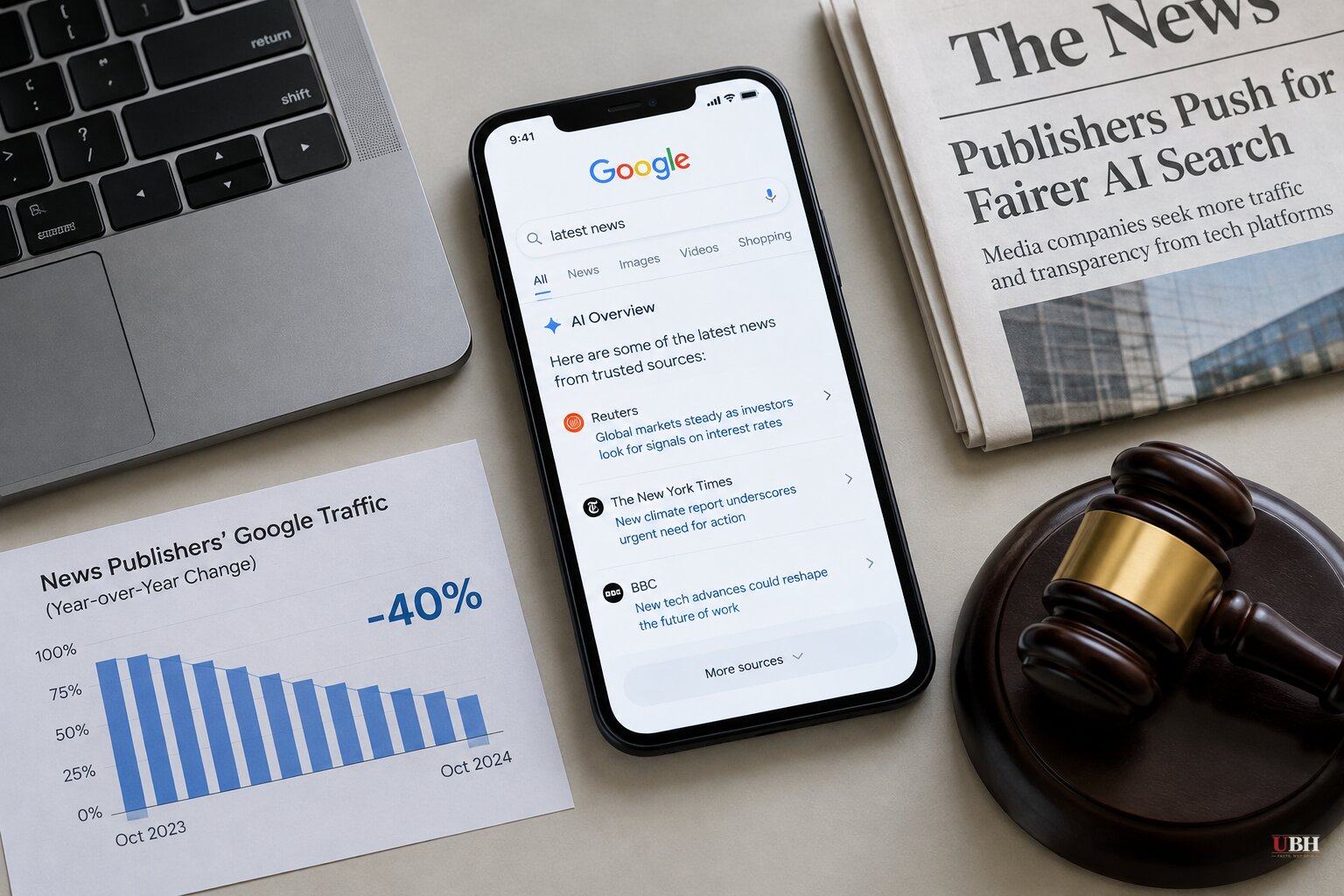
Google said Thursday, Oct. 15, that it is putting more inline links into its AI answers and placing them higher on the page. The change applies to AI Overviews and AI Mode, the two features publishers blame for keeping readers on Google instead of sending them out.
The announcement came with no evidence that it will bring traffic back.
What Google changed
Google says inline links will appear more often and higher in AI responses. It is also testing a dedicated section of prominent links marked official, for queries where one or two authoritative sites are the obvious answer. Each link would carry a note on why the site is useful.
Timely-article carousels are expanding to more languages and regions, including news from a user's Preferred Sources. Google says the number of people using Preferred Sources is up more than sevenfold since the start of the year. Related-article suggestions at the end of AI answers are getting larger thumbnails.
Some of this is rolling out and some is a test. The official-link section and clickable creator names are tests, and Google has not said every user or query will see them.
The Preferred Sources figure is a growth rate for a feature. It does not say how many visits publishers get from it.
The traffic numbers
Chartbeat found that news publishers lost 40 percent of their Google-originated traffic between July 2025 and July 2026.
In August, Apig, which represents French daily newspapers, formally told that country's Competition Authority that AI summaries breach agreements reached with publishers in 2022.
Google is also expanding its News AI licensing pilot to more than 400 publishers. Axios, CNN and the Financial Times are among the partners paid to supply content for new AI features, including article overviews on Google News publisher pages.
The courts say that's not an antitrust problem
Publishers tried the legal route first. On Sept. 30, Judge Amit Mehta dismissed suits from Penske Media, owner of Rolling Stone, Variety and Billboard, and from education company Chegg. His opinion runs 41 pages.
Both companies argued that Google uses its search dominance to force publishers to hand over content for snippets, AI Overviews and Gemini, because refusing could cost them visibility. In a competitive market, they said, Google would have to pay.
Mehta rejected that theory. The reciprocal-dealing claim needed an agreement, and he found the publishers pleaded only an expectation. "An expectation is not an agreement," he wrote.
He treated AI Overviews as part of search, not a separate product, which undercut the tying claim. He found the markets the publishers pleaded, "online publishing" and "online educational publishing," implausibly defined. He also held that lost referral traffic and ad revenue are not direct antitrust injuries caused by Google.
Mehta wrote that antitrust law is not a substitute for lawmakers when new technology causes economic harm. He added that he is not unsympathetic to creators whose work is reused without pay.
This was a ruling on the pleadings. TheWrap reports the Penske dismissal was without prejudice, meaning the company can refile. Neither Penske nor Chegg has announced a next step.
The ad tech case is a separate fight
Google's other big antitrust loss concerns the plumbing that pays publishers, not AI. In April 2025, Judge Leonie Brinkema of the Eastern District of Virginia ruled that Google illegally maintained monopolies in publisher ad servers and ad exchanges, and illegally tied its DFP ad server to its AdX exchange.
In a memorandum opinion dated Sept. 2, 2026, she declined the Justice Department's demand that Google sell AdX. She chose conduct restrictions instead, meant in her words to "pry open" the harmed markets. Those include sharing auction data, connecting with competitors, and six years of monitoring.
On Oct. 2, Google, the Justice Department and 17 state attorneys general filed a joint proposed final judgment. They did not agree on everything. The sharpest disagreements were over monitoring and enforcement, and the government flagged concerns about circumvention in several sections.
The other side of the pipe
Cloudflare and OpenAI published first results today, Oct. 16, from a three-month pilot announced July 8. Cloudflare fed live network-observation signals into OpenAI's crawling pipeline for about 1% of its network. Cloudflare says that let OpenAI "discover and index hundreds of millions of new web pages" that link-following crawlers would not have found.
Cloudflare's examples are appliance manuals, passport requirements and local menus. These pages matter to users even when few sites link to them.
Indexing is not traffic. The post does not say whether the newly found pages send visitors back to the sites that host them.
What publishers want
The publishers' position is that visible attribution is not payment. Penske and Chegg told the court that Google takes content under threat of lost search visibility. Chartbeat's numbers are the measure publishers point to.
Google's licensing deals with a few hundred partners are a different answer, but they pay selected publishers for specific products, not the open web.
The next concrete steps are on the docket and in Google's analytics. Brinkema has to rule on the competing proposed judgments, especially on monitoring and enforcement. Penske has to decide whether to refile or appeal. Publishers will see within months whether links placed higher in AI answers move the Chartbeat numbers.
Sources used for this briefing
7 links from 7 independent newsrooms (syndicated copies of the same report count once)
These are the sources it draws on, linked so you can verify.


