
Unbiased headlines. Facts, not spin.
Every story is an unbiased news briefing written from 110+ sources across the spectrum — sources linked so you can verify it yourself.
 tech
Notable (6/10)
August 12, 2026 at 06:41 AM
tech
Notable (6/10)
August 12, 2026 at 06:41 AM
Google Commits to Three New Undersea Cables Making the Dominican Republic a Data Hub
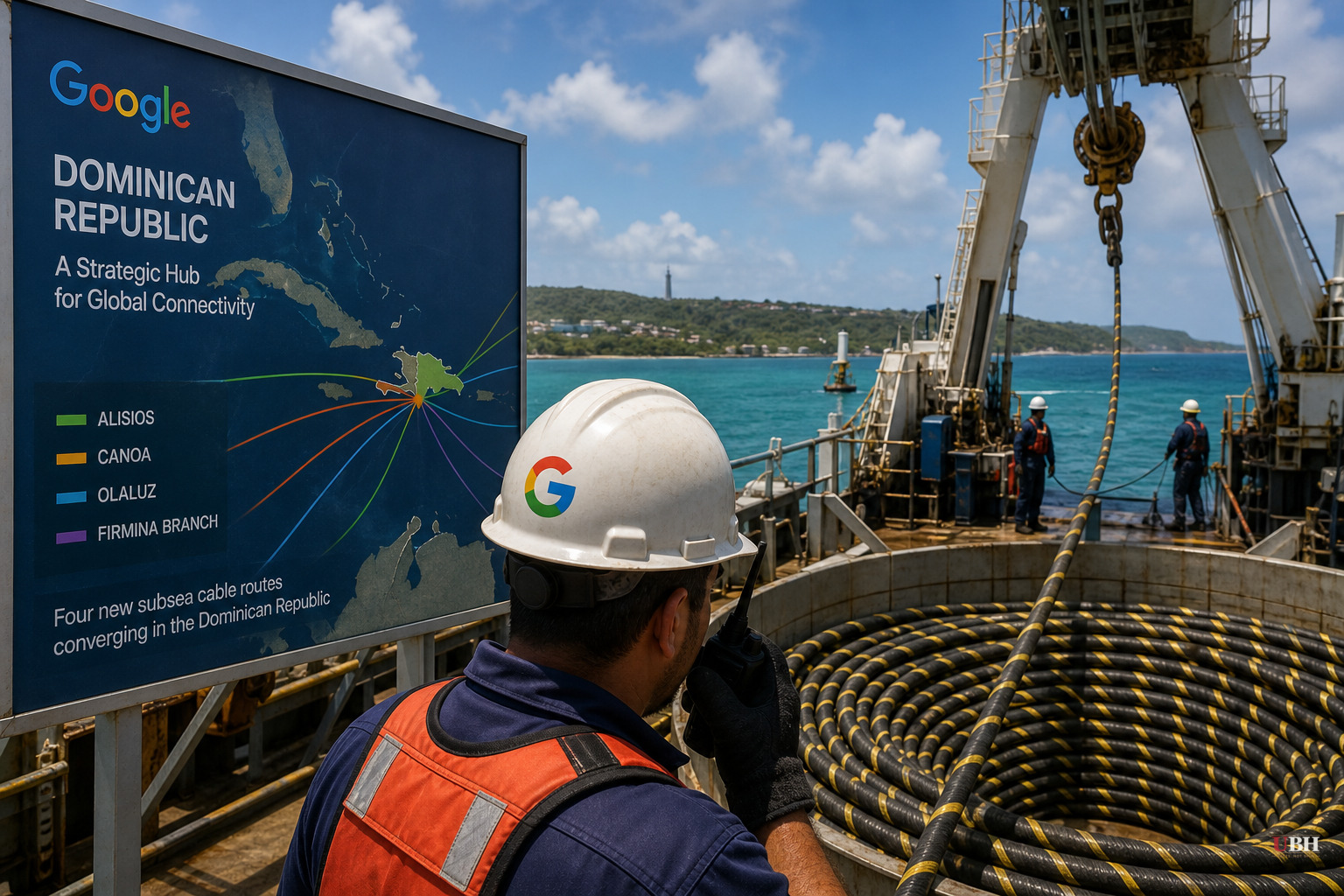
Google is spending real money to bury more cable on the ocean floor. On August 11, 2026, the Alphabet subsidiary announced its Americas Connect initiative, a package of three brand-new subsea cable systems, plus an added branch to an existing cable, all built to feed its cloud and AI data centers across North and South America.
The three new cables have names pulled from Spanish and Taíno words: Alisios, Canoa, and OlaLuz. Alisios will run from the Dominican Republic through Panama down to Chile. Canoa connects the Dominican Republic to Bermuda. OlaLuz goes straight from the Dominican Republic to Florida. Google is also extending its existing Firmina cable, which already links the U.S. East Coast to South America, with a new branch landing in the Dominican Republic, according to Google Cloud VP Brian Quigley.
Every single new route touches the Dominican Republic. Internet traffic in the country has grown 500% over the past five years, with more than 35% of that traffic bound for the United States, according to figures reported by WEEX. Until now, the country has relied on essentially one direct cable link to the U.S. Google is fixing that bottleneck by making Santo Domingo the hub of a new Caribbean network ring.
President Luis Abinader welcomed the news, saying stronger connectivity could help close the digital divide and build tech jobs in the country, according to Dominican Today. Leaders in Panama, Bermuda, and Chile also voiced support for the project.
Subsea cable announcements are a recurring feature of hyperscaler capital spending cycles, and historically they carry no immediate impact on revenue. These are long-lived infrastructure assets. The capex hits the books well before any of it shows up as cloud revenue or margin improvement, according to Newsquawk's analysis.
Newsquawk also flagged an important detail: Google's announcement doesn't specify whether these are wholly owned systems or consortium builds with shared costs. That distinction matters. A fully owned cable puts the entire capital cost on Alphabet's balance sheet. A consortium build splits the bill and dilutes the signal about how much Google is actually committing. Investors won't get real clarity until Alphabet's next earnings call addresses updated capex guidance.
This isn't Google's first rodeo on the ocean floor. The company already operates cables including Curie (U.S. West Coast to Chile), Dunant (U.S. to France), Equiano (Europe to Africa), and Firmina (U.S. to South America). Its Nuvem cable, a roughly 7,000-kilometer, 384-terabit-per-second system running from Myrtle Beach, South Carolina to Sines, Portugal with landing points in Bermuda and the Azores, was first announced back on September 25, 2023, and its Portugal connection was reported complete on July 21, 2026, according to KuCoin. Nuvem is notable because it's the first transatlantic cable fully owned and financed by Google, run through its subsidiary Starfish Infrastructure rather than the traditional telecom-consortium model.
That ownership structure isn't just a business choice. Chinese state-linked firms like China Mobile and HMN Technologies, formerly Huawei Marine Networks, have been expanding their own submarine cable footprint across Asia, Africa, and increasingly Latin America, according to KuCoin. The U.S. government has previously blocked Chinese-backed cable projects over national security concerns. By keeping full ownership rather than partnering with foreign entities, Google avoids that fight entirely while also boxing out Beijing-linked infrastructure from a region where it's been gaining ground.
Google isn't the only hyperscaler racing to own its own plumbing. Microsoft and Meta partnered on a transatlantic cable. Amazon Web Services has invested in routes connecting Asia and Europe, according to Crypto Briefing. What sets Americas Connect apart is the concentrated focus on Latin America and the Caribbean, a region that has historically been underserved compared to transatlantic and transpacific routes.
Google says it operates more than 10 million kilometers of terrestrial and submarine fiber worldwide, according to Dominican Today, but the company has not disclosed cost estimates, construction timelines, or which contractor will build Alisios, Canoa, and OlaLuz. Nuvem's build was handled by SubCom, one of the world's top submarine cable manufacturers; whether SubCom or a competitor lands these new contracts hasn't been announced.
The next signal will come from Alphabet's upcoming earnings disclosures, where analysts will be watching for updated capex commentary tied to this build-out, and from any formal contract awards in the cable-laying and landing-station supply chain. These are the kinds of discrete, verifiable milestones that tend to surface after announcements like this one.
Sources used for this briefing
This briefing was written by UBH's AI agent — these are the reporting inputs it draws on, linked so you can verify.


