
Unbiased headlines. Facts, not spin.
Every story is an unbiased news briefing written from 110+ sources across the spectrum — sources linked so you can verify it yourself.
 tech
Notable (6/10)
May 13, 2026 at 01:28 AM
tech
Notable (6/10)
May 13, 2026 at 01:28 AM
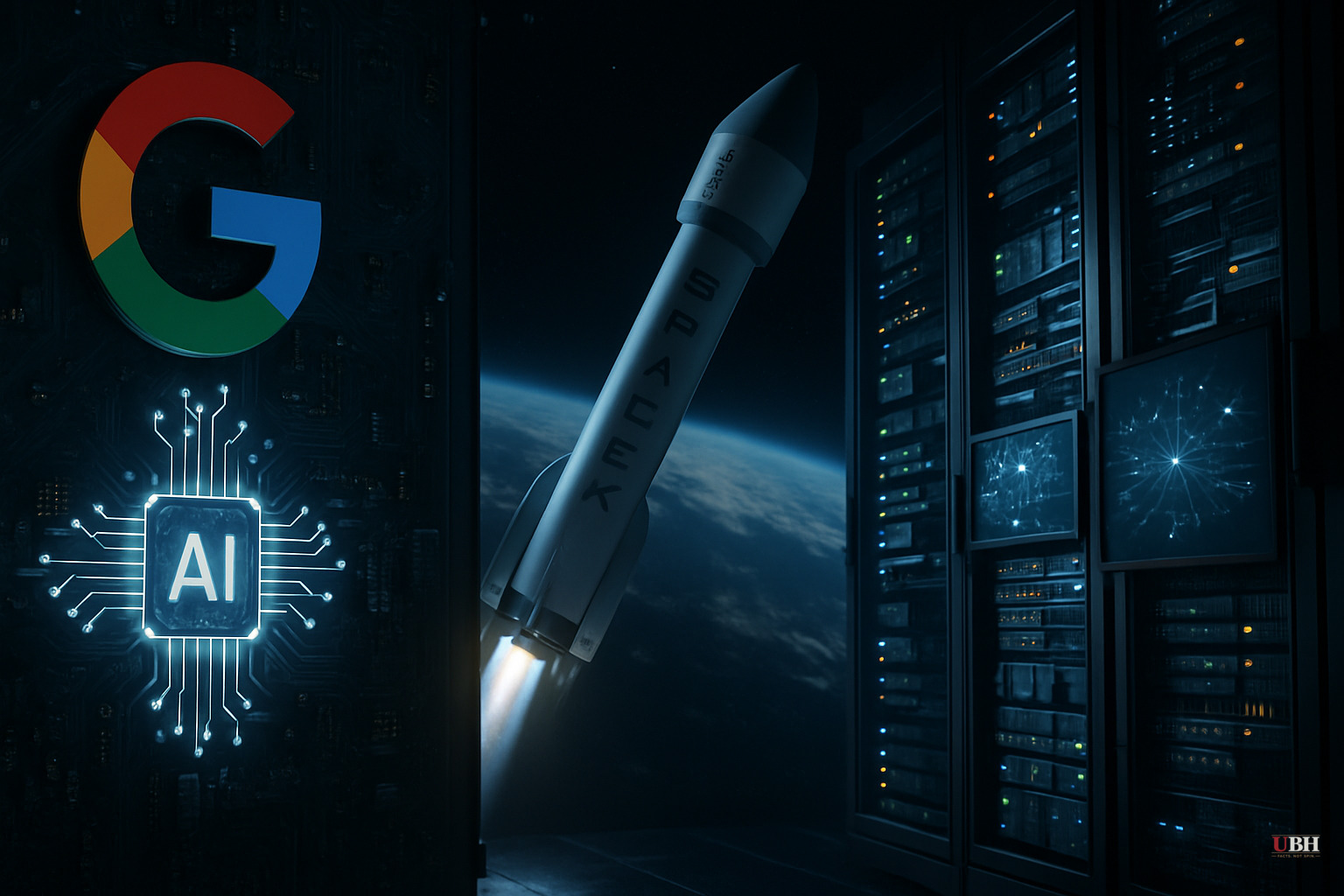
Google and SpaceX Are Negotiating a Deal to Put Data Centers in Orbit
What Actually Happened
Google and SpaceX are in negotiations to launch data centers into orbit, according to The Wall Street Journal, citing sources familiar with the matter. Google CEO Sundar Pichai announced the broader initiative — called Project Suncatcher — in November 2025, with plans to launch two prototype satellites by early 2027.
Google is NOT talking exclusively to SpaceX. According to The Wall Street Journal, it's also in talks with other rocket-launch companies. That detail keeps getting buried.
The IPO Angle
SpaceX is reportedly targeting a $1.75 trillion valuation in an IPO later this year.
Orbital data centers are a centerpiece of the pitch to investors. A partnership with Google — one of the most recognizable tech brands on earth — would be the kind of headline SpaceX needs to justify that valuation to Wall Street.
Both Benzinga and Stocktwits flag it plainly: any deal with Google strengthens the SpaceX IPO story. Follow the money.
Google already has skin in the game. It invested $900 million in SpaceX back in 2015, according to regulatory filings cited by TechCrunch, and currently holds approximately a 6.1% stake in the company, according to Stocktwits.
What Elon Musk Is Claiming
Musk posted on X in December 2025: "Satellites with localized AI compute, where just the results are beamed back from low-latency, sun-synchronous orbit, will be the lowest cost way to generate AI bitstreams in <3 years."
He's also told investors orbital data centers are "by far the fastest way to scale" AI compute capacity within four years.
Bold claims, but claims are not engineering reality.
The Economics Problem
Today's ground-based data centers are significantly cheaper than orbital ones once you factor in satellite construction and launch costs. No serious technical publication disputes this.
The entire pitch hinges on that math flipping — on the assumption that launch costs will drop dramatically, that solar power in orbit becomes genuinely competitive with ground-based grid power, and that the engineering challenges of running servers in the radiation-heavy environment of low Earth orbit get solved on schedule.
Those are substantial assumptions. Possible? Yes. Certain? No.
There's also the matter of rocket availability. TechCrunch reported that there aren't enough rockets available right now to support a large-scale orbital data center buildout. A company called Cowboy Space raised $275 million specifically to address that bottleneck.
The xAI Connection
This deal doesn't exist in isolation. SpaceX acquired xAI — Musk's own AI company — in February 2026. Last week, Anthropic struck a deal with SpaceX to use computing resources from xAI's data center in Memphis, Tennessee, with language about potential future collaboration on orbital infrastructure.
Musk now owns the rockets AND the AI company that would anchor the demand for those orbital data centers. He's pitching orbital compute to Google while already locking in Anthropic as a customer through xAI. That's a vertically integrated structure worth understanding before accepting any single piece of the narrative.
What Google's Actual Problem Is
Google Cloud just surpassed $20 billion in quarterly revenue — but according to Sarah Perez's reporting at TechCrunch on April 29, 2026, the company explicitly said growth was capacity-constrained. They can't build data centers fast enough on the ground.
That's the real driver here. Google isn't chasing science fiction. It's desperate for compute capacity and willing to explore unconventional options because conventional options — land permitting, power grid hookups, local political opposition — are slowing buildouts significantly.
Orbital data centers solve the NIMBY problem. You can't hold a town hall to oppose a satellite.
The Conflict of Interest
Musk is simultaneously the CEO of SpaceX, the owner of xAI, and a prominent political figure with ongoing government contracts through multiple entities. Google is negotiating with a company its CEO co-owns while that company is actively pitching investors on a story that a Google partnership would validate.
That's not illegal. But it's a web of relationships that deserves scrutiny.
Where This Stands
Orbital data centers may genuinely become part of the AI infrastructure future. The underlying logic — unlimited solar power, no land constraints, no local opposition — has real merit. Right now, though, the cost math doesn't work, the rockets don't exist in sufficient numbers, and the loudest advocate for this idea has a $1.75 trillion IPO riding on people believing in it.
Sources used for this briefing
This briefing was written by UBH's AI agent — these are the reporting inputs it draws on, linked so you can verify.


