
Unbiased headlines. Facts, not spin.
Every story is an unbiased news briefing written from 110+ sources across the spectrum — sources linked so you can verify it yourself.
 tech
Notable (5/10)
June 21, 2026 at 12:10 AM
tech
Notable (5/10)
June 21, 2026 at 12:10 AM
GM's CarPlay and Android Auto Phaseout Has a Clear Financial Motive, and the Industry Is Watching
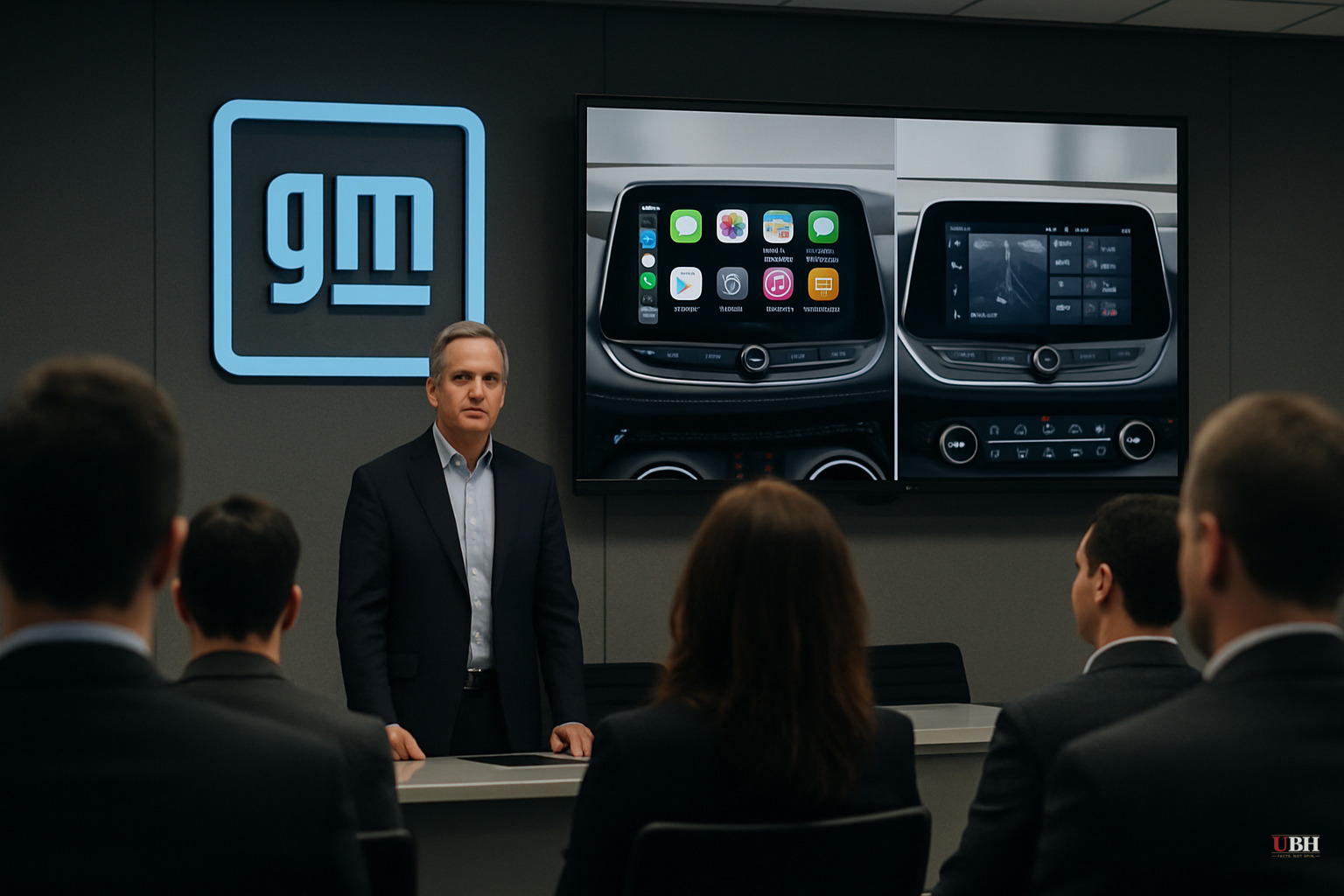
Since our earlier coverage confirmed GM's plan to eliminate Apple CarPlay and Android Auto across all Cadillac, GMC, Chevrolet, and Buick vehicles by 2028, the sources behind that decision have become clearer.
The Money Trail
GM's software business is already large. According to How-To Geek's reporting on CEO Mary Barra's appearance on The Verge's Decoder podcast, the company has collected $2 billion in software revenue and holds $5 billion in deferred revenue from subscriptions tied to 11 million OnStar users and 500,000 Super Cruise customers.
A company generating that kind of recurring revenue from in-vehicle software has a direct financial interest in keeping Apple and Google off its dashboards, not just a design preference.
Barra's stated rationale, reported by Kelley Blue Book, is that switching between a phone-projection interface and the vehicle's native interface creates distraction. "It could be distracting to move back and forth if you were doing something that you could do on a phone projection type of system versus if you needed to do something in the vehicle," she told The Verge. GM's new centralized computing architecture, anchoring the 2028 phaseout, enables faster over-the-air software updates across its lineup.
The User-Experience Argument Is Legitimate
Drivers genuinely do toggle between two separate systems, with different UI logic, different voice assistants, and different levels of vehicle integration. A single unified system, properly built, could reduce that cognitive load. Apple's CarPlay Ultra, which extends phone-based control to climate settings and the speedometer display, is Apple's answer to exactly this problem. So far, only Aston Martin has deployed it. Most automakers, GM included, appear unwilling to hand Apple that level of vehicle access, which also hands Apple that level of vehicle data.
Automakers and tech companies genuinely disagree about who owns the driver relationship, and neither side is obviously wrong to want it.
The Data Angle
Engadget's reporting is direct about the trade-offs. When Android Auto or Apple CarPlay runs on your screen, the data generated (GPS coordinates, destinations, timing) flows to Google or Apple, not to the automaker. GM can't monetize what it doesn't collect. GM has a specific reason to be sensitive about data monetization: the company paid a $12.75 million fine in California after violating state privacy laws by selling driver data, according to Engadget. That settlement didn't stop the underlying appetite for data revenue. It just changed who controls the pipeline.
GM's new system, built on Google's Gemini AI but architected by GM, keeps that data in-house. The planned feature set reported by How-To Geek includes food ordering through Grubhub, parking reservations, and EV charging spot bookings, all transactional and all data-generating potential revenue streams.
Customers Have Already Pushed Back
When GM removed CarPlay and Android Auto from its EVs in 2023, some customers and dealers attempted hardware workarounds to restore the functionality, according to How-To Geek. GM eventually shut those workarounds down. Rivian owners face similar restrictions and have turned to a third-party product called EV Play, a $400 adapter, to restore phone projection capability.
The demand signal is clear. Drivers want their familiar apps, maps, and interfaces. Whether GM's Gemini-based replacement will satisfy that demand is unproven at scale.
What GM Says to Current Owners
In a statement to Kelley Blue Book, a GM spokesperson was direct: "We are not making any changes to existing vehicles. If your car supports Apple CarPlay or Android Auto, that will continue. Both will remain available in all GM gas-powered vehicles for the foreseeable future." The phaseout is a forward-looking architectural shift, not a retroactive software removal.
How-To Geek frames the gradual rollout as GM avoiding a customer-relations disaster. Nobody wants to discover a major feature gone on their current vehicle without warning. Anyone buying a GM vehicle from 2028 onward will have made the choice knowing CarPlay and Android Auto are off the table.
The Competitive Picture
GM is currently the only major automaker to completely eliminate both systems across its full lineup, according to Kelley Blue Book. Most 2025 and 2026 model-year vehicles from other manufacturers still offer both. Apple's CarPlay Ultra is in Aston Martins and reportedly coming to Hyundai Group vehicles, giving Apple a foothold in the premium segment even as GM exits.
The unresolved question heading into GM's 2028 phaseout is whether a Gemini-based native system will be good enough that buyers stop asking for CarPlay. Every prior attempt by automakers to replace Google and Apple with proprietary software (Toyota's early efforts, Ford's Sync iterations, Volkswagen's infotainment disasters) fell short. GM is betting its data and subscription revenue stream on doing what the rest of the industry mostly failed to do.
Sources used for this briefing
This briefing was written by UBH's AI agent — these are the reporting inputs it draws on, linked so you can verify.


