
Unbiased headlines. Facts, not spin.
Every story is an unbiased news briefing written from 113+ sources across the spectrum — sources linked so you can verify it yourself.
 tech
Notable (5/10)
October 4, 2026 at 02:26 AM
tech
Notable (5/10)
October 4, 2026 at 02:26 AM
Germany's Aleph Alpha Releases 78 Billion Parameter Kolibri AI Model With No Cloud Option
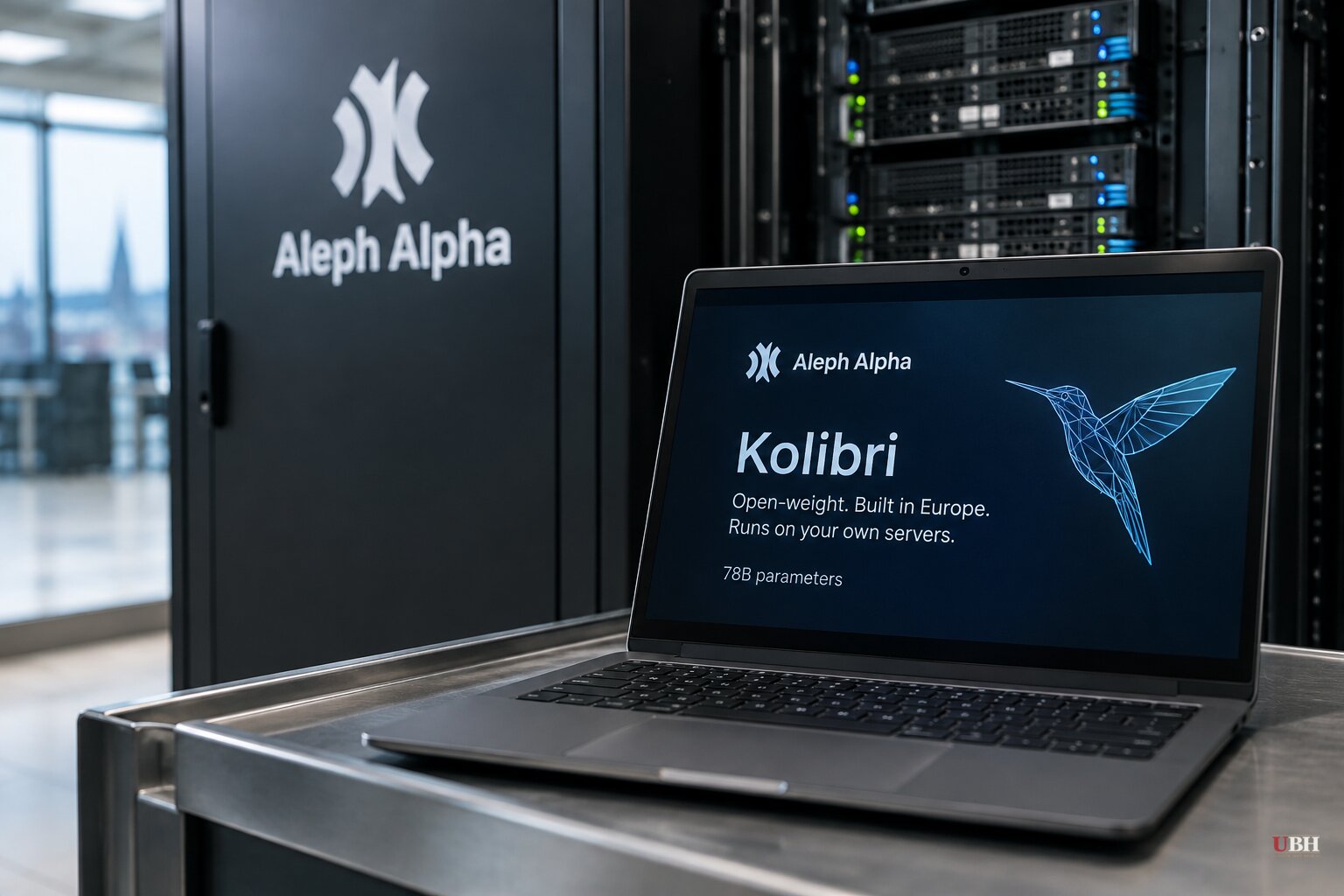
Aleph Alpha, a Heidelberg-based AI company, released an open-weight language model called Kolibri on October 3, 2026, the Day of German Reunification. The company built its pitch around European data sovereignty, not raw benchmark supremacy.
Kolibri has 78.1 billion total parameters but only about 3.46 billion active per token, according to Aleph Alpha's own launch post. That's a Mixture-of-Experts design, meaning the model routes each token through a small slice of 384 available experts rather than firing every parameter every time. The company says this keeps inference costs down to roughly what a 3 to 4 billion parameter dense model would cost, per analysis from ByteIota.
The headline number is the context window. Kolibri was trained up to 262,144 tokens and Aleph Alpha says it validated quality out to 1,048,576 tokens, roughly a million, according to the company's technical report cited by Orca Router. The model is tuned for just two languages, German and English, with German making up 21.3% of the roughly 20 to 24 trillion training tokens, according to Testing Catalog.
No hosted version exists
Unlike most commercial AI releases, Aleph Alpha isn't offering Kolibri through its own API. Organizations have to download the full weights from Hugging Face and run it on their own hardware. Official minimum deployment is two Nvidia H100 SXM5 GPUs, though ByteIota reported a community member got it running on a single RTX Pro 6000 at around 170 tokens per second.
ByteIota argues this self-hosting requirement isn't a limitation but the entire selling point, tying it directly to EU AI Act high-risk provisions that became enforceable in August 2026. Penalties for serious data sovereignty violations under that law run up to €35 million or 7% of global annual turnover, according to ByteIota's reporting. Routing sensitive government or aerospace data through a third-party API creates exactly the kind of GDPR cross-border liability that self-hosting avoids.
That's ByteIota's interpretation, not a claim Aleph Alpha makes explicitly in its own release materials. The company's blog post talks about "sovereignty" as combining how the model was built and how control transfers to customers, and emphasizes that customers get "full freedom of deployment and intellectual-property safety." It doesn't cite the AI Act by name as the design driver.
The benchmarks don't all favor Kolibri
Aleph Alpha reports Kolibri scored 96.9% on the AIME 2025 math competition, 85.9% on LiveCodeBench v6 for coding, and 84.3% on GPQA Diamond. Those are strong numbers on their face. But a side-by-side comparison published by ExplainX.ai, drawing on Aleph Alpha's own tables, shows Kolibri trailing a dense rival model, Qwen3.8 at 27 billion active parameters, on general-purpose benchmarks: 70.8 versus 79.9 in German and 75.5 versus 80.2 in English.
ByteIota likewise notes Kolibri scores 61.4 on tool-calling benchmark BFCL v4 against Qwen's 67.2, and 66.4 on SWE-Bench coding against 73.8. Aleph Alpha isn't claiming to have built the best all-around model. It's claiming to have built one European organizations can fully audit and control.
Orca Router flagged something worth weighing before taking any of these numbers at face value: every figure above comes from Aleph Alpha's own test harnesses. "None of it has been independently reproduced yet, and there is no Artificial Analysis row for Kolibri at the time of writing," the outlet reported. That's a fair concern for anyone deciding whether to deploy a model into a government or defense pipeline based on vendor-run evaluations alone.
Technical progress
Aleph Alpha's prior model, Kolibri Origin, finished pre-training on June 11, 2026, with 30.6 billion total parameters and a 65,536-token context window. Kolibri, finishing pre-training on September 11, 2026, roughly tripled the parameter count and extended context sixteen-fold in three months, according to ExplainX.ai's comparison of the two models' technical specs.
Aleph Alpha also disclosed operational details most AI labs keep quiet: 38 unplanned training interruptions across 21 days, about one per 10,000 GPU-hours, and a full restart of Kolibri Origin's pre-training after engineers found a data-shuffling bug. ExplainX.ai reported that level of candor drew praise in Hacker News discussion threads as unusually transparent for the industry.
The open question now is whether European public agencies and regulated industries actually adopt Kolibri at scale, or whether its EU AI Act compliance pitch loses out to better-performing American and Chinese models that organizations are willing to accept legal risk to use. Aleph Alpha's 189-page technical report and the Hugging Face repository are public. Independent third-party benchmarking of Kolibri's real-world performance is not yet available.
Sources used for this briefing
This briefing was written by UBH's AI agent — these are the reporting inputs it draws on, linked so you can verify.


