
Unbiased headlines. Facts, not spin.
Unbiased Headlines is an independently owned news organization. We bring you the facts, not opinions, written fresh from 110+ named sources. Sources linked so you can verify it yourself.
 economy
Major Story (7/10)
Event date: October 19, 2026 ·
Gartner Stands by $4.9 Trillion AI Revenue Gap, Says Compute Supply Exceeds Demand
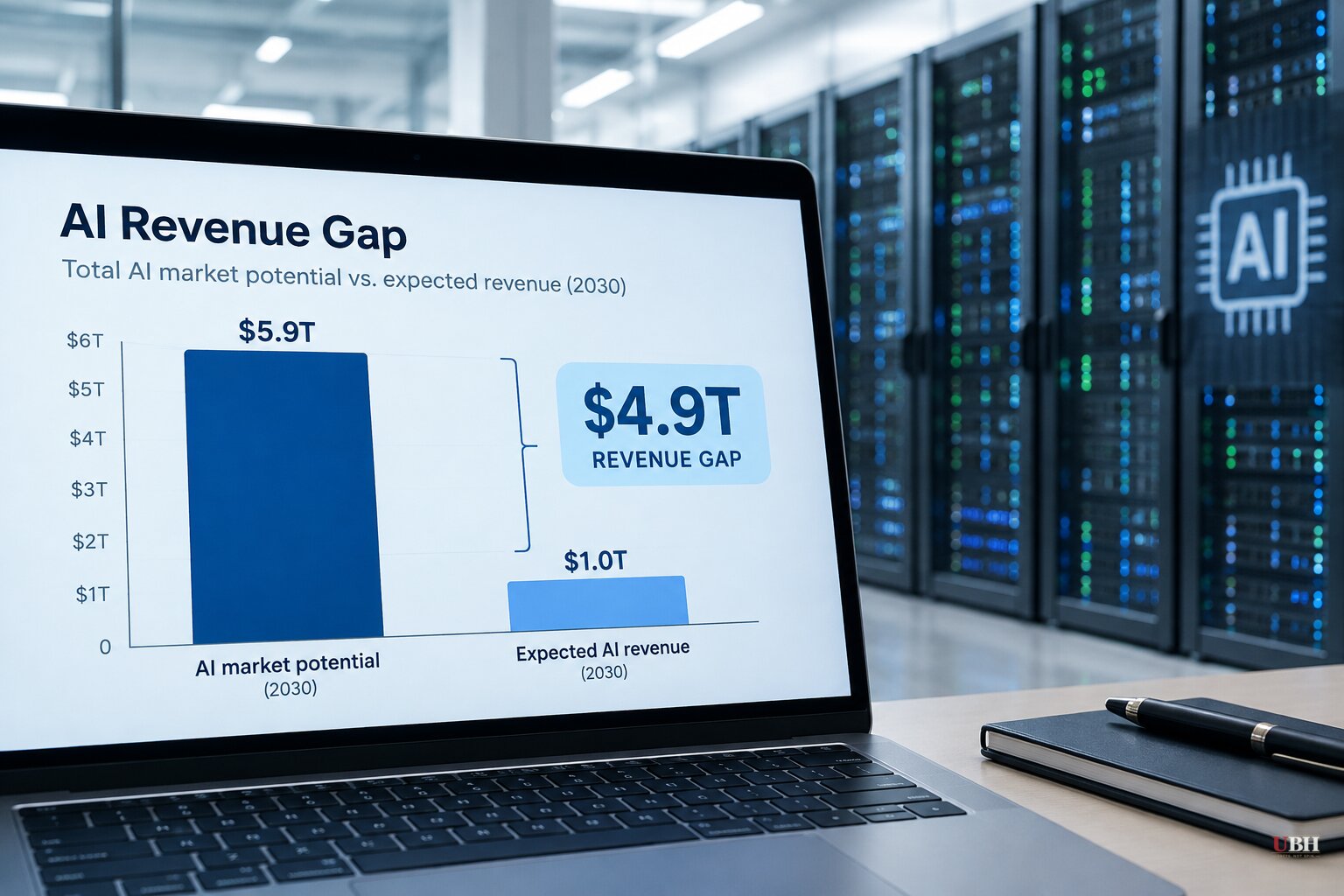
Since Gartner published its forecast on Oct. 14 that AI data-center spending will fall trillions short of the revenue needed to justify it, the firm has doubled down. Its chief forecaster, John Lovelock, told CNBC on Monday, Oct. 19, that the problem is a mismatch between supply and demand.
"At the moment, we have more compute capacity than we have demand, and we have a lot of the tokens and processing power being given away in freemium solutions," Lovelock said. "Everyone in the AI race is running for a last-man-standing position. Pretty much every market that Gartner is tracking in our AI race is likely to collapse down to a duopoly."
Gartner's analysis names Anthropic and OpenAI as the two companies it sees consolidating the frontier-model market.
The arithmetic behind the warning
Gartner says data-center owners would need $8.5 trillion in cumulative revenue through 2030 to cover announced capital spending and financing costs and earn a 12% return on invested capital. Gartner treats 12% as the hurdle rate.
The firm forecasts no more than $3.6 trillion in enterprise and consumer AI revenue attributable to those data centers over the same period. That leaves a gap of $4.9 trillion.
On the spending side, Gartner senior director analyst Will Sommer said AI providers are expected to spend nearly $1 trillion on infrastructure in 2026 and another $6 trillion from 2027 through 2030. Gartner puts cumulative global AI capital spending at $7.5 trillion for 2025 through 2030. Annual spending is projected to approach $2 trillion by 2030, well over 1% of global GDP.
If spending holds that pace, more than $3.5 trillion of AI infrastructure could face impairment by the end of 2030. More than $4 trillion could be exposed through 2032. Gartner does not expect infrastructure owners to reach a 12% return until the end of 2032 at the earliest.
The building boom is already visible in construction numbers. A 2026 BOMA study found data centers made up about $41.2 billion, nearly 46%, of private office construction in 2025. A decade earlier the share was under 5%.
Neoclouds take the hit
Gartner predicts more than 80% of neocloud operators, the specialist firms that rent out AI computing power, will stop operating independently by 2030. It cites cost pressure and a lack of differentiation.
Bloomberg named CoreWeave and Nebius as more directly exposed than Microsoft, Alphabet and Amazon, whose broad revenue streams Gartner says can support AI spending for years.
CoreWeave shares fell more than 25% in the week ending Oct. 16 and ended Monday 0.4% lower. Iren, Nebius and Applied Digital all closed higher Monday after steep declines the week before. No source in the record ties those moves to the Gartner report alone.
The structural problem, Sommer said, is where the money lands. "For every dollar that's spent on compute, only a fraction of that is going to the owners of compute." Most AI-native companies run asset-light businesses, so much of the revenue goes to model and application sellers rather than the firms holding the chips and buildings.
What Gartner says it does not mean
Gartner's own framing is narrower than the headline numbers suggest. The write-down figures apply if providers keep spending at their current pace. And "ceasing independent operations" is not the same as collapse.
"That doesn't mean that compute assets are just going to disappear," Sommer told TechTarget. "Ceasing independent operations may include acquisition, it may include partnerships, or it may include outright failure. Not every single company that disappears is going to fail."
He told The Register: "Not everyone is in trouble. Some will outperform, some will underperform, and some will have to exit the market."
The $8.5 trillion requirement also rests on Gartner's chosen 12% hurdle rate. A lower required return would shrink the gap. Gartner's forecast that infrastructure spending on AI-optimized cloud will grow from $66 billion in 2027 to $174 billion in 2030 is, in Sommer's words, too low to let most compute providers earn back their investment before newer chips replace current ones.
Anthropic's slowdown
The Financial Times obtained Anthropic's quarterly revenue figures from a private investor meeting. They showed revenue above $16 billion in a single quarter and growth of about 46% from the prior quarter, down from roughly 145% the quarter before. Other accounts put the third-quarter figure at $16.8 billion and the growth slowdown at 140% to 45%.
The growth is still enormous for a company this young. It sits against more than $5 trillion that hyperscalers are projected to spend on the ecosystem through 2030.
What it means for buyers
Sommer said vendor survival is now a procurement question for chief information officers. "For the first time in really a generation, the math is starting to move toward 'build' and away from 'buy' or 'partner,'" he told TechTarget, while adding that building in-house is not preferred across the board. He pointed to smaller models running on laptops or on-premises servers as one way to cut exposure to scarce, costly compute.
Mike Shedlock, who writes the MishTalk blog, took a blunter view: "There is no way the AI bubble doesn't burst." He conceded he could not say whether the market is closer to 1997 or March 2000, and added that "nobody else does either."
Gartner's forecasts run on two clocks. The first is the end of 2030, when it expects 80% of neoclouds to have lost independence and more than $3.5 trillion of spending to be exposed to impairment. The second is the end of 2032, the earliest it sees infrastructure owners hitting a 12% return.
Sources used for this briefing
8 links from 8 independent newsrooms (syndicated copies of the same report count once)
These are the sources it draws on, linked so you can verify.


