
Unbiased headlines. Facts, not spin.
Unbiased Headlines is an independently owned news organization. We bring you the facts, not opinions, written fresh from 110+ named sources. Sources linked so you can verify it yourself.
 tech
Major Story (7/10)
tech
Major Story (7/10)
Gartner Says $3.5 Trillion in AI Infrastructure Spending Is Exposed to Write-Downs by 2030; CoreWeave Shares Fell Up to 17%
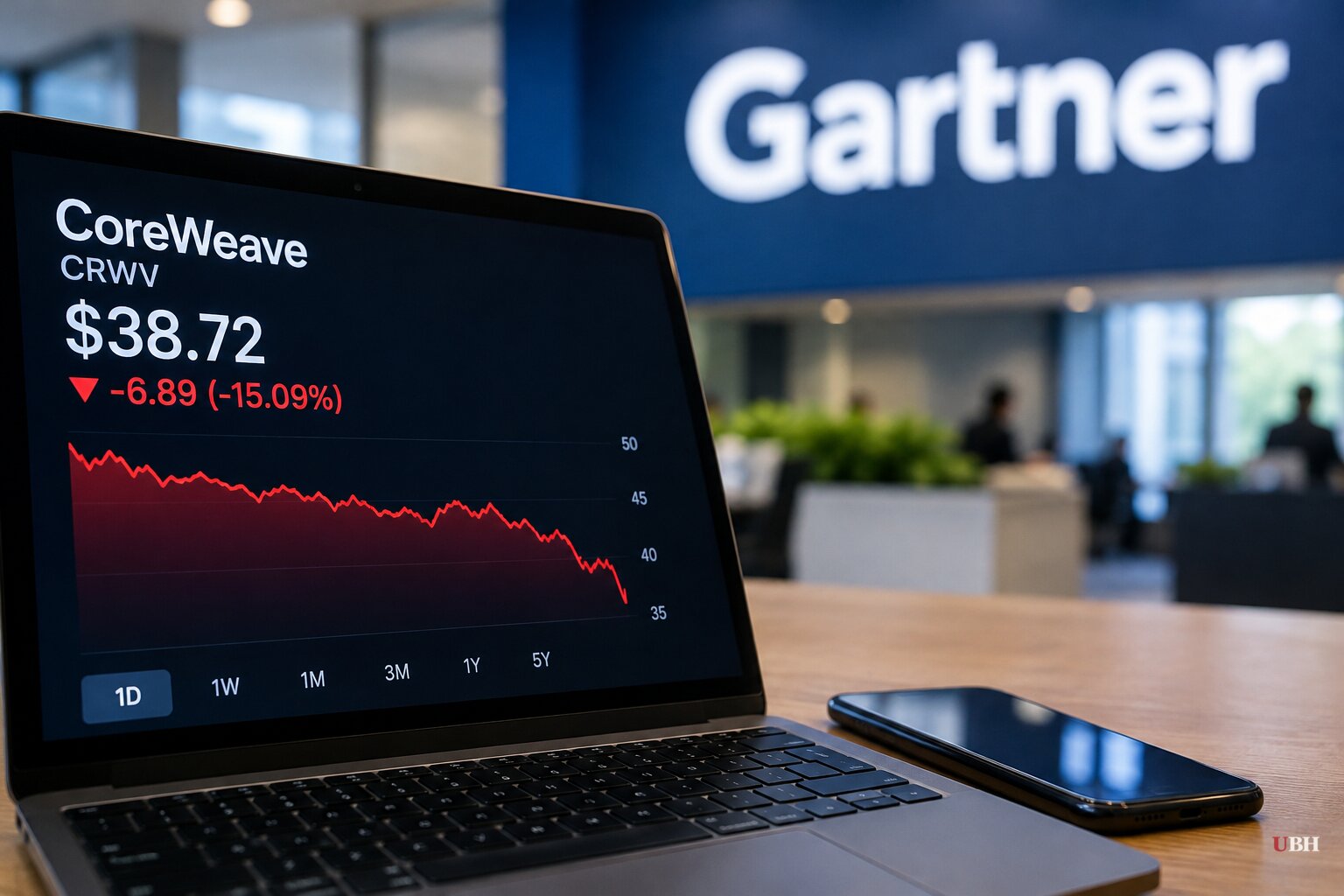
Since AI providers began committing hundreds of billions of dollars a year to data centers, the open question has been whether customers will ever pay enough to cover the bill. On Wednesday, Oct. 14, Gartner put a number on the gap.
The research firm's report, titled "Prepare for AI Market Consolidation," says more than $3.5 trillion in AI infrastructure spending is exposed to impairment by the end of 2030. That exposure could pass $4 trillion through 2032.
The math behind the number
Gartner expects AI providers to spend nearly $1 trillion on infrastructure in 2026. It forecasts another $6 trillion between 2027 and 2030. That puts the decade's total near $7 trillion.
To cover announced capital spending, financing costs and a 12% return on invested capital, Gartner says data center owners would need $8.5 trillion in cumulative revenue through 2030.
Its forecast for enterprise and consumer AI revenue attributable to those data centers over the same stretch: no more than $3.6 trillion.
That is less than half of what the spending requires. When an asset can't earn what was expected, the owner has to cut its recorded value. That is the write-down Gartner is describing.
"Our research indicates that enterprise and consumer AI revenue will be insufficient to support profitable returns on all planned AI capital expenditures during this period," said Will Sommer, senior director analyst at Gartner.
Under this scenario, Gartner does not expect a 12% return on invested capital before the end of 2032 at the earliest.
Neoclouds take the hit
The exposure is uneven. Gartner predicts that cost pressure and a lack of a differentiated business model will force more than 80% of neocloud providers to cease independent operations by 2030. Neoclouds are the specialized firms that rent out GPU capacity and AI-optimized infrastructure.
Gartner projects spending on AI-optimized infrastructure-as-a-service will grow from $66 billion in 2027 to $174 billion in 2030. It says that still won't be enough for many providers to earn back their investments, largely because hardware turns over so fast.
Sommer also pointed to a structural problem. Many AI-native companies run asset-light models, which hinders revenue from reaching the companies that actually own the infrastructure.
Hyperscalers get a cushion. Gartner cites their "massive and highly diversified revenue sources," which support continued AI investment regardless of returns in any one sector.
What "cease independent operations" means
Sommer was explicit that the 80% figure is not a forecast of 80% bankruptcies.
"That doesn't mean that compute assets are just going to disappear," he said. "Ceasing independent operations may include acquisition, it may include partnerships, or it may include outright failure. Not every single company that disappears is going to fail."
He also said the report is not a blanket warning: "Not everyone is in trouble. Some will outperform, some will underperform, and some will have to exit the market."
These are Gartner's projections, built on Gartner's revenue forecast. The firm's own wording is conditional. Sommer described the affected companies as those hit "should they come to pass."
The market reaction
Neocloud stocks sold off Wednesday. CoreWeave shares fell by as much as 17% during the session, according to Stocktwits' market coverage. Nebius (NBIS) and IREN also fell.
Stocktwits also reported that CoreWeave's unsecured bonds traded at levels indicating distress, and that the move drew comment from Chamath Palihapitiya and Elon Musk. That account of the bond move comes from Stocktwits alone. CoreWeave has leaned on high-yield and asset-backed debt to buy Nvidia GPUs and build data centers, Stocktwits reported.
A falling share price is not the same as realized losses for anyone who owns the stock. The reporting does not say who bought or sold.
Money is still flowing into the same part of the stack. AI Weekly noted that Modal closed a $750 million Series D at a $15.75 billion valuation.
Build, buy or partner
The report also reaches corporate technology buyers. Sommer told TechTarget that "for the first time in really a generation, the math is starting to move toward 'build' and away from 'buy' or 'partner.'"
He said that does not mean building is the better choice everywhere. But he said scarce, costly compute makes running smaller models on local hardware, from souped-up laptops to on-premises servers, more attractive for some use cases.
For chief information officers, the vendor-survival question is practical. A neocloud that gets acquired can change pricing, terms or product lines.
The key variable is the revenue line. Gartner's $3.6 trillion cap is a forecast, and the $8.5 trillion hurdle assumes a 12% return. If AI revenue outruns Gartner's projection, the impairment figure shrinks. If it doesn't, the firm says the 12% return does not arrive before the end of 2032.
Sources used for this briefing
7 links from 7 independent newsrooms (syndicated copies of the same report count once)
These are the sources it draws on, linked so you can verify.


