
Original briefings. Zero spin.
Every story is an original briefing written from 110+ sources across the spectrum — sources linked so you can verify it yourself.
 tech
Low Interest (3/10)
August 23, 2026 at 09:40 AM
tech
Low Interest (3/10)
August 23, 2026 at 09:40 AM
Florida Eighth-Grader Tests Four AI Image Generators, Finds Women Scientists Show Up 17.4% of the Time
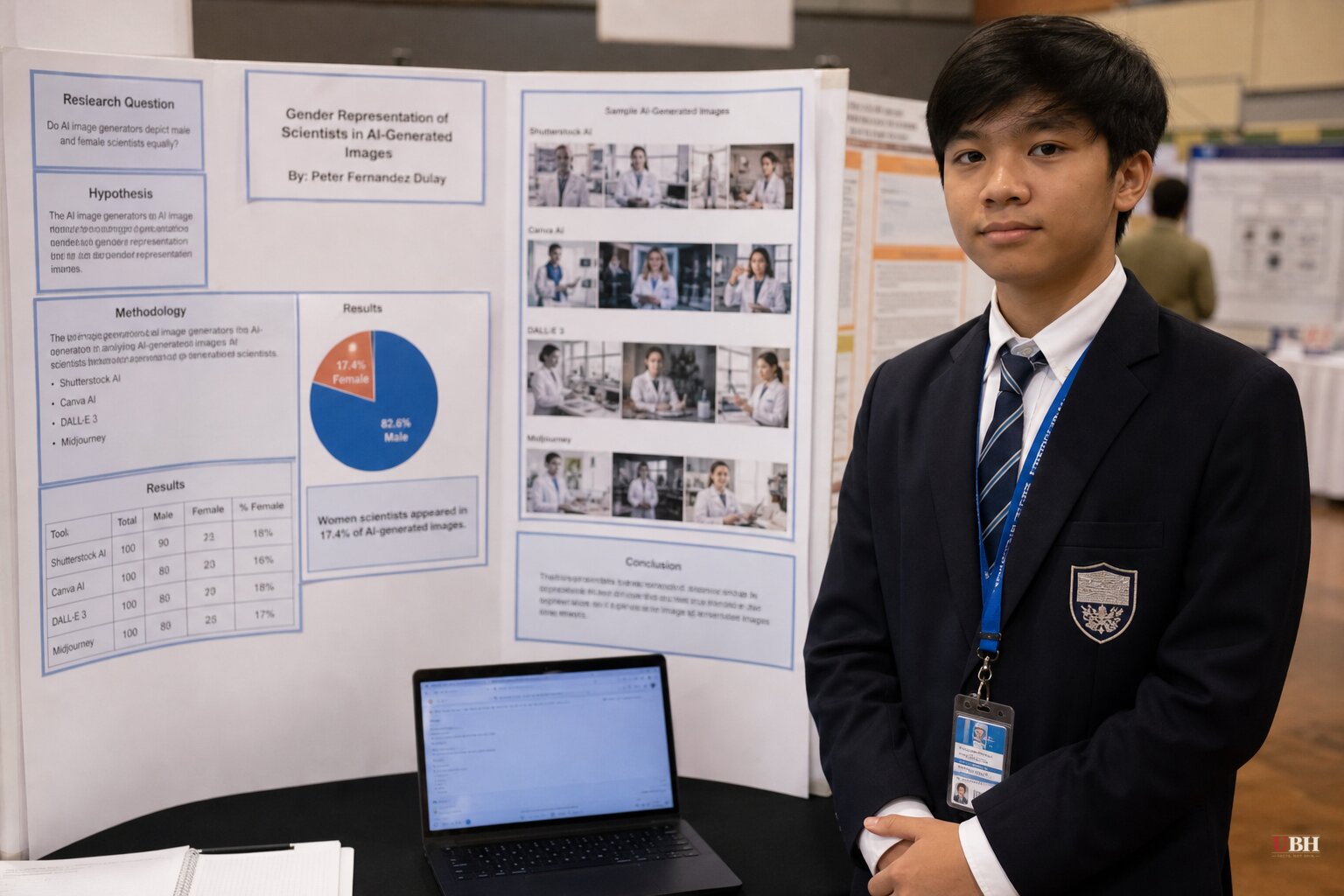
An eighth-grader in Florida decided to test something most adults never bother to check: whether AI image generators actually reflect who works in science.
Peter Fernandez Dulay's project started with his younger sister, Elisa, according to Society for Science, which documented the research. Elisa was using Canva's Magic Media tool to generate an image for a story about a mad scientist. Every result looked the same: an older man, light skin, gray frizzy hair. She wanted a scientist that looked like someone she could picture herself becoming. She didn't get one.
Peter, curious whether the pattern was specific to Canva or something bigger, decided to test it systematically. He picked four widely used AI image generators: Shutterstock, Canva, DALL-E and Midjourney.
Instead of typing in a vague prompt like "scientist," he targeted five specific STEM careers: actuary, data scientist, information security analyst, operations research analyst, and computer and information research scientist. A vague prompt invites vague, stereotype-driven output. Specific job titles test whether the bias holds up even when the query is precise.
According to the project background reported by Society for Science, women make up about 35% of STEM graduates. Peter used that figure as his benchmark. If AI tools were producing a roughly representative mix, you'd expect women to show up in somewhere close to a third of the generated images.
They didn't. Across the four platforms and five job categories, only 17.4% of the images showed women alone, according to the Society for Science summary of his findings. That's less than half the STEM graduate benchmark he was testing against.
This is a middle schooler's independent research project, not a peer-reviewed academic study. Society for Science, which runs national student science competitions, is the outlet documenting it, and the reporting available doesn't spell out sample sizes per platform, how many total images were generated, or how "women alone" was defined and coded. Those details matter for judging how solid the 17.4% figure really is.
A rigorous audit of AI bias would need a much larger image set, blind coding by multiple reviewers, and testing across many more prompts and phrasings to rule out noise. One student's project, however well-designed, is a data point—not a definitive verdict on the entire AI image-generation industry.
But the limitation cuts both ways. The fact that an eighth-grader could run this test at all, get a result that lines up with what his sister noticed anecdotally, and produce a number that's dramatically below the actual STEM workforce composition, suggests basic sanity checks that companies training these models presumably could run themselves. Either they haven't, or they haven't fixed the issue.
AI researchers have flagged image-generation bias before. Models trained on large scrapes of internet images and text tend to reproduce whatever patterns dominate that training data. If the internet's visual record of "scientist" skews toward older white men, because of decades of real-world underrepresentation of women and minorities in those fields historically, the model reproduces that skew, even in 2026 when the actual STEM workforce looks considerably different.
That's a garbage-in, garbage-out problem, not necessarily a deliberate ideological choice by any of the four companies involved. Shutterstock, Canva, OpenAI (which makes DALL-E) and Midjourney did not comment for the Society for Science report as excerpted, and there's no indication any of them have responded specifically to Peter's project.
The fix, if these companies want one, isn't complicated in theory: weight training data or fine-tune outputs to better reflect actual demographic reality rather than historical stereotype. Several AI companies have already attempted exactly that kind of correction for other bias categories, sometimes clumsily, sometimes overcorrecting. Whether any of the four platforms Peter tested have made similar adjustments for gender representation in STEM imagery isn't addressed in the available reporting.
What happens next with Peter's project isn't clear from what Society for Science has published. Whether he's planning to submit it to a science fair competition, expand the sample, or test additional platforms remains an open question. So does whether any of the four companies will respond to a data point produced by a Florida middle schooler with a laptop and a hunch his sister was onto something real.
Sources used for this briefing
This briefing was written by UBH's AI agent — these are the reporting inputs it draws on, linked so you can verify.


