
Unbiased headlines. Facts, not spin.
Unbiased Headlines is an independently owned news organization. We bring you the facts, not opinions, written fresh from 110+ named sources. Sources linked so you can verify it yourself.
 sports
Low Interest (4/10)
sports
Low Interest (4/10)
FIFA Bans Paredes 10 Games, Molina 7, Over World Cup Final Brawl With Spain
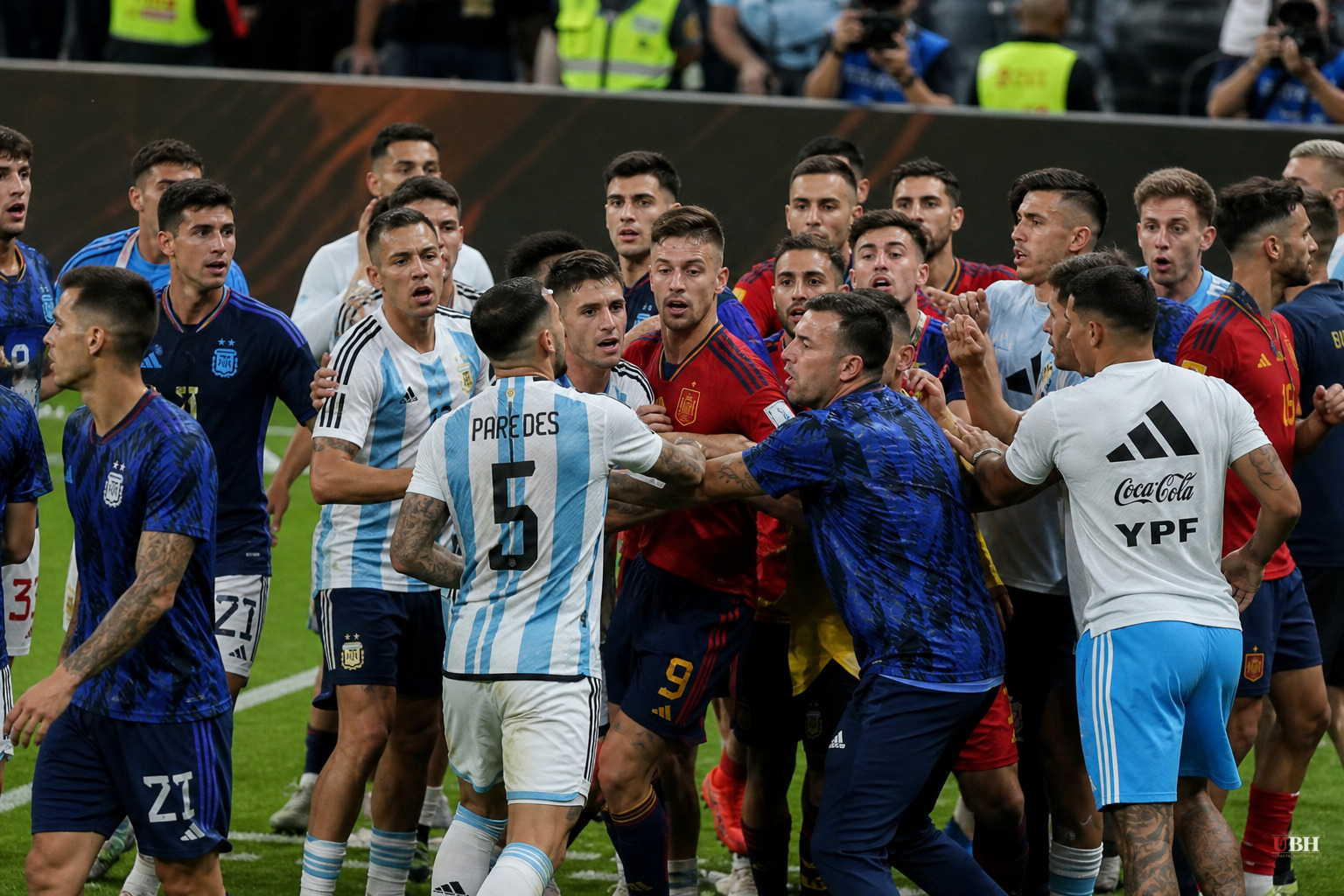
FIFA came down hard on Argentina on Friday, August 21, handing out a combined 21 games of international suspensions over the brawl that broke out after Spain beat Argentina 1-0 in the World Cup final on July 19 at MetLife Stadium in East Rutherford, New Jersey.
Midfielder Leandro Paredes got the worst of it: a 10-match ban and a $90,000 fine. FIFA's disciplinary committee found he grabbed Spain defender Eric Garcia by the throat and threw Gavi to the ground after the final whistle, according to the BBC and FIFA's own charging documents cited by Complex. Video also showed Paredes appearing to strike Gavi in the face.
Because FIFA's international calendar runs 10 games through June 2027, the ban is effectively a one-year expulsion from the national team, as Sportsnet, Al Jazeera and the Guardian all note. All of those games could be friendlies, since Argentina has no competitive fixtures currently scheduled.
Nahuel Molina drew a seven-match ban and a $90,000 fine for what multiple outlets describe as striking Rodri, Spain's man of the match, as he ran onto the pitch to celebrate. Thiago Almada got one match and a $30,000 fine for unsporting behavior. Argentina assistant coach Roberto Ayala was suspended three matches and fined $30,000 for what Complex and the BBC both reported was a blow to Dani Olmo's face, with Ayala also accused of holding Garcia by the throat.
Spain didn't walk away clean. Gavi received a one-match ban and a $30,000 fine for his role in the scuffle. That suspension lands on Spain's Nations League match against England at Wembley on September 26, according to Euronews and Sportsnet. Gavi has said he doesn't think Paredes should have been punished, a point the BBC included without editorializing on it.
FIFA had formally opened proceedings on July 29, charging Paredes with three counts of assault, Molina with two assault counts and one count of unsporting behavior, and Almada with one count of unsporting behavior, according to Complex. Paredes was shown a red card on the night that was later deleted from FIFA's system, a detail only Complex reported in detail.
The suspensions apply only to international matches, not club competition, a point emphasized by both the New York Times and Sportsnet.
The federation fine and the Falklands banner
Beyond the individual bans, the Argentine Football Association was fined $321,000 for a mix of offenses: using the tournament for "demonstrations of a non-sporting nature," team misconduct, and discriminatory chants and gestures by fans. FIFA is requiring $100,000 of that fine go toward an anti-discrimination program, while suspending another $100,000 for a probationary period.
Part of the fine traces back to a banner Argentina players displayed after their 2-1 semifinal win over England, reading "Las Malvinas son Argentinas," Spanish for "the Falklands are Argentine." The Guardian noted the banner drew condemnation from UK politicians at the time, including Liberal Democrat leader Ed Davey, who called for the players involved to be suspended over it. Notably, FIFA only fined the federation for the banner rather than suspending any player over it, a distinction the Guardian's headline draws attention to directly: players were banned for the brawl, but "only fined" for the political display.
If FIFA treats a political banner claiming sovereignty over disputed British territory as a fine-only matter while suspending players for throat-grabbing and punches, critics can fairly ask whether FIFA's priorities on "non-sporting demonstrations" are consistent. FIFA has previously suspended players for similar political statements, as both the Guardian and other reporting note regarding UEFA's earlier ban of Spain's Rodri and Álvaro Morata over chants about Gibraltar.
As for discrimination, FIFA's fine also covers "discriminatory chants and gestures" by Argentine supporters during the tournament, though the disciplinary decision as reported does not detail specific incidents beyond the general finding.
Argentina also faces a stadium-capacity penalty: its next home match must be played at 50% capacity, with a second capacity restriction suspended during a probationary period.
Argentina received $34 million in World Cup prize money from FIFA, according to Sportsnet and Al Jazeera, a figure worth noting against the roughly $321,000 fine, which amounts to under 1% of that payout.
What happens next
The Argentine Football Association says it will appeal to FIFA and, if that fails, take the case to the Court of Arbitration for Sport, according to the BBC and the New York Times. All parties have 10 days to request a "motivated decision" detailing FIFA's reasoning, which would then be published on FIFA's legal portal, per Complex's reporting. The sanctions remain subject to appeal in the meantime.
Multiple outlets, including Euronews, Sportsnet and Al Jazeera, rank Paredes' ban alongside FIFA's 2014 punishment of Luis Suarez, who got four months and nine international matches after biting Italy's Giorgio Chiellini. Whether CAS ultimately reduces Paredes' ban, as sometimes happens on appeal, is the open question hanging over Argentina's next year of international football.
Sources used for this briefing
8 links from 7 independent newsrooms (syndicated copies of the same report count once)
These are the sources it draws on, linked so you can verify.


