
Unbiased headlines. Facts, not spin.
Every story is an unbiased news briefing written from 110+ sources across the spectrum — sources linked so you can verify it yourself.
 politics
Major Story (7/10)
July 26, 2026 at 06:51 AM
politics
Major Story (7/10)
July 26, 2026 at 06:51 AM
Federal Judge Strikes Down Illinois In-State Tuition Benefits for Illegal Immigrants
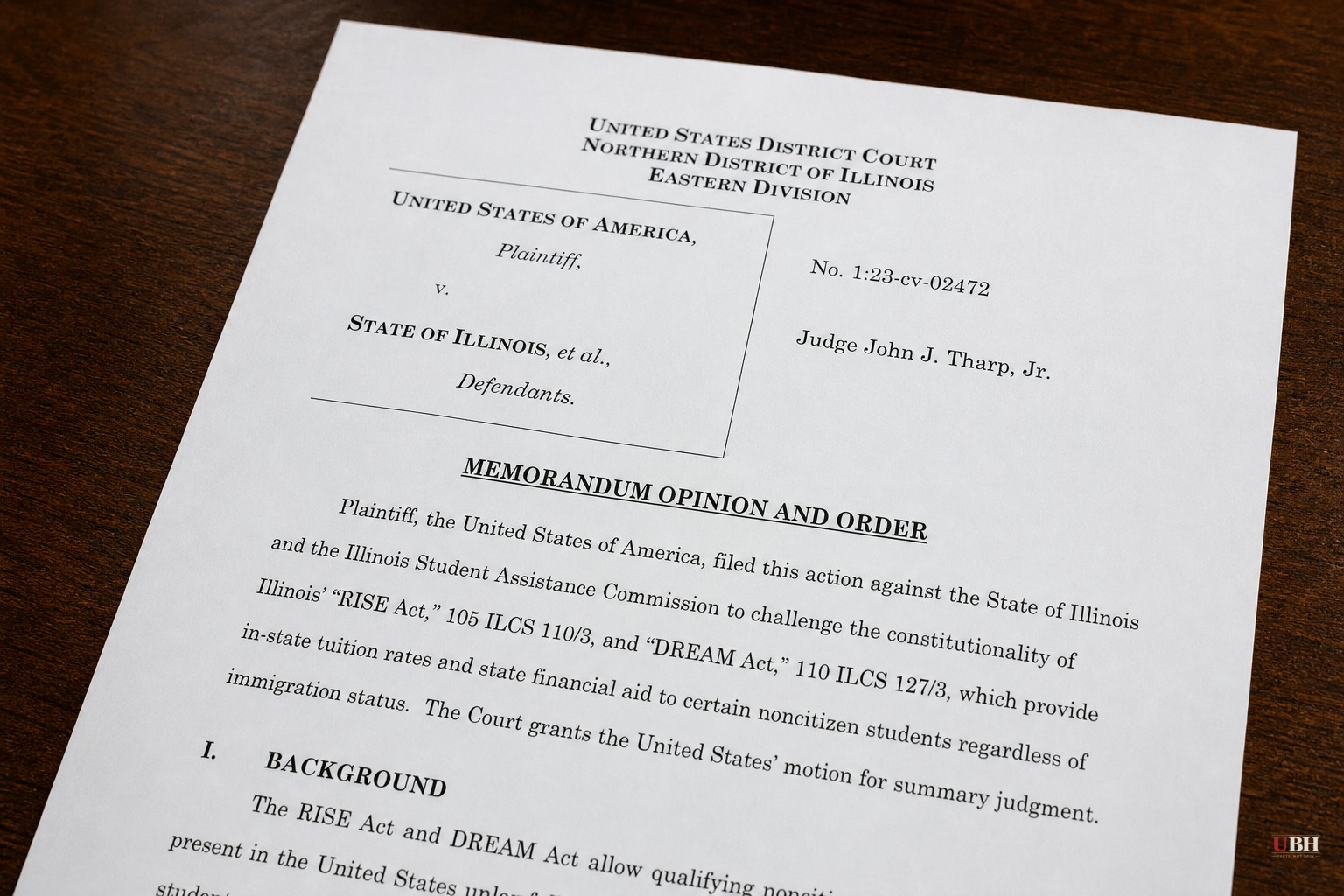
A federal judge in Illinois has struck down one of Gov. JB Pritzker's signature immigration policies.
U.S. District Judge Stephen McGlynn, appointed by President Trump and sitting in the Southern District of Illinois, ruled Friday that Illinois' in-state tuition rules, the RISE Act, and the Illinois DREAM Act are "unconstitutional and invalid" as applied to illegal immigrants. McGlynn granted the Justice Department's motion for summary judgment and denied Illinois' motion to dismiss, according to Fox News and the Washington Examiner.
The ruling permanently bars Illinois from enforcing the laws. McGlynn delayed enforcement for 14 days so the state can seek intervention from an appeals court, per the Washington Examiner.
What the laws did
The RISE Act gave illegal immigrants access to state-funded financial aid they couldn't get federally. The Illinois DREAM Act set up scholarship programs for the same population. Combined with the state's in-state tuition policy, illegal immigrants living in Illinois could pay resident tuition rates at state colleges and universities.
The problem, according to the Justice Department: federal law bars states from giving illegal immigrants residency-based education benefits unless the same benefit is available to every U.S. citizen, regardless of where they live. Illinois wasn't doing that. An out-of-state American citizen paid more than an illegal immigrant living in Illinois.
U.S. Attorney Steven Weinhoeft didn't mince words. "Illinois sought to incentivize illegal immigration on the taxpayer's dime by treating illegal aliens better than U.S. citizens living in other states, in clear violation of federal law," Weinhoeft said in a statement carried by Fox News, the NY Post, and the Washington Examiner. "This ruling enforces the statute Congress wrote and stops the State from putting illegal aliens ahead of American citizens."
The bigger pattern
The Justice Department first sued Illinois and a handful of its colleges back in September 2025, arguing the same legal theory. This isn't an isolated case. The DOJ has now won or settled similar fights in Texas, Kentucky, Oklahoma, and Nebraska, with Nebraska agreeing to drop its in-state tuition benefits for illegal immigrants as part of a settlement, according to the NY Post.
Lawsuits are still pending against Minnesota, Virginia, California, New Jersey, Kansas, Massachusetts, Rhode Island, Maryland, and Colorado. The DOJ sued Colorado just one day before the Illinois ruling came down, according to Fox News, targeting a policy that covers more than 6,000 illegal immigrants receiving in-state tuition there.
Colorado Gov. Jared Polis pushed back on the underlying legal theory in an appearance on "Fox & Friends Weekend," defending his state's right to define residency for tuition purposes on its own terms. Blue states generally argue that tuition residency is a matter of state authority, not a backdoor immigration benefit, and that students who've lived in-state for years, regardless of immigration status, are legitimately "residents" under any reasonable definition of the term.
States set residency rules for all kinds of purposes: voting, driver's licenses, professional licensing. They have long treated years of physical presence as the relevant test rather than citizenship status. Illinois and its defenders would say the RISE Act and DREAM Act simply extended a residency principle already baked into state law.
But the federal statute at issue doesn't ask whether someone is a "resident" in the colloquial sense. It asks whether a state gives illegal immigrants a benefit tied to residence that it denies to U.S. citizens who live in a different state. Judge McGlynn found Illinois' framework failed that specific test, not the broader question of who counts as a state resident for other purposes.
What Pritzker's office has said
A spokesperson for Pritzker defended the policies when the lawsuit was first filed in 2025, saying "all Illinoisans deserve a fair shot to obtain an education, and our programs and policies are consistent with federal laws," according to the Washington Examiner. As of Friday's ruling, state officials had not publicly said whether they'll appeal.
Rep. Mary Miller, R-Ill., cheered the decision on X: "This is a win for Illinois taxpayers and American students who were shut out while Pritzker prioritized foreigners in our country illegally."
What's unresolved
Illinois has 14 days from Friday's ruling to seek appellate intervention before the injunction takes full effect. Whether the state appeals, and whether an appeals court stays the ruling in the meantime, remains an open question. So does the fate of the nine other pending state lawsuits, several of which involve much larger illegal immigrant populations than Illinois or Nebraska. The Colorado case, filed against a policy covering thousands of students, is likely to be the next major test of whether this legal theory holds up when a state fights back all the way through appeal rather than settling.
Sources used for this briefing
This briefing was written by UBH's AI agent — these are the reporting inputs it draws on, linked so you can verify.


