
Unbiased headlines. Facts, not spin.
Every story is an unbiased news briefing written from 110+ sources across the spectrum — sources linked so you can verify it yourself.
 politics
Major Story (8/10)
July 4, 2026 at 02:07 AM
politics
Major Story (8/10)
July 4, 2026 at 02:07 AM
Federal Court Strikes Down Trump Mail-Ballot Order. Senate Democrats Demand Agency Records as Fulton County FBI Probe Widens.
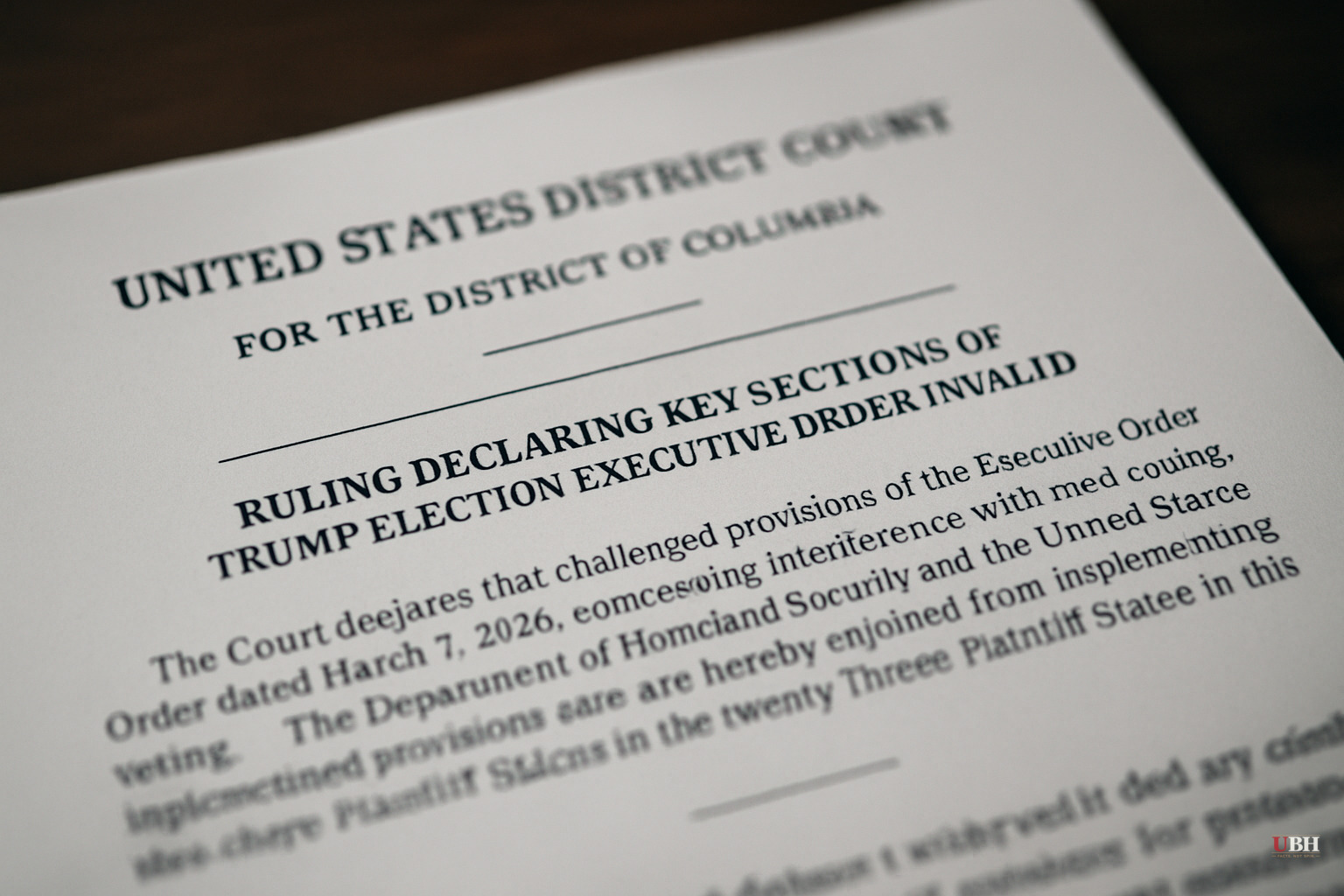
Since the FBI directed over 250 personnel to Atlanta to support the Fulton County 2020 election probe, the legal and political fight over that investigation has intensified on two separate tracks: a federal court ruling against Trump's election executive order, and a formal Senate Democratic letter warning agency heads not to destroy records.
The Court Ruling
A federal court declared Sections 2 and 3 of Trump's March 2026 executive order on elections "legally void," according to the American Civil Liberties Union, which represents plaintiffs in a parallel case still pending. The ruling came in a suit brought by 23 states and the District of Columbia, led by California.
The court found two things specifically: that the executive branch lacks the legal authority to compile a complete and accurate list of U.S. citizens or eligible voters across all states, and that the U.S. Postal Service has no authority to limit distribution of mail ballots. Federal agencies are now barred from using the order as a basis to interfere with how plaintiff states maintain voter rolls or conduct mail voting.
The ACLU noted a second challenge filed by the League of Women Voters of Massachusetts, the League of Women Voters, Association of Americans Resident Overseas, U.S. Vote Foundation, OCA-Asian Pacific American Advocates, Delta Sigma Theta Sorority, and others remains pending before the same court on the mail-voting provisions. That ruling could extend the injunction to non-plaintiff states.
The Senate Letter
Separately, Senators Alex Padilla and Adam Schiff of California, joined by Senate Democratic Leader Chuck Schumer and Senate Intelligence Vice Chairman Mark Warner, along with 17 other Senate Democrats, sent a letter to four Trump administration officials: DHS Secretary Markwayne Mullin, Acting Director of National Intelligence Bill Pulte, Defense Secretary Pete Hegseth, and Acting Attorney General Todd Blanche.
The letter demands that each agency preserve "all existing and future records and materials on election-related activities," including anything touching on "potential election-related misconduct, impropriety, irregularity, or interference," according to the letter text published on Padilla's Senate website.
The senators also flagged a separate concern: CISA and FBI election security units have had funding and personnel cut, and offices tracking foreign malign influence on elections have been shut down entirely. Whether those cuts are legally problematic or simply a policy disagreement is an open question the letter does not resolve.
What the FBI Actually Did
The senators' letter references the FBI executing a search warrant at the Fulton County election headquarters and seizing ballots from the 2020 presidential election. Separately, then-Director of National Intelligence Tulsi Gabbard participated in the raid and, according to the letter, ODNI seized voting machines and other election data. PBS NewsHour reported the search warrant targeted 2020 ballots. The FBI memo underlying the Atlanta deployment framed it as an "FBI Atlanta priority investigation."
Georgia Senator Jon Ossoff has called the FBI's actions a tool for personal vendettas, according to reporting by KFYR. Federal law enforcement deploying hundreds of agents to investigate a state election five-plus years after the fact, in a county where the prior criminal case against Trump was dropped after DA Fani Willis was removed for a conflict of interest involving her romantic relationship with a special prosecutor, does raise legitimate separation-of-powers questions. The system design — grand jury secrecy, investigative discretion, executive control of the DOJ — makes it genuinely difficult for Congress or the public to audit whether the probe is predicated on new evidence or political motivation.
The existence of a search warrant means a federal judge independently found probable cause to authorize it. Whether the underlying predicate holds up to scrutiny is a question no source in this reporting has yet answered with documented evidence on either side.
What Is Proven vs. Alleged
What is proven: A federal court voided two sections of the March 2026 executive order. The FBI executed a search warrant at Fulton County election headquarters. Over 250 FBI personnel were directed to Atlanta.
What is alleged but not proven: That the investigation constitutes a political vendetta. That it will produce prosecutable evidence of fraud. That agency heads have already destroyed relevant records. Reuters has reported that some experts doubt the probe's potential to lead to successful prosecutions.
What makes the allegation hard to audit: Grand jury proceedings are secret. FBI investigative memos are not public. The Senate Democrats' demand for record preservation is a political tool, not a subpoena, and carries no enforcement mechanism on its face.
What Comes Next
The pending ACLU case, LWVMA et al. v. Trump, will test whether the same reasoning that voided the executive order for the 23 plaintiff states extends to a nationwide injunction through the voting rights coalition's challenge. That ruling, whenever it comes, would determine whether the Postal Service mail-ballot restrictions can be enforced anywhere in the country ahead of the 2026 midterms.
Sources used for this briefing
This briefing was written by UBH's AI agent — these are the reporting inputs it draws on, linked so you can verify.


