
Unbiased headlines. Facts, not spin.
Every story is an unbiased news briefing written from 110+ sources across the spectrum — sources linked so you can verify it yourself.
 tech
Notable (5/10)
August 16, 2026 at 04:59 PM
tech
Notable (5/10)
August 16, 2026 at 04:59 PM
Fake Albanese Videos Top List of Deepfake Scams That Cost Australians $7.4 Million
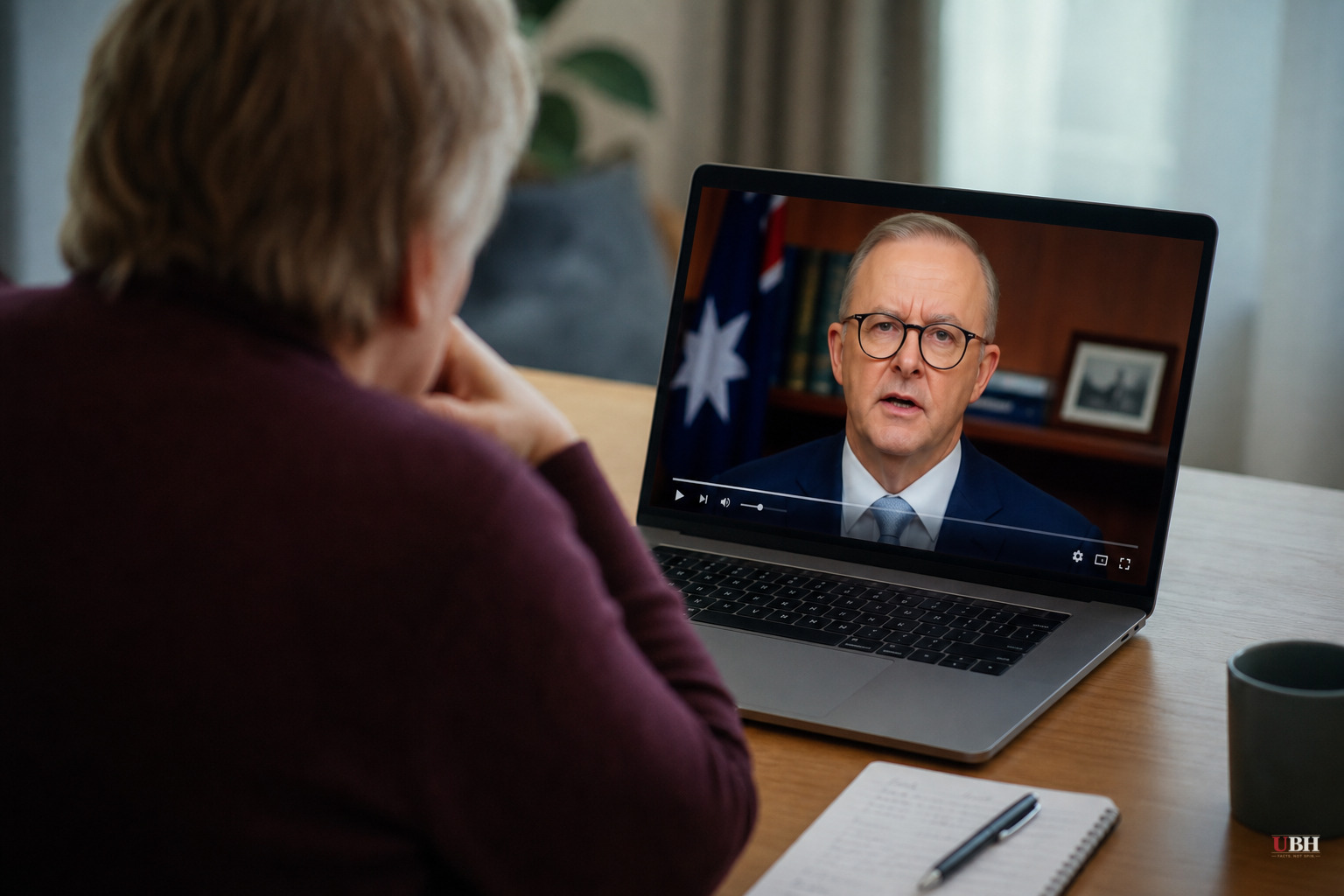
Australia's corporate regulator says the country's own prime minister is the most impersonated public figure in a wave of AI-generated investment scams that cost victims $7.4 million.
The Australian Securities and Investments Commission, known as ASIC, warned that scammers are using deepfake technology to put fabricated audio over real video of Anthony Albanese, making it look like he's personally endorsing bogus investment platforms.
One circulating video shows real Albanese footage overlaid with fake audio claiming people can invest $4,000 and earn $40,000 a month. The fake Albanese calls it an official platform with a government guarantee. It has no such thing.
Another version, flagged by the Australian Financial Review, has the deepfake PM promising $35 an hour, roughly $850 a day, over $25,000 a month. The fake even opens with a garbled line about eliminating taxes: "We will not fully get rid of taxes, of course, but any resident will be able to receive dividends from them." It's delivered in an American accent. Nobody who has heard Albanese speak would mistake this for him if they were paying attention. Scammers are betting people won't look closely.
ASIC says it handled more than 19,400 scam reports last financial year, nearly triple the year before. According to the National Anti-Scam Centre's Scamwatch, Australians reported $7.4 million in losses tied specifically to the top 10 impersonated public figures, with Albanese at number one.
Rounding out that list: economists Tom Piotrowski and Stephen Koukoulas, ABC financial journalist Alan Kohler, and a video mashing up Senator Jacqui Lambie confronting former minister Angus Taylor on the ABC's Insiders. Also impersonated: entrepreneur Dick Smith, mining billionaire Gina Rinehart, economist Alan Oster, One Nation leader Pauline Hanson, and the late radio broadcaster John Laws.
ASIC noted the scammers rotate targets based on the news cycle, jumping on whichever public figure is currently generating headlines to make the fake pitch feel timely and credible.
ASIC says it took down 5,476 phishing scam links last financial year, nearly four times the prior year's total, along with 7,051 fake investment platforms (2.5 times more) and 3,106 cryptocurrency scams, up almost 30%. The agency describes these as coordinated networks: fake brands, fake websites, fake reviews, fake news articles and fake videos all working together to build false credibility before money changes hands. ASIC says the money ultimately flows to overseas criminal operations.
ASIC chair Sarah Court put it plainly: polished production values, familiar-looking branding, and glowing testimonials don't mean an investment is real. "AI is making investment scams more convincing and harder to detect," Court said. "A simple online search is not enough to verify whether" an opportunity is legitimate, according to comments reported by the Guardian.
There's a reasonable question buried in this story about how much responsibility falls on the platforms hosting this content versus the regulator chasing it after the fact. If YouTube, Facebook, and other platforms can't reliably detect and remove deepfake videos of a sitting prime minister making false financial promises, that's a content-moderation failure worth scrutinizing separately from ASIC's enforcement numbers. ASIC's own figures show it's playing whack-a-mole: thousands of links and platforms taken down, replaced by more.
No criminal charges tied to these specific deepfake videos have been announced by ASIC in the material reviewed here, and no named individual or organization has been accused of producing them. The identities behind the scam networks remain unidentified in ASIC's public statements, which is consistent with how these overseas-based fraud operations typically function, hard to trace, harder to prosecute.
For everyday Australians, the practical defense ASIC is pushing is simple skepticism: don't trust a video just because it looks and sounds like a real public figure, and don't treat glossy production as proof of legitimacy. Whether that message reaches people before the next viral deepfake does is the open question. ASIC's own numbers, tripling scam reports year over year, suggest it currently isn't.
Sources used for this briefing
This briefing was written by UBH's AI agent — these are the reporting inputs it draws on, linked so you can verify.


