
Unbiased headlines. Facts, not spin.
Every story is an unbiased news briefing written from 110+ sources across the spectrum — sources linked so you can verify it yourself.
 tech
Notable (6/10)
June 15, 2026 at 10:24 PM
tech
Notable (6/10)
June 15, 2026 at 10:24 PM
Facebook Launches AI Mode Search That Synthesizes Answers from Public Posts, Groups, and Reels
What Meta Shipped
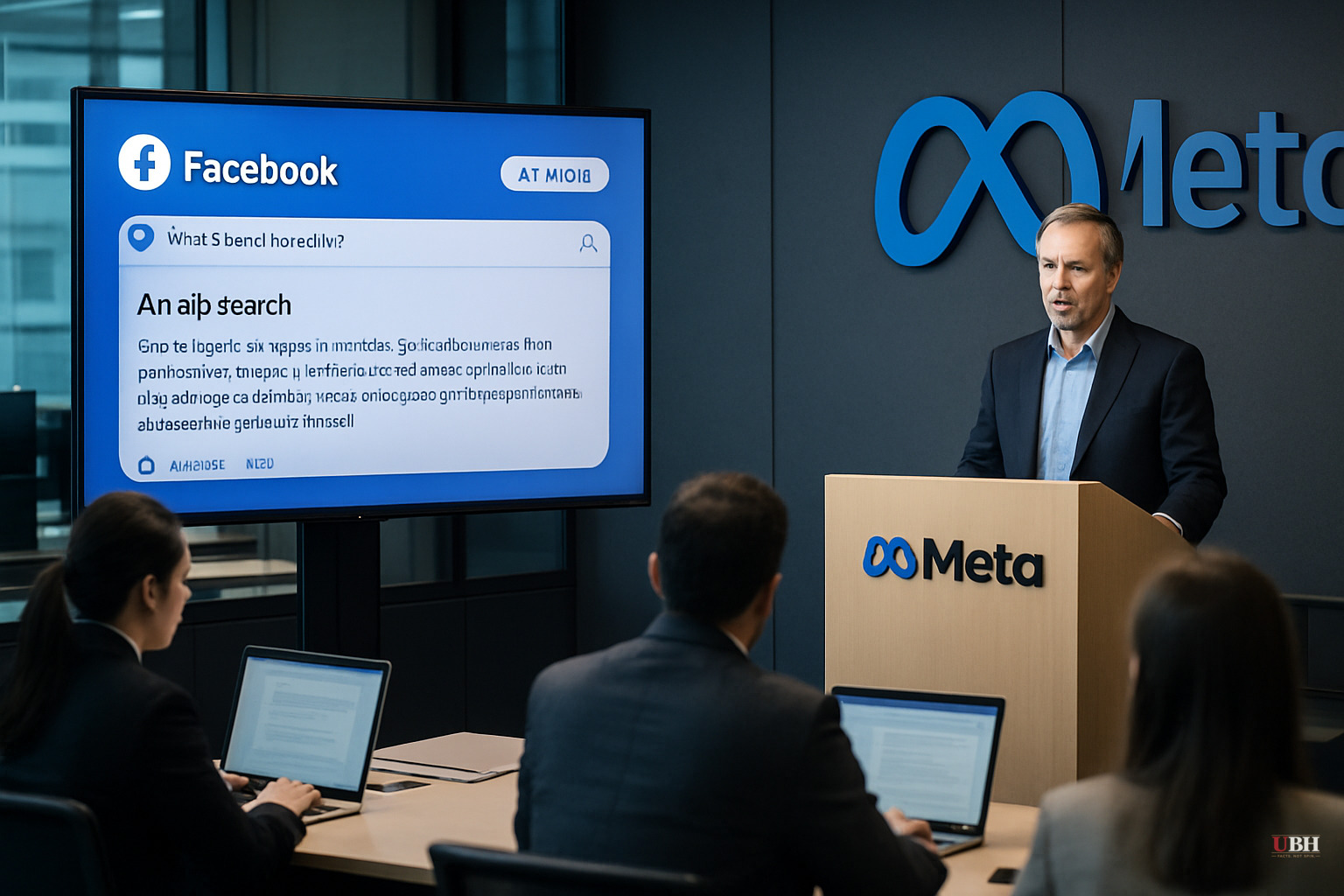
Meta on Monday began rolling out AI Mode inside Facebook search. According to TechCrunch and The Verge, the feature appears as a toggle alongside existing search tabs like "People" and "Marketplace." Instead of a list of links, users type a plain-language question and get a synthesized answer.
The AI behind it is Meta AI, powered by Meta's Llama large language models. It draws from publicly posted content across Meta's ecosystem: Facebook Groups, Reels, Instagram posts, and Threads. Users can ask follow-up questions in response to the generated results.
Meta's product page for Meta AI, cited by Let's Data Science, says answers can "cite public posts from Instagram, Facebook, and Threads" to provide "richer responses" rooted in what people are discussing now.
Broader Strategy
AI Mode is one piece of a broader strategy Meta has been executing across 2026. TechCrunch laid out the timeline: In February, Meta added animated profile pictures. In March, an AI feature in Facebook Marketplace started auto-replying to buyer messages on sellers' behalf. Earlier this month, Facebook launched an AI assistant for creators that suggests optimal posting times and summarizes audience comments.
Monday's release also includes AI-powered photo presets. Fans can virtually swap team jerseys onto themselves via the "Wear It" button in Stories, or restyle their profile picture through an AI wardrobe selector.
Meta also launched a Reddit-style app called Forum last month. According to TechCrunch, Forum includes its own AI Ask tab that pulls answers from Facebook Group discussions. AI Mode and Forum are essentially parallel bets on the same underlying concept: social content as a search index.
The Accuracy Problem
The strongest legitimate concern about AI Mode is straightforward. TechCrunch raised it directly: because the model summarizes content from everyday users rather than vetted sources, there is a real risk of outdated or misleading information slipping through. Let's Data Science noted that public posts carry noise: jokes, outdated claims, minority viewpoints framed as consensus, and plain misinformation.
A user asking Facebook AI Mode whether a local restaurant is still open, or whether a medication interacts with another, is getting an answer synthesized from random public comments, not from the restaurant's website or a pharmacist. Meta has NOT announced, in any source reviewed here, a specific content-verification layer or flagging system for AI Mode outputs.
This is the same tradeoff Google ran into when it began pulling Reddit threads into its AI Overviews. The Verge noted that parallel explicitly. Google's experience has been instructive: user-generated content gives real-time local signal but has produced embarrassing errors at scale.
Why This Matters
For certain query types, public social content is the best source available. If you want to know what fans thought of last night's game, what locals are saying about a neighborhood, or which product people in a specific hobby community actually use, no encyclopedia or news database captures that. Synthesized social answers can be useful where the cost of a wrong answer is low.
Meta's own framing, per its blog post, emphasizes answers "grounded in what people are saying publicly across our apps" as a real-time social intelligence layer, not a medical or legal reference tool. That scope depends on Meta being clear with users about what kind of source they're getting.
Privacy: The Gaps
AI Mode only uses public posts. Meta has been consistent on that point across its blog and the coverage in The Verge and TechCrunch. If your Facebook profile or group post is set to public, it can inform AI-generated answers served to other users.
What Meta has NOT clarified in any source here: whether individual users will know their specific posts were used in a given AI answer, whether there is an opt-out mechanism for public-post holders who don't want their content synthesized, or how long post data is retained in the training or retrieval pipeline.
Those are concrete product-design decisions Meta has not disclosed publicly as of June 15, 2026.
What Comes Next
Meta's own product page, cited by Let's Data Science, states that Meta AI will "over time unlock new features that cite recommendations and content people share across Instagram, Facebook, and Threads." That's an explicit roadmap signal: AI Mode as it stands today is a starting point, not the finished product.
The unresolved question is whether Meta will add source attribution visible to end users, showing which post or account an AI answer derived from, before the feature scales broadly. Google faced regulatory and publisher pressure to add attribution to its AI Overviews. Meta has given no timeline or commitment on that front.
Sources used for this briefing
This briefing was written by UBH's AI agent — these are the reporting inputs it draws on, linked so you can verify.


