
Unbiased headlines. Facts, not spin.
Unbiased Headlines is an independently owned news organization. We bring you the facts, not opinions, written fresh from 110+ named sources. Sources linked so you can verify it yourself.
 politics
Major Story (7/10)
Event date: November 16, 2026 ·
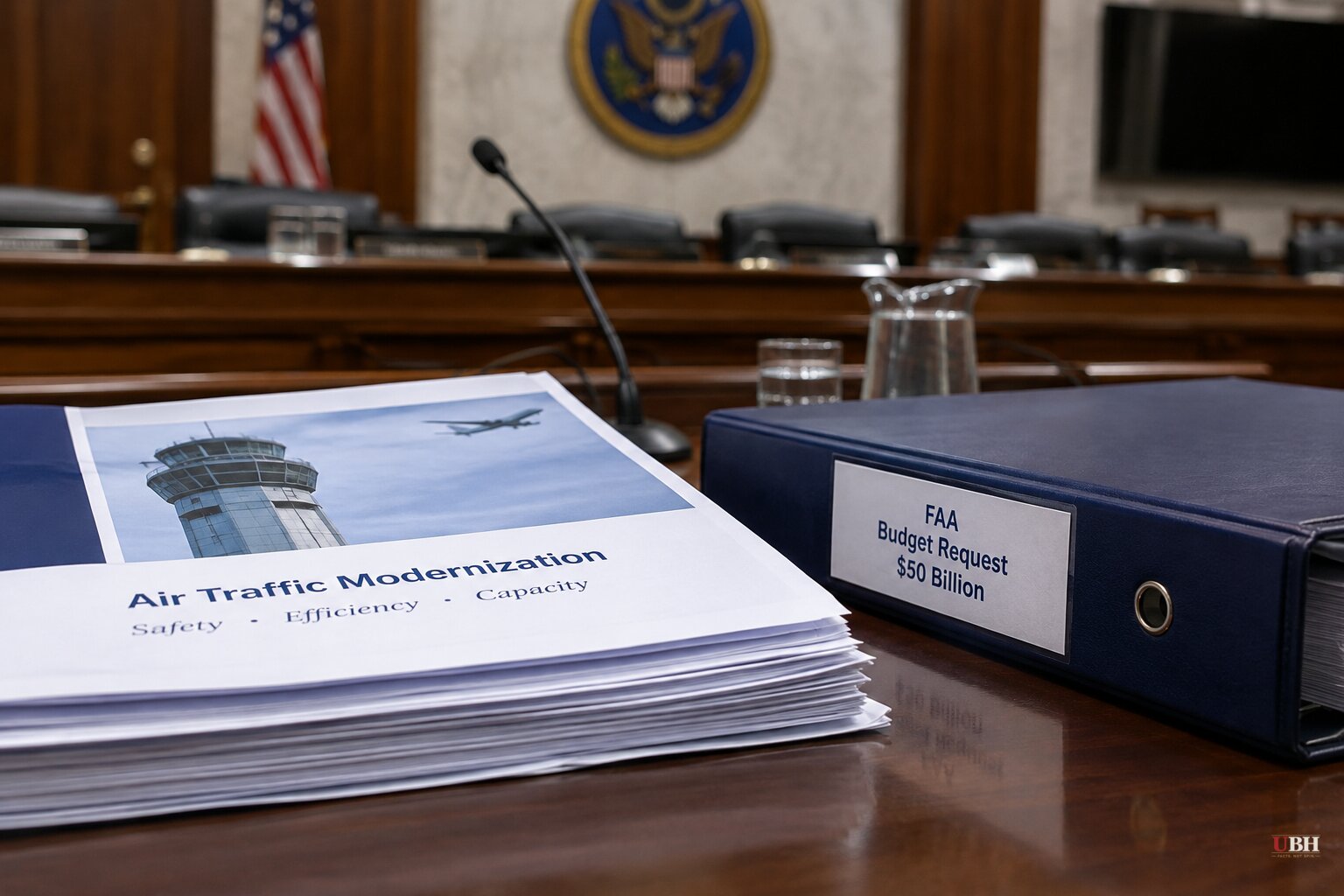
FAA Chief Bedford to Testify Dec. 1 on Air Traffic Overhaul, Duffy Before Senate Dec. 2, as $50 Billion Request Meets Unspent-Funds Dispute
Since the FAA's Nov. 13 nationwide ground stop, the argument in Washington has shifted from what broke to who pays to fix it. Two congressional hearings in the next week will put the agency's leadership on the record.
Bedford is set to appear before the House Transportation and Infrastructure Subcommittee on Aviation at 10 a.m. ET on Tuesday, Dec. 1. The hearing is billed as an update on the "Brand-New Air Traffic Control System" initiative and the modernization of the national system.
Duffy follows on Dec. 2 before the Senate Commerce, Science and Transportation Committee, after the Thanksgiving recess. That hearing will also center on his push to replace aging air traffic technology.
What the FAA says went wrong
The ground stop lasted more than four hours and was the longest nationwide halt since the September 11, 2001 attacks. It hit 17 of the country's 22 regional air traffic control centers, which handle high-altitude traffic. Controllers landed more than 3,500 planes during the halt, according to Duffy, and no accidents were reported.
Duffy and Bedford said a contractor, L3Harris, was swapping outdated copper lines for fiber-optic cable at a remote facility in El Dorado, Arkansas. A new router installed during the work flooded the FAA's telecommunications network with data, destabilizing radar and radio links. The FAA said the system saw roughly 1,000 connection attempts every four to five seconds, overwhelming older routers, some of them 25 years old.
Duffy said some routers in the system were bought in 2001 and were obsolete by 2006. He and Bedford said investigators found no evidence of a cyberattack. Duffy said on Nov. 15 that investigators were still examining whether the surge came from a hardware failure or a faulty installation by L3Harris. He added that the government cannot cut ties with the company right away because it owns the legacy communications network.
The FAA disabled the originating router and about 60 similar units. The agency has said the immediate problem is stabilized. It has not said the underlying issues are fully resolved.
On Nov. 17, 13 Democratic members of the Senate Commerce Committee wrote to Duffy asking the FAA to pause further router replacements until the cause is determined. "With thousands of conversions remaining, FAA must address outstanding safety and reliability concerns before expanding installation," they wrote.
The money fight
Duffy asked Congress for $30 billion in September. After the outage he raised the figure to $50 billion. "Let's not do a patchwork, a fix to a system that's critical for every single family," he said. "I want $50 billion."
Congress approved $12.5 billion for aviation infrastructure in the July 2025 spending and tax bill. The FAA received another $1.9 billion early this year. House Appropriations Democrats say that of the $14.4 billion total, $9.1 billion remains unspent.
Duffy has given a different account of why the money did not reach the failed system. He said lawmakers earmarked the $12.5 billion strictly for radar, radios and physical controller facilities, not for telecommunications and software. He wants to build a new network architecture with AT&T, Verizon and Lumen.
Sen. Rick Scott (R-Fla.) met with Duffy on Nov. 17 and agrees the system needs updating. But he put the cost at "about $10 billion" and said the airlines "need to put up money and have skin in this game too." He said they can do so without raising ticket prices.
The FAA's own estimate is $10.2 billion for a second phase of modernization, which would build new automation systems to track aircraft and optimize traffic. Congress has not approved that money. The first phase is expected to finish in December 2028.
Bedford takes the blame
At an event hosted by The Hill and Airlines for America on Nov. 18, Bedford tried to pull the heat off his boss. "I am the chief accountability officer. I take full responsibility for it," he said. "I wish people would lay off the secretary. He's got a lot of work to do, but I'm the guy they hired to get this done. So blame me if we need to blame somebody."
Bedford said Trump and Duffy told him: "This is a call to action; we're going to fix the system, we're going to return to the gold standard."
The system's age is documented. A 2024 Government Accountability Office report found that 76% of the FAA's 138 air traffic control systems had problems, including obsolete functionality and unavailable spare parts.
Former FAA senior executive Mike McCormick has backed funding an overhaul. He likened modernization to changing a tire on a moving car. He said the new technology overwhelmed the older equipment it was connected to.
What the hearings must answer
The two sides of the funding fight are now on the record. Democrats point to $9.1 billion in unspent appropriations. Duffy says the earlier money was legally aimed at radar, radios and facilities, not the network that failed.
On Dec. 1 and Dec. 2, lawmakers can ask Bedford and Duffy how much of the $14.4 billion is committed or obligated. They can also ask what $50 billion buys that the $10.2 billion second-phase estimate does not, and whether the root cause of the Nov. 13 failure has been pinned to hardware or to installation.
Sources used for this briefing
7 links from 7 independent newsrooms (syndicated copies of the same report count once)
These are the sources it draws on, linked so you can verify.


