
Unbiased headlines. Facts, not spin.
Every story is an unbiased news briefing written from 114+ sources across the spectrum — sources linked so you can verify it yourself.
 defense
Major Story (8/10)
Event date: October 8, 2026
defense
Major Story (8/10)
Event date: October 8, 2026
Ethiopia Retakes Tigray Capital Mekelle; Monitor Says Government Drones Hit Eritrean Troops
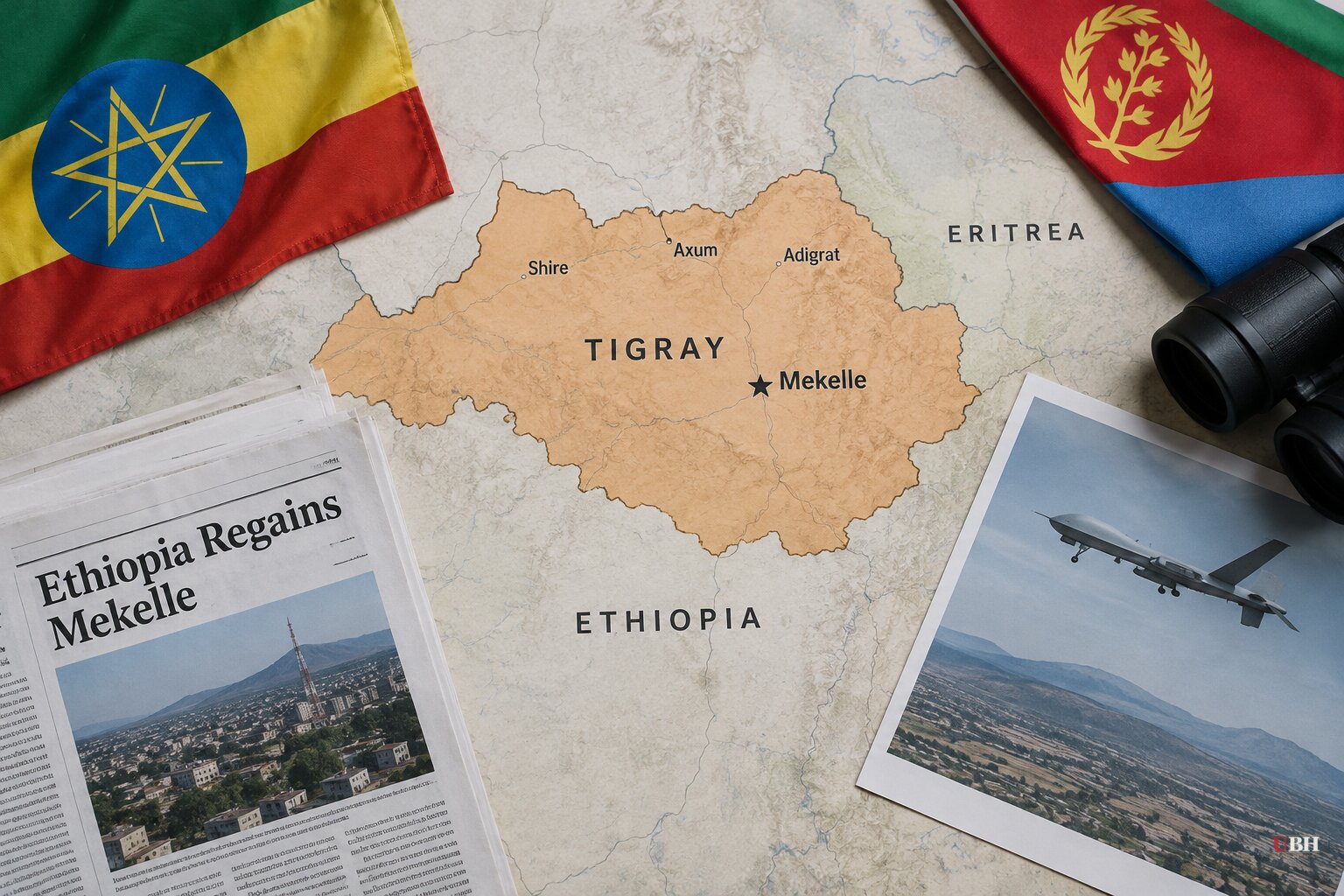
Ethiopia's federal forces and an allied militia, the Tigray Peace Force, took control of Mekelle on Oct. 4 after the Tigray People's Liberation Front withdrew from the regional capital. The 2022 Pretoria ceasefire, which ended a war that killed between 300,000 and 800,000 civilians according to British government estimates, has effectively collapsed.
The fighting is not over. Rebel forces, pushed back after defeats around the towns of Alamata and Kobo, pulled into the surrounding countryside.
"We will confront the enemy on our terms and where we choose," TPLF leader Debretsion Gebremichael said.
How the ceasefire collapsed
On Sept. 20, the TPLF announced an alliance with six other armed groups with the stated aim of overthrowing Prime Minister Abiy Ahmed's government. On Sept. 23, Tigrayan forces seized the federally administered airports at Mekelle, Axum and Shire, according to the African Union. Ethiopian Airlines suspended operations at the Tigray airport.
The TPLF-led regional administration says its forces were responding to federal air and artillery attacks and has called it a "defensive war." The African Union said the airport seizures were inconsistent with the Pretoria agreement and urged both sides back to direct talks.
The International Crisis Group said the opening attacks appeared to be the first coordinated military operation by the new opposition alliance. Fronts opened in and around Amhara and Afar as well. Ethiopia is already fighting insurgencies in Amhara and Oromia.
The UN has warned of disrupted aid deliveries and forced recruitment, including of children.
Eritrea crosses the line
Eritrean military vehicles crossed the southern border into Tigray on Wednesday, Oct. 7, and reached Adigrat, about 40 km (25 miles) inside, according to civilian witnesses, a militia commander and the conflict-monitoring group ACLED. ACLED says Ethiopian government drones then struck the Eritrean troops Wednesday evening and Thursday morning.
One Adigrat resident told BBC Tigrinya he saw about 40 trucks carrying soldiers moving south. Another described 20 to 30 large trucks heading toward Edaga Hamus.
Eritrea has not confirmed or denied the deployment. Information Minister Yemane Ghebremeskel said only: "We are not in the business of refuting wild allegations or narratives."
The shift is striking. Eritrea fought alongside Abiy's government in the 2020-2022 war, after the 2018 rapprochement that won Abiy the 2019 Nobel Peace Prize. It has a long enmity with the TPLF, which ruled Ethiopia from 1991 to 2018 and fought Eritrea in a 1998-2000 war. The Guardian reports that Eritrea's fear of an Ethiopian move on the Red Sea now outweighs that hostility.
Eritrea severed diplomatic ties with Ethiopia on Oct. 1. Ethiopia closed its embassy in Asmara and ordered 10 Eritrean diplomats out.
The Red Sea question
Ethiopia has been landlocked since Eritrea's independence and depends heavily on Djibouti for trade. Abiy has made sea access a strategic priority since 2023, and Ethiopian state media has claimed historical rights to the Eritrean port of Assab. Abiy raised the issue again in his parliamentary address after being sworn in on Monday, Oct. 5, for a new five-year term following his Prosperity Party's June 1 election win.
Ethiopia's government accuses Eritrea, Egypt and Sudan of backing the opposition coalition. All three deny it.
On Sunday, Oct. 4, Egyptian President Abdel Fattah el-Sisi hosted Eritrean President Isaias Afwerki, Sudanese army chief Gen. Abdel Fattah al-Burhan and Somalia's Hassan Sheikh Mohamud at El Alamein. Their joint declaration says Red Sea governance is "the exclusive responsibility of the littoral states," which excludes landlocked Ethiopia. It also rejects "unilateral measures" on the Nile, a reference to the dispute over Ethiopia's Renaissance Dam.
Ethiopia's Foreign Ministry replied Monday that it "stands ready to defend its sovereignty, territorial integrity, and core national interests" while urging dialogue and "good neighbourliness rather than confrontation and zero-sum approaches." It has also said it must be included in any discussion of the issue.
Hossamaldeen Ibrahim, an analyst at the Bloomsbury Intelligence and Security Institute, told Al Jazeera that Egypt sees both the dam and any Ethiopian army move toward the Red Sea as a strategic threat. "Ethiopia is seeking a sea outlet; Eritrea sees this as an existential threat," he said.
Outside pressure
The U.S. State Department said the conflict "jeopardizes ongoing U.S. collaboration on shared interests" with both countries. Massad Boulos, the department's senior adviser for Arab and African affairs, urged both to "exercise maximum restraint" and return to the dialogue set out in their 2018 peace framework.
The EU called Monday for immediate de-escalation on all fronts. Murithi Mutiga, the Crisis Group's Africa director, said the situation "is dangerously close to returning to full-blown war."
What the last war suggests
There is precedent for the TPLF's pledge. When Abiy's government declared victory after taking Mekelle in 2020, Tigrayan forces regrouped in the mountains, retook much of the region and recaptured the capital. The war ran for nearly a year and a half more.
Whether the same happens again depends on factors no one has settled: whether the TPLF can sustain a rural rebellion alongside six allied groups, whether federal forces can hold several fronts at once, and whether Eritrean troops stay in Tigray or withdraw after the drone strikes. The African Union's call for direct talks has not been taken up by either side.
Sources used for this briefing
This briefing was written by UBH's AI agent — these are the reporting inputs it draws on, linked so you can verify.


