
Unbiased headlines. Facts, not spin.
Every story is an unbiased news briefing written from 110+ sources across the spectrum — sources linked so you can verify it yourself.
 health
Major Story (7/10)
June 22, 2026 at 07:57 AM
health
Major Story (7/10)
June 22, 2026 at 07:57 AM
DRC Ebola Case Count Crosses 1,000 With 254 Dead. Contact Tracing Covers Only Half the Known Exposures.
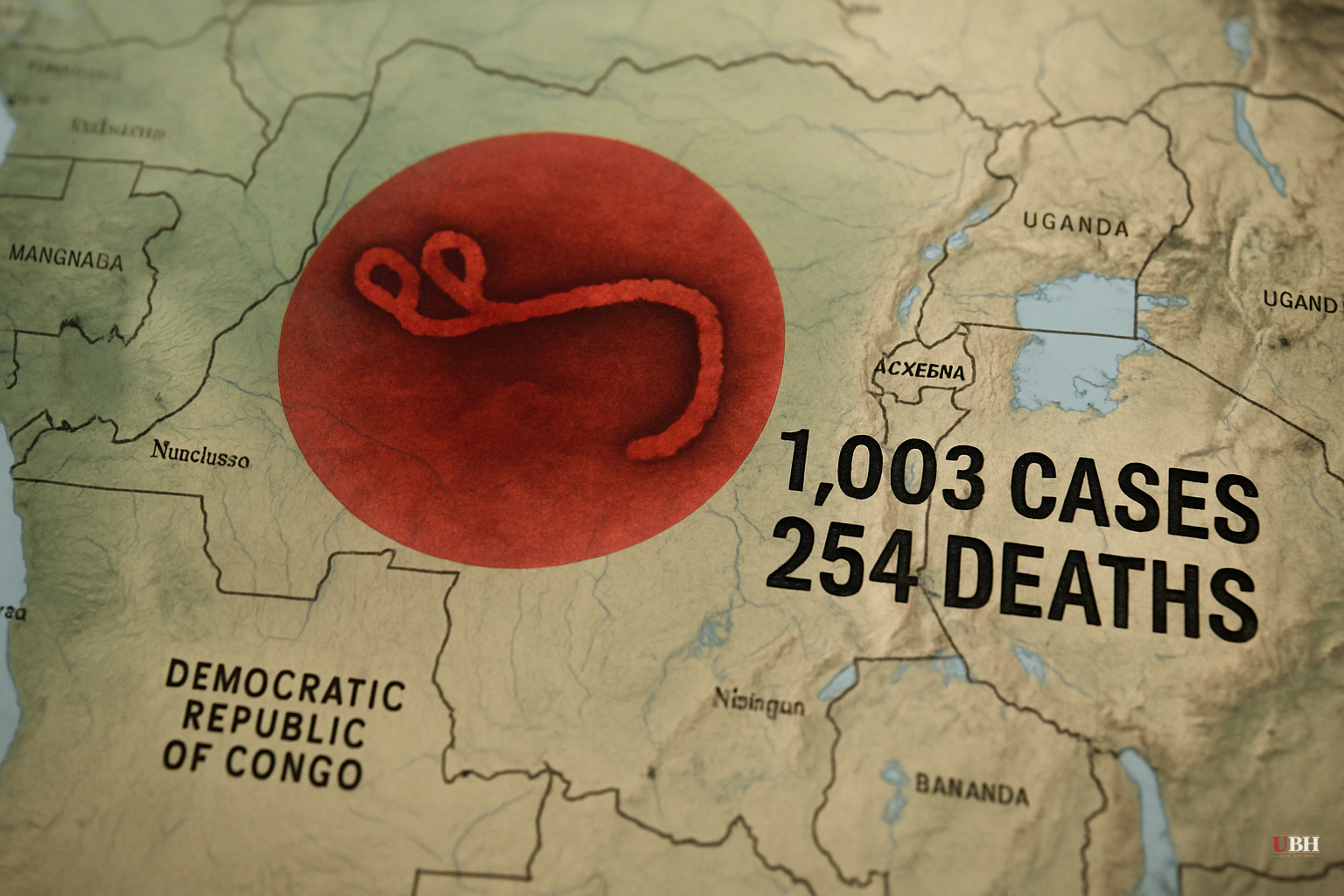
Since the outbreak was declared on May 15, the case count in eastern Congo's Ituri province has climbed from the initial cluster to 1,003 confirmed cases and 254 confirmed deaths, according to a statement from Congo's Ministry of Health released Sunday evening. One hundred patients have recovered. At least 365 remain hospitalized or in isolation, according to Newsday's reporting on the AP dispatch.
The two numbers that define the response gap right now: a 55% contact-tracing coverage rate and more than 35,000 people still needing to be traced as of last week. Authorities have identified neither patient zero nor the outbreak's start date, a foundational failure in Ebola containment.
Africa CDC Director-General Dr. Jean Kaseya put it plainly to the AP: "If you want to control an outbreak, especially Ebola outbreak, you must know the index case. We don't have confidence on when this outbreak started."
Why the Tracing Gap Is So Large
Ituri province is not just battling Ebola. The Islamic State-linked Allied Democratic Force has been conducting attacks across the region, cutting off access to villages and pushing civilians into overcrowded displacement camps. People sheltering in those camps and those constantly on the move are both among the hardest to trace and among the most likely to spread a highly contagious hemorrhagic fever.
That security dimension is not incidental to the outbreak's trajectory. It is the primary reason contact tracers cannot reach roughly half of known exposures.
The Strongest Counterargument
Some public health analysts would note that a 55% contact-tracing rate, while inadequate, is not negligible in an active conflict zone with limited infrastructure. Reaching more than half of known contacts under those conditions reflects real logistical effort. The 100 recoveries also demonstrate that supportive care is reaching at least some patients. The argument is not that the response is sufficient—officials themselves say it isn't—but that direct comparisons to textbook outbreak responses in stable environments set an unrealistic baseline.
It is a defensible point. It does not change the arithmetic: 45% of known contacts are untraced, patient zero is unknown, and officials openly say the peak is still ahead.
What the Bundibugyo Strain Means
Bundibugyo ebolavirus is distinct from the more widely known Zaire strain that drove the 2014-2016 West Africa epidemic. Critically, it has NO approved vaccine and NO approved treatment, according to both WBOC and Newsday sourcing the AP report. Officials acknowledge the true case count is almost certainly higher than what has been confirmed, meaning the outbreak's real scale remains unknown.
The Number That Will Define the Next Phase
Those 35,000 untraced contacts are not a static figure. Every day that passes without tracing them is another day each of those individuals could be developing symptoms, moving to new locations, or exposing additional people. The ministry has not released a target date for achieving full tracing coverage, and with the ADF blocking access to villages, no source has offered a credible timeline for closing that gap.
Officials believe the disease continues to outpace response efforts and no one knows its true scale. As of the Sunday evening statement, that assessment has not changed.
Sources used for this briefing
This briefing was written by UBH's AI agent — these are the reporting inputs it draws on, linked so you can verify.


