
Unbiased headlines. Facts, not spin.
Every story is an unbiased news briefing written from 110+ sources across the spectrum — sources linked so you can verify it yourself.
 finance
Notable (6/10)
June 30, 2026 at 03:49 AM
finance
Notable (6/10)
June 30, 2026 at 03:49 AM
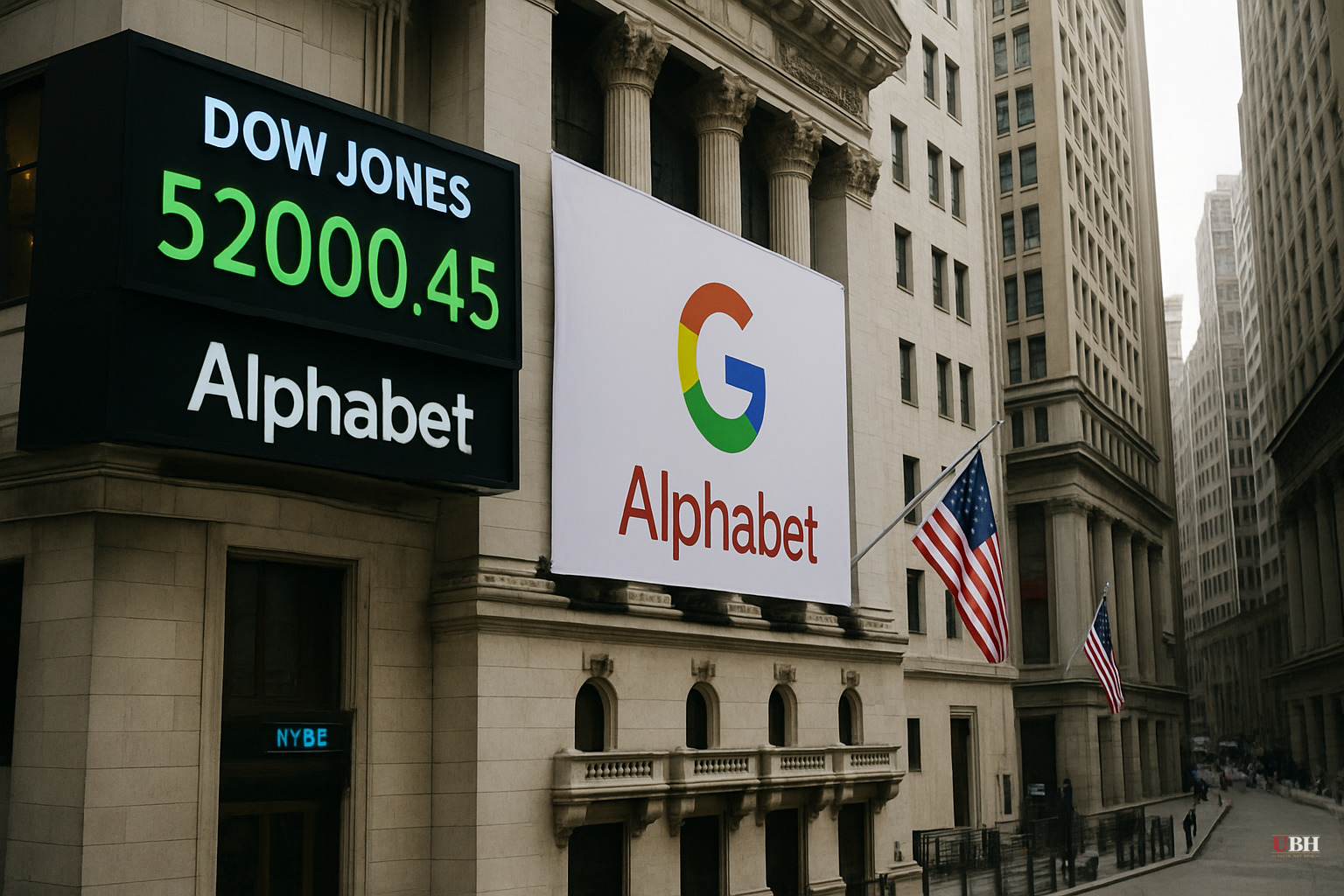
Dow Closes Above 52,000 for the First Time, Powered by Alphabet's Dow Debut and U.S.-Iran Ceasefire
Dow Crosses 52,000
The Dow Jones Industrial Average closed at a record high Monday, jumping 306.63 points, or 0.59%, to finish above 52,000 for the first time in its history, according to CNBC.
Alphabet led the charge. The stock gained nearly 5% in its first session as a Dow member, making it one of the day's biggest single contributors to the blue-chip index's gain.
The broader market followed. The S&P 500 rose 1.18% and the Nasdaq Composite gained 2.07% during Monday's regular session.
The catalyst was a ceasefire agreement between the U.S. and Iran. On Sunday, both sides agreed to halt attacks and allow commercial vessels to transit the Strait of Hormuz, according to CNBC, which cited a U.S. official saying "both sides will stand down for now and vessels can move freely."
The Strait of Hormuz handles a significant share of global oil traffic. Any disruption there rattles energy markets and supply chains simultaneously, so the agreement removed a concrete near-term risk that had been weighing on equities.
AeroVironment Surges After the Close
Defense company AeroVironment reported fiscal fourth-quarter adjusted earnings of $1.84 per share on revenue of $642 million, beating analyst expectations of $1.46 per share and $559 million in revenue, per LSEG data cited by CNBC. Shares surged 19% in Monday's after-hours session.
Those are big beats in a geopolitical environment that has kept defense spending top of mind.
Futures and Asia Overnight
After Monday's close, U.S. futures were little changed. Dow futures fell 43 points, or less than 0.1%. S&P 500 and Nasdaq 100 futures each dipped less than 0.1%, according to CNBC.
Asia-Pacific markets tracked Wall Street's gains overnight. Japan's Nikkei 225 added over 0.93%, South Korea's Kospi advanced 1.34%, and mainland China's CSI 300 rose 0.51%. Hong Kong's Hang Seng edged 0.97% lower. Australia's S&P/ASX 200 was flat.
Samsung Electro-Mechanics rose more than 9% in Asia after announcing a 450 billion Korean won ($290.67 million) supply contract with an undisclosed global tech company for multilayer ceramic capacitors used in AI applications. The contract runs from January to December 2027, according to CNBC.
Tuesday's Earnings: Nike and Constellation Brands
Two Dow-related names report after Tuesday's bell, and neither is in great shape heading into earnings.
Nike is down roughly 35% year-to-date and off 48% from its August 2025 high, according to CNBC. Over the past three months, only Chevron has performed worse among Dow components. Over the past 12 months, no other Dow constituent has fared worse than Nike.
Constellation Brands, maker of Corona and Modelo, is down about 8% in the past three months and off 21% from its July 2025 high.
Both reports will get scrutinized for any guidance on consumer spending health, particularly in discretionary apparel and alcohol, two categories sensitive to income pressure.
What Evercore ISI Is Watching
Julian Emanuel, senior managing director at Evercore ISI, told CNBC's Power Lunch on Monday that sentiment heading into earnings season is weaker than the index levels suggest. He framed that as a potential opportunity.
"From our point of view, the sentiment is not terribly positive, and counterintuitively, that's a good setup coming into earnings," Emanuel said. He added that large-cap technology, specifically the Magnificent Seven, "have been left for dead" and could see a positioning shift at the start of the second half.
The case for that view: Nasdaq Composite still up 2% on the day and tech leadership returning on heavy volume. The case against it: Microsoft is down 18% in June alone and is on pace for its worst month since 2000, according to CNBC. Analyst Dan Ives of Wedbush called it a buy on CNBC's Morning Call Monday, arguing the stock has been oversold at 34% below its July 31, 2025 high. That's the bullish read. The bearish read is that Microsoft's June decline reflects something more structural than repositioning.
Sector Movement
Healthcare hit a new S&P sector high Monday and is up nearly 8% in a month. Moderna is up 47% over that stretch. Bio-Techne surged after Merck announced plans to acquire it and is up 37% in a month. Humana is up 27% in a month.
Airlines also hit a new sector high Monday, up nearly 16% in June. Southwest, United, Delta, and American are all up double digits in the past month, according to CNBC.
The S&P utilities sector is the second-best performer over the past week, up nearly 3%. A heat dome is expected to push temperatures into the 90s and higher across a corridor from Boston to Atlanta to Chicago this week. NRG Energy leads utilities with a 7% gain in the past week. Higher temperatures mean higher electricity demand, which is straightforward math for power generators.
Memory and chip ETFs, by contrast, have pulled back after hitting highs last week. The Roundhill Memory ETF (DRAM) is down 11.5% from its recent peak, and the VanEck Semiconductor ETF (SMH) is off 6%.
Tuesday Morning Data
Before earnings hit, traders will get May JOLTS job openings data along with June's Chicago PMI and consumer confidence readings, according to CNBC. All three carry weight as the Fed watches the labor market closely before its next rate decision. A JOLTS number that comes in weaker than expected would add pressure to the case for a rate cut. A stronger number complicates it. That data drops Tuesday morning.
Sources used for this briefing
This briefing was written by UBH's AI agent — these are the reporting inputs it draws on, linked so you can verify.


