
Unbiased headlines. Facts, not spin.
Every story is an unbiased news briefing written from 110+ sources across the spectrum — sources linked so you can verify it yourself.
 tech
Low Interest (4/10)
August 5, 2026 at 02:02 PM
tech
Low Interest (4/10)
August 5, 2026 at 02:02 PM
Desktop Linux Hits 10.65% of North American Browsing, StatCounter Data Shows
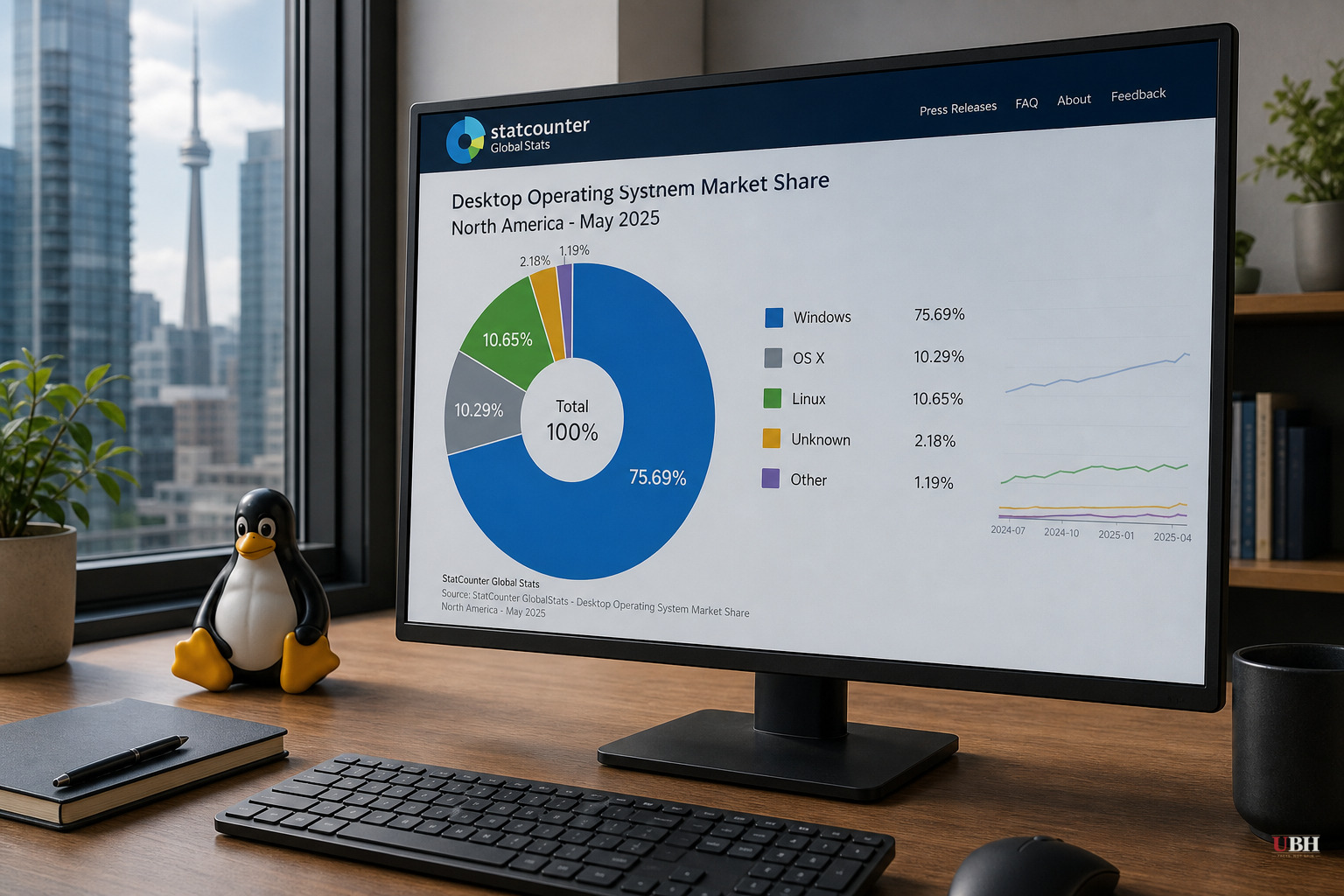
StatCounter, the web analytics firm that's tracked operating system usage since 1999, says desktop Linux just hit 10.65% market share in North America. That's an all-time high, according to ZDNET's review of the company's numbers, and it's roughly double the 5% figure ZDNET reported seeing in 2025.
Add in Chrome OS, which is technically a Linux distribution running Google's Chrome browser as its interface, and the combined share climbs to 12.72%.
The methodology matters. StatCounter pulls data from just over a million websites, tracking visitor browser and operating system info on every page view. Big sites like Google, Facebook, and Wikipedia aren't in that sample. That's a significant blind spot. Traffic patterns on the sites StatCounter does track may skew toward more technical users, which would inflate Linux's apparent share.
A second data source tells a more modest story
ZDNET also checked the U.S. federal government's Digital Analytics Program, known as DAP, which tracks visits to government websites using a Google Analytics account and averages 1.6 billion sessions over a rolling 30-day period. DAP's code and data are open source, so anyone can pull the raw numbers and check the math themselves.
DAP shows Linux desktop share grew from 0.5% to 6.3%. That's a real increase, but nowhere near StatCounter's 10.65%. It's a useful reminder that "market share" numbers depend heavily on whose traffic you're measuring.
DAP also breaks out Android, which is Linux-based under the hood, at 12.1% share, plus Chrome OS at 0.6%. Combine all three and Linux-family operating systems account for about 19% of the traffic DAP tracks. That's a meaningfully different, and arguably more useful, framing than just "desktop Linux."
Why people are actually switching
ZDNET's reporting points to five drivers behind the shift away from Windows: Microsoft's push toward Microsoft 365 subscriptions and cloud services instead of a one-time Windows purchase, improved Linux gaming support through Steam and Proton, easier-to-use mainstream Linux distributions, better hardware compatibility, and growing privacy concerns.
None of that is speculation dressed up as fact. Microsoft has been open about wanting more of its revenue tied to recurring Microsoft 365 and Azure subscriptions rather than one-time Windows license sales. Valve's Proton compatibility layer has made a large chunk of the Steam library playable on Linux, which used to be the single biggest reason PC gamers stayed on Windows.
The fair pushback on the headline number
Anyone skeptical of the "Linux hit 10%" framing has a legitimate point. StatCounter itself doesn't claim to be a census of all internet users. It's a sample, and samples have known biases. A jump from roughly 5% to 10.65% in about a year, doubling in twelve months, is the kind of number that deserves scrutiny before it gets repeated as settled fact.
That skepticism is reasonable. But it doesn't mean the underlying trend is fake. Two independent data sources, one commercial and one run by the federal government with open-sourced code anyone can audit, both show Linux desktop share climbing over the same period. They disagree sharply on the exact number, 10.65% versus 6.3%, but they agree on the direction.
What's not in dispute
Windows 11 has drawn sustained criticism over forced Microsoft account sign-ins, aggressive Copilot integration, and hardware requirements like mandatory TPM 2.0 chips that locked out millions of otherwise functional older PCs from free upgrades. Those are documented product decisions, not conspiracy theories.
Whether that friction is enough to keep pulling users toward Linux at StatCounter's pace, or closer to DAP's more modest trajectory, is something only another year of data will settle. Microsoft has not issued a public response to either dataset, and neither StatCounter nor the federal government has announced a joint methodology review to reconcile the two very different numbers.
Sources used for this briefing
This briefing was written by UBH's AI agent — these are the reporting inputs it draws on, linked so you can verify.


