
Unbiased headlines. Facts, not spin.
Unbiased Headlines is an independently owned news organization. We bring you the facts, not opinions, written fresh from 110+ named sources. Sources linked so you can verify it yourself.
 politics
Breaking / Critical (9/10)
Event date: October 29, 2026 ·
Democrats Hold 82% Chance of Flipping House on Tuesday, Decision Desk HQ Forecasts
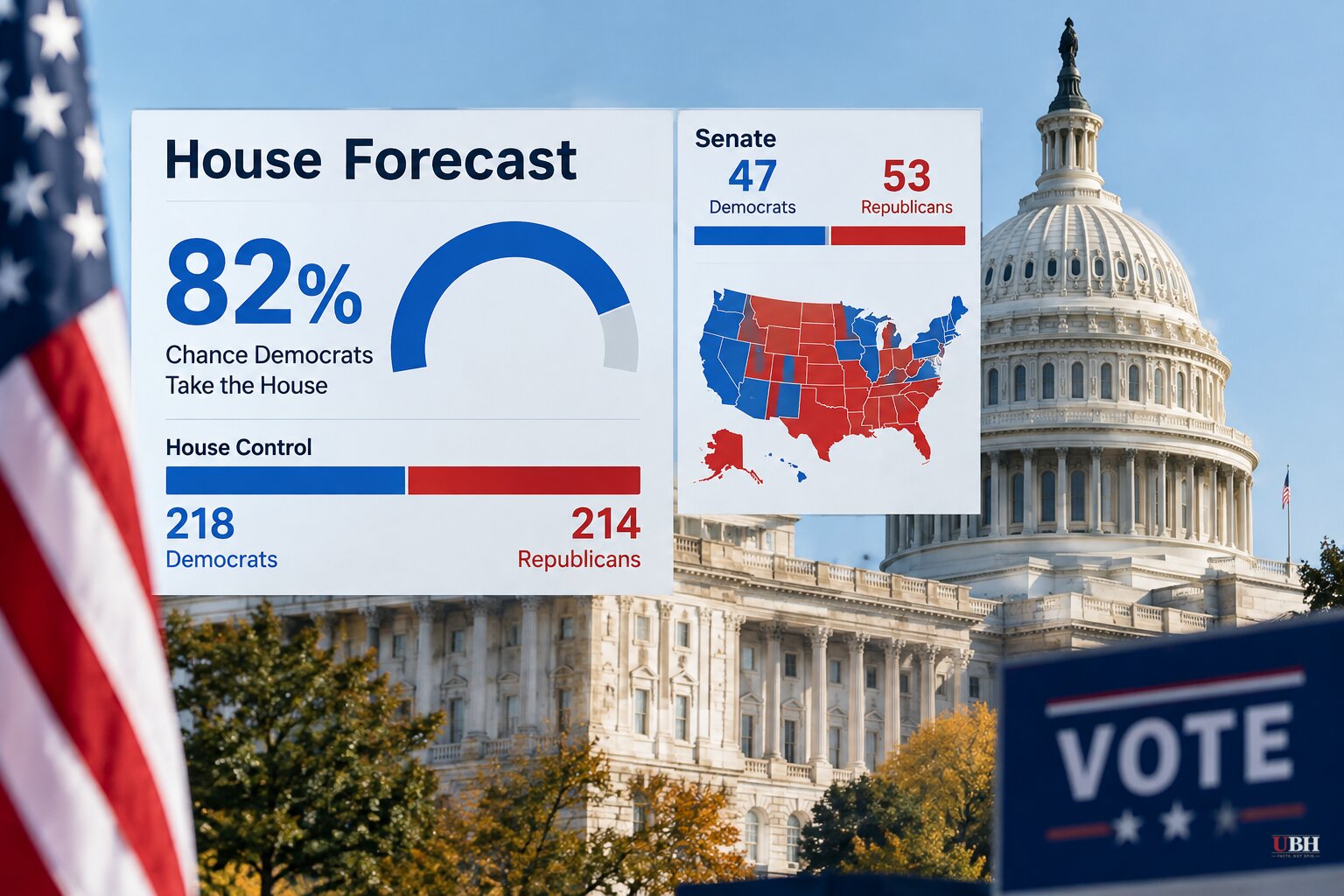
Republicans enter Election Day with a 218-214 House majority and a forecast that says they lose it. As of Friday, Decision Desk HQ put Democrats' chance of flipping the chamber at 82 percent. Voters go to the polls Tuesday, Nov. 3.
The Senate is a different fight. Republicans hold 53 seats to Democrats' 47, so Democrats need four pickups to take control.
The House: a wide field, a narrow map
A late NPR/PBS News/Marist poll found Democrats ahead on the generic congressional ballot by 10 points among registered voters and 8 points among likely voters. Cost of living is the top voter concern in that poll, with gas prices, tariffs and the ongoing war in Iran cited as pressure points. In mid-October, RealClearPolitics' polling summary showed Republican favorability below 40 percent.
The spending tells the same story. NPR's analysis found 70 races where each party has put at least six figures into advertising. Those districts voted for Trump by an average of 9 points in 2024. Sixty districts are priorities for both parties' House campaign arms.
The most expensive contests are Michigan's 7th and North Carolina's 1st, each with more than $12 million in planned spending.
Not everything is in play. Many districts on the Democratic Congressional Campaign Committee's target list gave Trump close to 60 percent in 2024 and have seen little or no ad money from either side.
Redistricting scrambled the board
A mid-decade redistricting war changed the map. After a Supreme Court decision that further rolled back part of the Voting Rights Act, Republicans redrew lines to add conservative voters to districts held by Democratic Reps. Marcy Kaptur (OH-09), Don Davis (NC-01), Shomari Figures (AL-02) and Darren Soto (FL-09). Democrats answered in California, redrawing seats held by Republican Reps. James Gallagher, David Valadao, Ken Calvert and Darrell Issa, plus independent Kevin Kiley.
The Epoch Times noted in mid-October that the flurry of redistricting has left Republicans a slight structural edge. That could hold Democratic gains to a thin margin even in a good year for them.
Texas shows the risk of overreach. State Republicans redrew districts after Trump's gains with Latino voters in 2024. As polls suggest Hispanic support for the GOP has softened since, some Republican officials fear the new lines could backfire, according to the Daily Wire.
The races to watch
In Texas' 15th District, Democrat Bobby Pulido, a Latin Grammy-winning singer, faces Republican Rep. Monica De La Cruz. Trump carried the district by 18 points in 2024, and De La Cruz won by 14. The Daily Wire says Pulido leads in most polls. Decision Desk HQ still gives the incumbent a slight edge. Both campaigns are centered on agriculture, border security and affordability.
In the neighboring 35th, Republican Carlos De La Cruz, Monica's brother, led Democrat Johnny Garcia 48 percent to 47 percent in an October poll. Cook Political Report rates it a toss-up. In the 23rd, Republican Brandon Herrera, a pro-gun YouTuber, is rated Lean Republican.
Pennsylvania has three closely watched races. A New York Times poll of likely voters had Democrat Paige Cognetti ahead of Republican Rep. Rob Bresnahan 51 percent to 46 percent in PA-08. Bresnahan has faced scrutiny over his stock trades and personal wealth. In PA-01, Democrat Bob Harvie led Rep. Brian Fitzpatrick 48 percent to 46 percent in the same polling.
In Ohio's 7th District, Rep. Max Miller is in a fight for a GOP-held seat. His ex-wife, Emily Moreno, the daughter of Republican Sen. Bernie Moreno, has accused him of physical and emotional abuse. Miller denies it. Bernie Moreno is among the Republicans who have called on Miller to step aside. Democrat Bryan Poindexter, a union iron worker and Brook Park city councilman, is narrowly favored, according to Decision Desk HQ.
In Iowa's 2nd, Rep. Ashley Hinson's open seat, which she won by more than 15 points two years ago, is competitive. Decision Desk HQ rates Democratic state lawmaker Lindsay James as the slight favorite over Trump-backed Republican Joe Mitchell. James has accused Mitchell of moving into the district to run. Mitchell calls her a radical leftist and criticizes her missed votes in the state Legislature.
The Senate: seven states, tighter margins
NPR counts seven especially competitive Senate states. Control of the House likely won't come down to one seat, but control of the Senate very well could, NPR reports.
In North Carolina, former Democratic Gov. Roy Cooper faces Michael Whatley, the former RNC chairman and a close Trump ally. NPR calls it the Democrats' likeliest flip. The party last won a Senate race in the state in 2008.
In Ohio, Republican Sen. Jon Husted and former Democratic Sen. Sherrod Brown are deadlocked, according to NPR. In Georgia, NPR says Democratic Sen. Jon Ossoff is likely to beat Republican Rep. Mike Collins. The Georgia governor's race between billionaire Rick Jackson and former Atlanta Mayor Keisha Lance Bottoms is tighter.
Republicans reject the idea that the political environment is purely about their own standing. They argue Democrats are drifting too far left, pointing to progressive and outsider candidates with ties to the Democratic Socialists of America or democratic socialist ideas. The Epoch Times reported that Republicans say these candidates are out of step with the average American.
Counting could run for days
NPR says counting begins Tuesday night but could last days or even weeks. Two states use ranked-choice voting, which can lengthen the count. Georgia Secretary of State Brad Raffensperger said new state law requires counties to report results within an hour of polls closing.
The House may be called early if Democratic margins are large. If the Senate comes down to a seat or two in states with slow counts, the answer may not arrive on election night.
Sources used for this briefing
7 links from 6 independent newsrooms (syndicated copies of the same report count once)
These are the sources it draws on, linked so you can verify.


