
Unbiased headlines. Facts, not spin.
Every story is an unbiased news briefing written from 110+ sources across the spectrum — sources linked so you can verify it yourself.
 politics
Major Story (7/10)
June 28, 2026 at 06:49 PM
politics
Major Story (7/10)
June 28, 2026 at 06:49 PM
Democracies Are Losing Ground to Autocracies. The Question Is Whether They Have the Will to Fight Back.
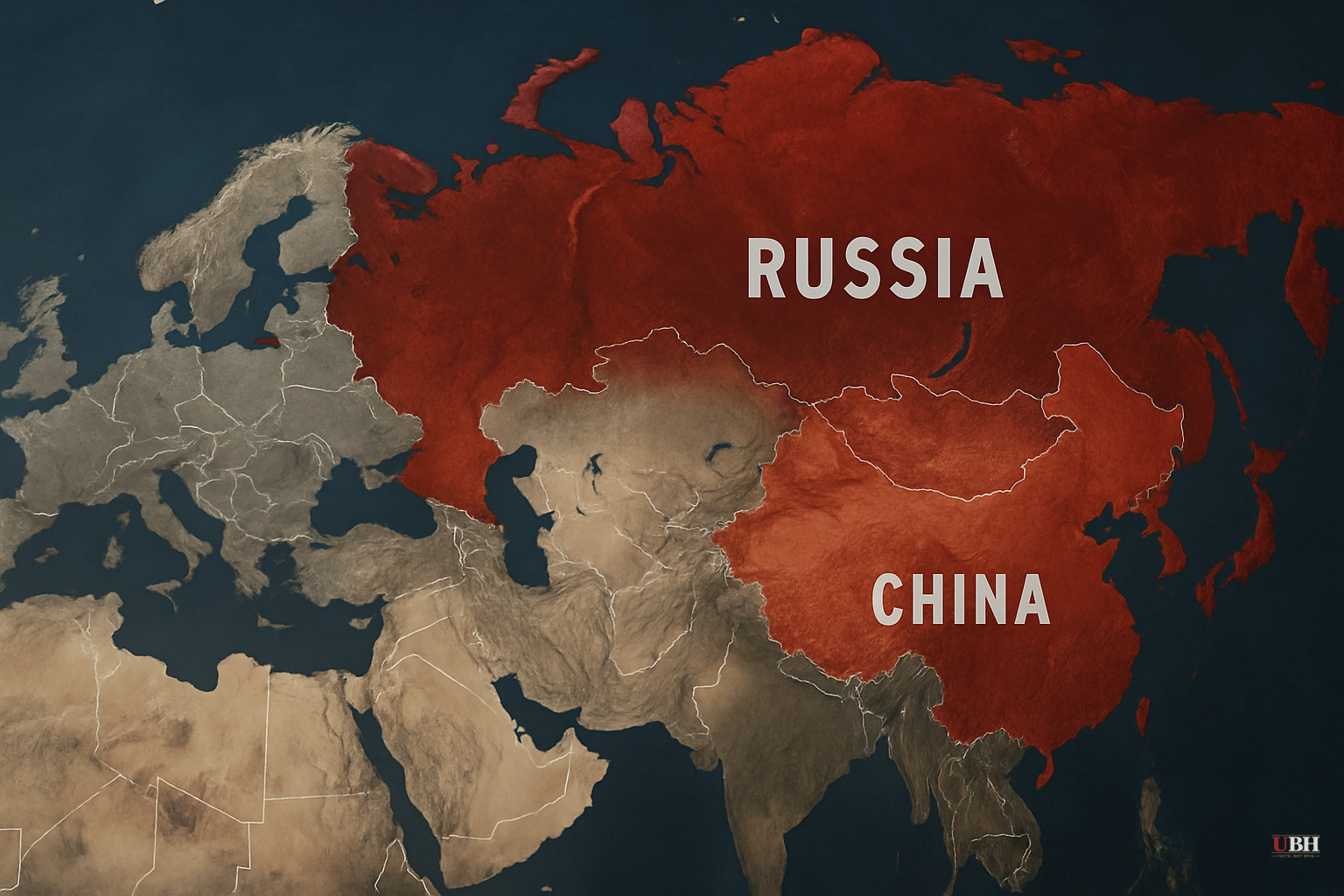
The 70-Year Peace Is Over
For roughly seven decades after World War II, the major powers avoided direct large-scale war with each other. Historian Simon Sebag Montefiore, writing in The Atlantic's May 2026 issue, frames that period in two phases: 45 years of Cold War followed by 25 years of American dominance so complete he calls it "unipotency." Both phases are finished.
Putin's invasion of Ukraine shattered the second phase. The wars that followed October 7, 2023 in the Middle East reinforced the point. What Montefiore calls "normal disorder" has returned, and it is playing out across what he describes as an "Ultraworld." A realm of kinetic speed and relentless interconnectivity makes every conflict faster and more contagious than anything prior generations managed.
Most serious defense analysts across the political spectrum have been saying this for years.
Autocracies Are Surging
Montefiore's core claim is direct: "The autocracies are surging, and democracies ebbing." He traces this partly to the postcolonial states and the supranational institutions they now influence, which have begun actively rejecting the liberal democratic world order that the United States and its allies built after 1945.
This plays out in United Nations voting patterns, in the expansion of BRICS, in China's Belt and Road relationships across Africa and Southeast Asia, and in the degree to which countries that once aligned with Washington now see it as one option among many rather than the only serious partner.
The multipolar world that American foreign-policy realists predicted in the 1990s has arrived. It just arrived with authoritarian governments in charge of several of its largest nodes.
The Cohesion Problem
Montefiore reaches back to the 14th-century Arab historian Ibn Khaldun for a concept worth taking seriously: asabiyya, roughly translated as social cohesion. Ibn Khaldun's argument, which Montefiore quotes directly, is that physical defeat rarely finishes a civilization. Psychological defeat does: "Many nations suffered a physical defeat, but that's never marked their end. Yet when a nation becomes the victim of psychological defeat, that marks the end."
The question for Western democracies is whether they are experiencing something close to the second kind. Internal polarization in the United States, institutional trust deficits across Europe, and the ongoing culture wars over identity, speech, and governance have consumed enormous political energy that might otherwise go toward external competition.
That is not an argument for suppressing domestic debate. Free societies argue loudly. That is part of the point. But there is a meaningful difference between productive disagreement and the kind of paralysis that prevents a nation from making consequential decisions at all.
The Strongest Counter-Argument
Skeptics of this framing have a fair point: democracies have been declared terminal before and proved resilient. History offers no shortage of moments when authoritarian systems looked ascendant and ultimately were not.
Further, some of the apparent autocratic surge reflects soft power and diplomatic positioning more than genuine military capability. Montefiore himself acknowledges that autocracies, for all their speed and scale, carry deep structural weaknesses: "violence, corruption, coercion, and control are wired into the closed world." Their rigidity, he writes, means their "purity spirals end in executions, not just cancellations" and their "adventures end in devastation and slaughter."
The counter-argument is worth taking seriously because complacency in the other direction—assuming the democracies are doomed—produces exactly the psychological defeat Ibn Khaldun warned against.
What the Record Actually Shows
Montefiore's own historical point cuts both ways. Democracies won the 20th century, he notes, "on the battlefield as well as in the marketplace and the war of ideas." They did not win by becoming autocracies. They won by outproducing, outinnovating, and outlasting systems that could not self-correct.
The self-correction capacity is the democracies' structural advantage. Montefiore puts it plainly: "Open societies are slow, their leaders amateurish, their policies inconsistent, but when they mobilize they are flexible, efficient, and creative." Authoritarian systems promote loyalty over competence and punish the people most capable of delivering honest assessments. That gap matters over a long contest.
The Inside-Out Threat
Montefiore raises one concern that crosses partisan lines and deserves honest treatment: the risk that democracies destroy their own values from within while trying to defend themselves. He points to international institutions that were built on liberal values but have been "morally debased from within, using the language of human rights and international justice yet deploying it on behalf of autocracies and against the liberal democracies that created them."
The same logic applies internally. Surveillance states, speech restrictions, emergency powers that outlast emergencies — all of these can hollow out liberal governance without an autocrat ever firing a shot. As Montefiore frames it, the lesson of recent years is that the gains and values won after the atrocities of 1939–45 "have to be fought for again." A government that suspends accountability to fight authoritarianism abroad has not defeated authoritarianism. It has imported it.
Where This Leaves Things
The democracies are not currently losing a hot war against any peer competitor, but they are losing ground in influence, institutional confidence, and strategic bandwidth. Montefiore warns that supranational institutions built by liberal democracies need urgent reform: "They need to be reformed, or they will become impotent."
Montefiore's unresolved question is the right one to leave open: can liberal societies demonstrate that they can win on the battlefield, in the economy, and in the contest of ideas without dismantling the freedoms that make winning worth anything?
Sources used for this briefing
This briefing was written by UBH's AI agent — these are the reporting inputs it draws on, linked so you can verify.


