
Unbiased headlines. Facts, not spin.
Every story is an unbiased news briefing written from 110+ sources across the spectrum — sources linked so you can verify it yourself.
 tech
Notable (5/10)
August 16, 2026 at 01:36 PM
tech
Notable (5/10)
August 16, 2026 at 01:36 PM
DeepSeek's Cheap 'Monster' Model Fails Half Its Real-World Agent Tasks, Then Gets a Price Hike
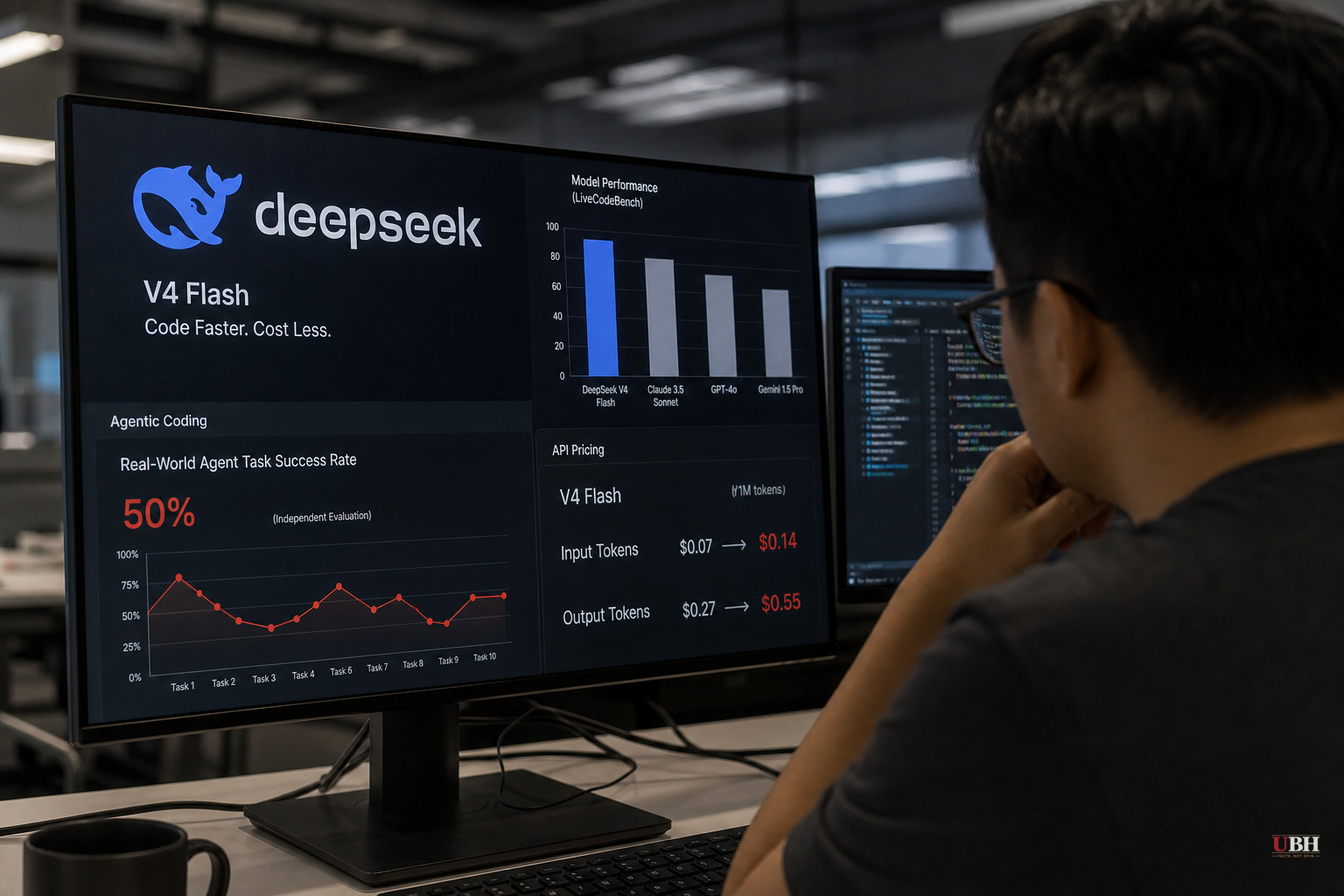
DeepSeek's V4 Flash launched to public beta on July 31, 2026, and developers immediately started calling it a "total monster." ML researcher Nathan Lambert posted on X that adoption numbers were "insane" and that the model matched GLM 5.2 in benchmark scoring. It quickly became the most-used model on OpenRouter by weekly token volume, according to VentureBeat.
Then someone actually tested it on real work.
Composio, an AI testing firm, ran V4 Flash through eight different agent harnesses including Claude Code, Codex, and OpenCode. They threw 30 deliberately hard, multi-step tasks at it using tools people actually use: Gmail, GitHub, Slack, Google Sheets. Out of 240 total runs, only 129 passed. That's a 53.8% success rate. Only six of the 30 workflows got completed successfully across every single harness tested, according to both VentureBeat and Crypto Briefing.
Benchmarks measure one thing. Production measures another.
Results swung wildly depending on which harness ran it. Crypto Briefing reported that Pi Agent was the strongest performer, completing 20 of 30 tasks, while other harnesses did worse with the identical underlying model. Same brain, different results, depending on tool configuration, caching behavior, retries, and the provider stack underneath it.
For anyone treating leaderboard rank as a purchasing decision, this presents a problem. The model isn't the product. The model plus the harness plus the orchestration is the product. VentureBeat's framing gets this right: orchestration, not raw model capability, may decide whether this succeeds in enterprise settings.
DeepSeek itself, in its own July 31 changelog posted on deepseek.ai, was upfront that the benchmark numbers it published were vendor-reported and evaluated using DeepSeek's own harness in "minimal mode," with specific temperature and top_p settings. The company said plainly: "treat them as vendor-reported until independently reproduced." Composio's testing is exactly that kind of independent reproduction, and it landed at a fraction of the polish DeepSeek's internal benchmarks implied.
The price is going up. A lot.
DeepSeek is following up the beta rollout with a steep price increase. According to VentureBeat, Flash pricing is rising to 22 cents per million input tokens and 66 cents per million output tokens off-peak, jumping to 44 cents and $1.32 at peak hours. That's a 57% to 371% increase depending on tier. V4 Pro, which went generally available August 13, is seeing similarly steep hikes, 51% to 355% depending on usage. Cache-hit pricing, where models reuse prior prompts instead of recomputing from scratch, is rising by as much as 1,100% in some configurations.
Crypto Briefing noted the original appeal: at $0.14 per million input tokens, V4 Flash undercut comparable Western models by roughly tenfold. That was the pitch. Cheap, fast, good enough. The new pricing narrows that gap considerably, even if DeepSeek models remain cheaper than frontier competitors from OpenAI or Anthropic.
DeepSeek's own materials call V4 Flash a beta product, still under public beta as of this writing, with a broader pricing adjustment reportedly set to take effect August 16, 2026. That beta label is doing real work here. DeepSeek isn't claiming this is a finished, production-hardened system. It's asking developers to test it while it evolves, and pricing accordingly.
The fair pushback
Developers who've adopted V4 Flash have a reasonable point: a 53.8% pass rate on deliberately difficult, multi-step tasks using live third-party tools isn't necessarily damning. These were tasks Composio built specifically to be hard. Real-world usage for simpler workloads, drafting code, summarizing documents, basic tool calls, likely sees much higher success rates. And at a tenth the cost of competing models, even a middling agent success rate might still pencil out economically for high-volume, low-stakes tasks.
That's a fair point, and it's exactly why the harness-dependent results matter: Pi Agent hit 20 out of 30 with the same model that flopped elsewhere. Good orchestration can partly rescue an imperfect model. But it also means buyers can't just trust the leaderboard number and walk away. They have to test their own stack.
The unresolved question is whether DeepSeek's forthcoming price hike will hold, or whether the company backs off once developers start comparing real costs against real failure rates. No official confirmation exists yet on final rates beyond DeepSeek's own rate card, and DeepSeek has said it re-checks and publishes pricing changes weekly. Anyone building a product on V4 Flash right now is pricing against a moving target, on top of a model that fails on half of hard tasks depending on which harness they're using.
Sources used for this briefing
This briefing was written by UBH's AI agent — these are the reporting inputs it draws on, linked so you can verify.


