
Unbiased headlines. Facts, not spin.
Unbiased Headlines is an independently owned news organization. We bring you the facts, not opinions, written fresh from 110+ named sources. Sources linked so you can verify it yourself.
 tech
Major Story (7/10)
Event date: November 5, 2026 ·
Data Center Limits Went Before Voters in 10 States as China's Buildout Pipeline Hits 728.8 Billion Yuan
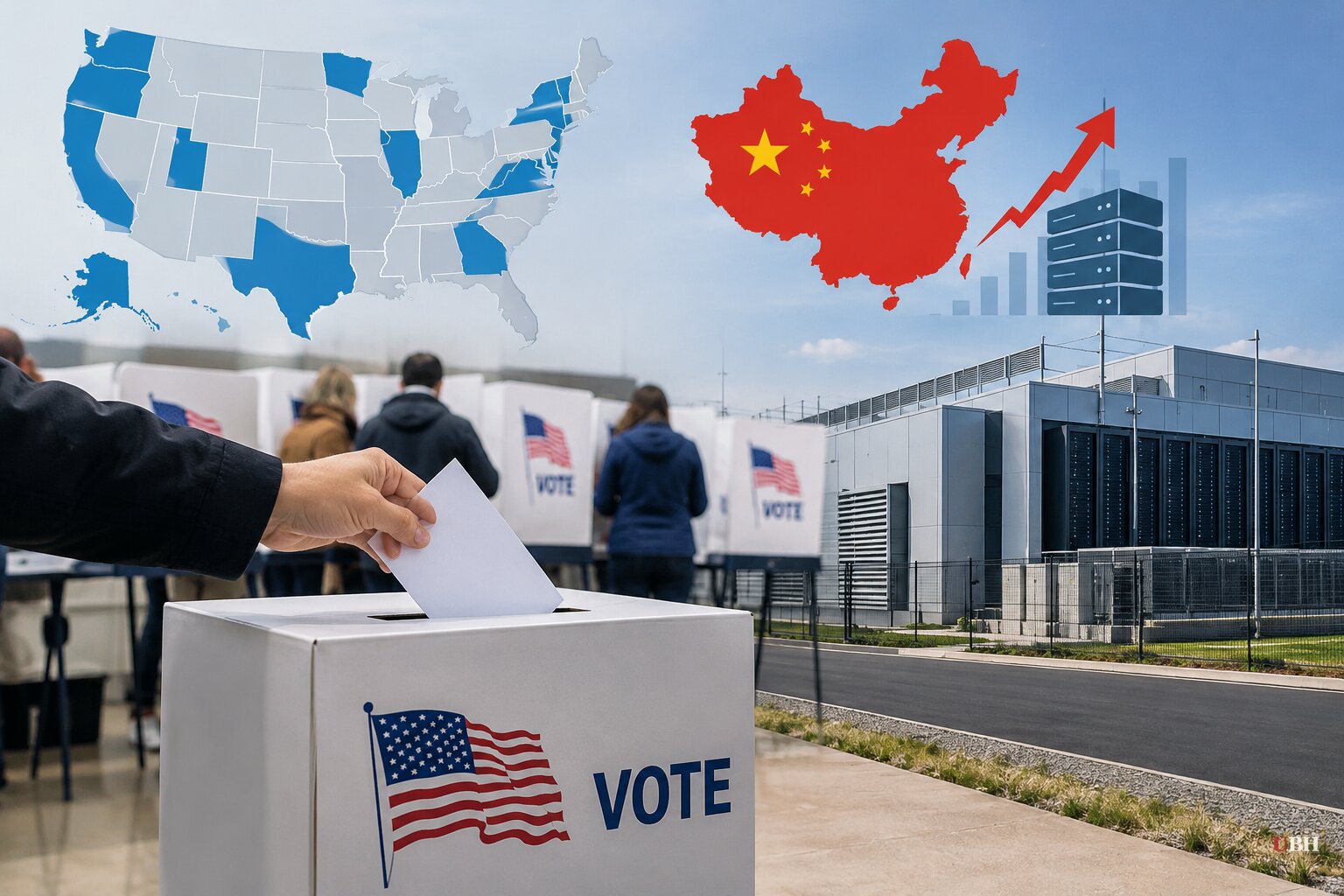
The AI buildout hit a wall at the ballot box last week. Voters in 38 jurisdictions across 10 states decided 41 data center-related proposals in the midterms, and the results generally favored restrictions, according to a count by China's 21st Century Business Herald.
Ohio led the way with 21 restrictive measures across 18 jurisdictions. Illinois had 7, Maine 4 and Kansas 3. California, Florida, Nevada, New Jersey, North Dakota and Wisconsin each had one.
Ohio is a fair test case. It ranks fourth nationally in data center inventory, and the number of data centers in central Ohio grew 1,800% from 2020 to 2025, the fastest pace in the country.
The China argument didn't sell
The industry's favorite pitch has been simple: build more here or lose the AI race to Beijing. Analysts say voters weren't persuaded.
"The argument that we need to build more data centres to win in AI against China no longer seems to have the kind of resonance it did before, if it ever did, frankly," said Kyle Chan, a fellow at the Brookings Institution's John L. Thornton China Centre.
Lizzi Lee of the Asia Society Policy Institute said invoking China as a justification for tech and industrial investment "is becoming less effective."
The local complaints are concrete: electricity bills, water use and the effect of warehouse-sized facilities on neighborhoods. Local governments often offered tax breaks and told residents the projects were harmless and would bring jobs.
Washington's awkward timing
Congress is back this week with a bipartisan bill that would speed approvals for energy projects while requiring large data centers to bear more of the costs they impose on the power grid. The Senate is preparing a procedural vote.
The bill creates a problem for Democrats, who now hold majorities in both chambers according to post-election market coverage. Some of them believe its provisions could encourage more data center construction, Reuters has reported. Many campaigned on restricting that construction.
The cost-sharing piece is the part ratepayers asked for. The approval-speedup piece is the part that could cut the other way.
The money doesn't slow down
The collision with Big Tech's spending is stark. In the third quarter of 2026, Microsoft, Alphabet, Amazon and Meta together spent $201.9 billion in cash on property and equipment. Their full-year capital expenditure guidance totals more than $700 billion, and they have issued debt in advance to lock in financing costs.
Morgan Stanley estimates a net U.S. data center power shortfall of about 38 gigawatts by 2028. Equipment delivery and grid-connection timelines are also getting longer.
What China is doing
China is building aggressively. As of June 2026 it had 15.56 million standard data center racks in operation. Its intelligent computing capacity reached 2,185 EFLOPS, up 177% from a year earlier, making it the world's second-largest market by that measure.
In the first seven months of 2026, at least 158 data center and intelligent computing projects each recorded winning bids above 100 million yuan ($15 million). Their combined value topped 113 billion yuan ($17 billion). Hubs in Inner Mongolia, Ningxia, Gansu and Guangdong are leading the push.
Industry figures cited in market coverage put China's delivery cycles at about 12 months and per-gigawatt construction costs more than 30% below U.S. levels. The Horinger cluster in Inner Mongolia runs on green power at a rate above 85%. Those are industry claims, not audited numbers.
The headline investment figure comes with a catch. Intelligent computing infrastructure investment in the first three quarters of 2026 reached 728.8 billion yuan ($109.2 billion). Only 13.6% of those projects had entered operation. Another 71.6% were still in planning and preparation.
Much of that money is committed to capacity that doesn't exist yet. Industry watchers expect a delivery wave as 2027 approaches.
Speculation about building in China
Some investment circles are floating a stranger idea: that North American tech companies could build or lease AI compute in China to hedge against delays at home, BigGo Finance reported. Even the people promoting the idea acknowledge obstacles in cross-border data compliance and low-latency communications engineering.
That is market conjecture, not an announced plan. It would also run straight into the national-security concerns that have defined U.S. policy toward Chinese technology.
What to watch
The Senate vote will show whether Democrats who ran against data centers will back a bill that others in their own party fear will produce more of them. The tension is built into the legislation.
On the other side of the Pacific, the open question is how much of China's 71.6% planning-stage pipeline turns into working capacity in 2027. That will show whether Beijing's speed advantage is real or mostly a matter of announcements.
Sources used for this briefing
7 links from 6 independent newsrooms (syndicated copies of the same report count once)
These are the sources it draws on, linked so you can verify.


