
Unbiased headlines. Facts, not spin.
Unbiased Headlines is an independently owned news organization. We bring you the facts, not opinions, written fresh from 110+ named sources. Sources linked so you can verify it yourself.
 tech
Notable (5/10)
DARPA Funds $1.83 Million Michigan-Led Project to Measure and Cut AI Energy Use
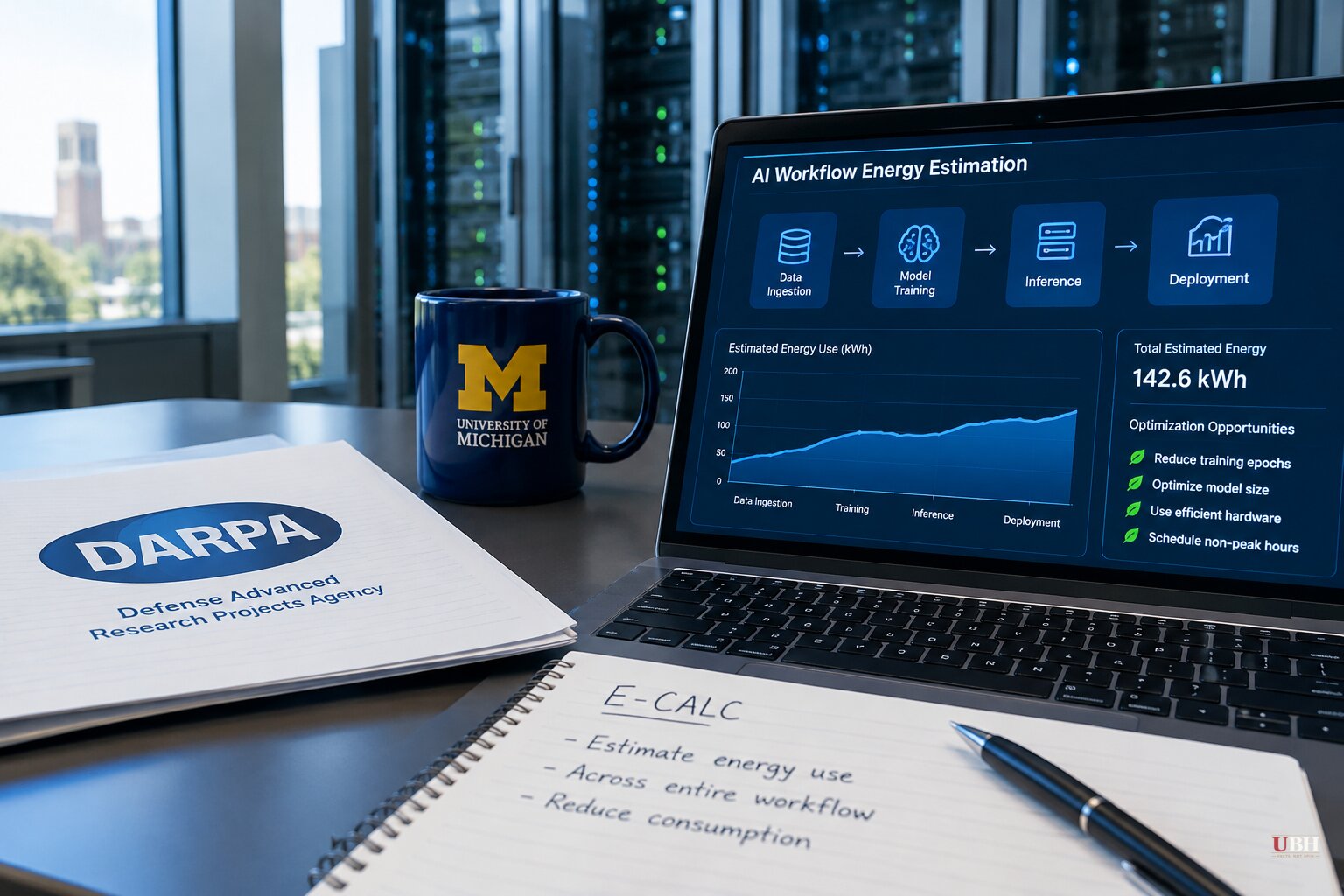
The Pentagon's research arm is putting money behind a problem the AI industry talks about mostly in terms of supply: how much electricity these systems burn, and whether anyone can measure it properly.
The Defense Advanced Research Projects Agency has awarded $1.83 million for a two-year project led by University of Michigan Engineering. It is called E-CALC, short for Energy Calculus for ML Lifecycle Optimization. Partners are the University of Illinois Urbana-Champaign and defense contractor BAE Systems.
What E-CALC is supposed to do
The team plans to build a mathematical framework, the "energy calculus," that lets developers estimate power use across the whole AI lifecycle: data processing, model training and real-world deployment. The point is to estimate before expensive hardware is switched on.
Today, finding an energy-efficient setup mostly means trial and error across thousands of hardware and software combinations. That is slow and costly, according to the researchers.
Over the two years, the team will build high-precision measurement tools that combine physical sensors with software analysis. The researchers intend to release them as open-source software and documentation.
Mosharaf Chowdhury, an associate professor of computer science and engineering at Michigan, is the principal investigator. He also leads two existing projects the work builds on. Zeus automatically tunes settings such as batch size and power limits during model training to minimize energy use. ML.ENERGY is a public leaderboard comparing the energy cost of running different open-weight models and open-source frameworks.
The numbers behind the push
Data centers consumed about 420 terawatt-hours of electricity in 2024. That figure is expected to more than double by 2030, with much of the growth tied to AI. One account of the projection puts the 2030 level above 840 TWh.
The Michigan researchers say mismatches between software and the chips it runs on can waste up to 30% of the electricity used during AI model training alone. They say more efficient software design could cut AI energy use by up to half.
Chowdhury said AI is becoming part of everyday life, business, science and national security, and that unchecked growth in its power demand could raise costs, strain power infrastructure and make advanced AI harder to deploy.
Why the Pentagon cares
The defense angle is practical. Drones, field equipment and remote computing systems cannot plug into a hyperscale data center. They run AI under hard power and battery limits, and every watt spent on computation is a watt not spent on endurance.
BAE Systems' role fits that picture. Michigan Engineering also says more energy-efficient AI would lower electricity demand, cut the cost of running AI and extend battery life in AI-enabled devices.
A second DARPA award, same problem
Stony Brook University received $1 million from DARPA on October 20, 2026, under the agency's Mapping Machine Learning to Physics (ML2P) program. Its two-year project is titled "Optimizing Machine Learning Models Using Accurate Energy Prediction." Ohio State University is a partner.
Aruna Balasubramanian is the principal investigator, with Niranjan Balasubramanian and Anshul Gandhi as co-PIs. Xiaorui Wang is the principal investigator at Ohio State.
The team's approach breaks a model into its basic components and represents its execution as a structured graph showing how each piece consumes energy. "Many existing approaches that predict energy are too coarse-grained," Aruna Balasubramanian said. "They are very helpful for getting a broad estimate, but they are not precise enough when you need to decide things like which model to deploy or which hardware to run it on."
The program expects its open-sourced outputs to enable energy-aware edge applications, including in defense industrial domains. The Stony Brook tools are meant to show tradeoffs between energy use and performance on constrained hardware such as drones.
The argument that AI will pay for itself
Not everyone treats the power draw as a problem to be engineered down. Proponents of AI argue it will eventually save more energy than it consumes by making processes across the economy more efficient. The Financial Times made that case last year, writing that finding new materials, catalysts or processes that produce goods more efficiently is the sort of "needle in a haystack" problem AI is ideally suited to.
The energy-sector commentary that prompted renewed attention to the DARPA awards takes the opposite view. It points to a buildout of natural gas plants driven by data center demand and says the industry's resource use is poorly measured. Researchers, it says, do not know precisely how much energy AI is using now.
That measurement gap is exactly what E-CALC targets.
Small money, open questions
The two awards total $2.83 million. That is a rounding error next to what is being spent on data center construction. Taxpayers are funding a measuring stick, not a power plant, and DARPA has a record of seeding foundational work that later spreads into commercial use.
But the 50% figure is a goal. E-CALC is a plan, not a finished product, and academic frameworks often struggle once they meet messy production systems running on mixed hardware.
The next marker is the end of the two-year contracts, when the Michigan and Stony Brook teams are expected to deliver their open-source tools. Whether energy estimates made on paper match what real chips draw from the wall will decide whether anything here changes how AI gets built.
Sources used for this briefing
7 links from 6 independent newsrooms (syndicated copies of the same report count once)
These are the sources it draws on, linked so you can verify.


