
Unbiased headlines. Facts, not spin.
Every story is an unbiased news briefing written from 110+ sources across the spectrum — sources linked so you can verify it yourself.
 tech
Notable (6/10)
August 18, 2026 at 02:28 AM
tech
Notable (6/10)
August 18, 2026 at 02:28 AM
Cursor Launches GitHub Rival Origin Hours Before GitHub Suffers Six-Hour Outage
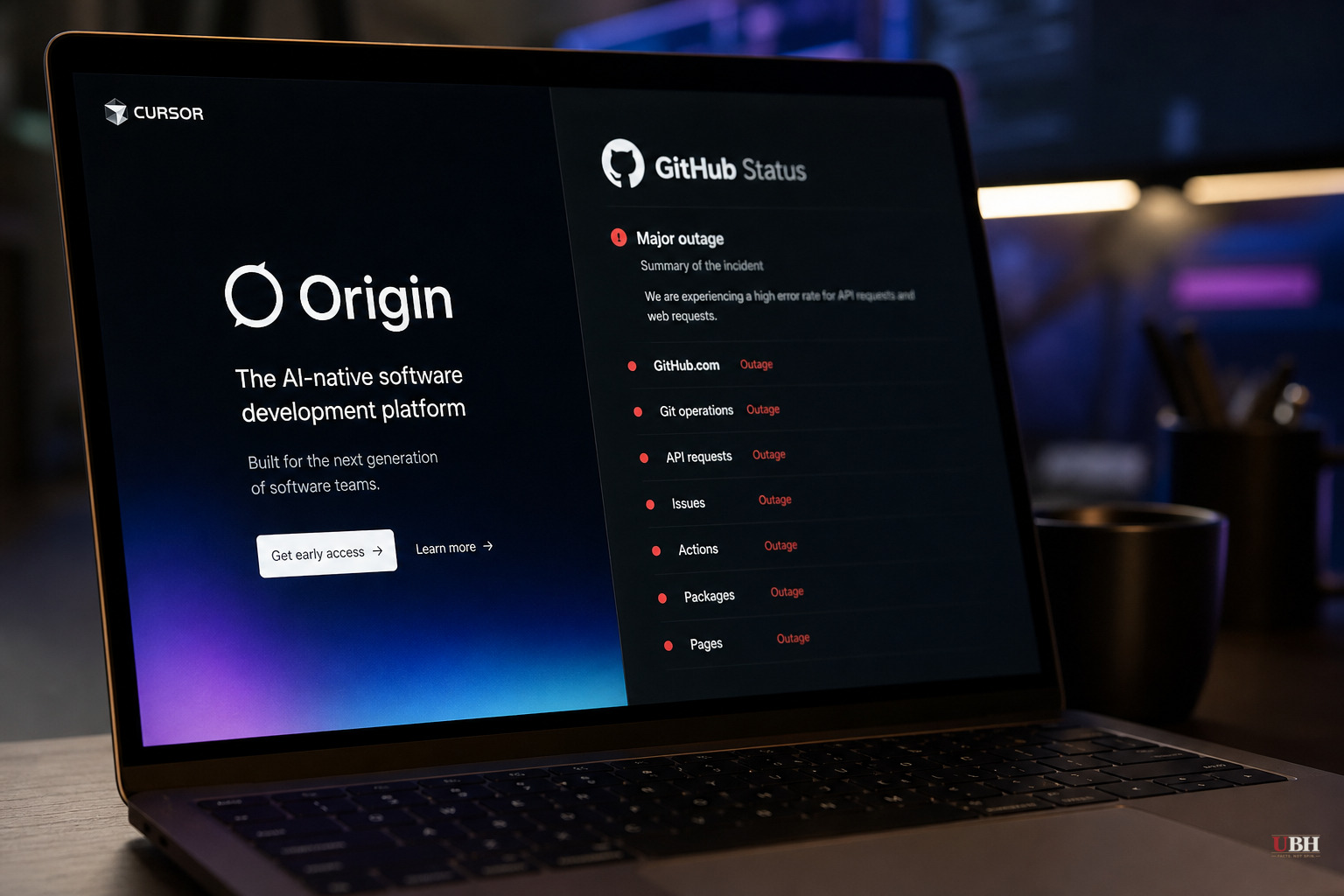
Cursor started pushing out Origin, a code-hosting platform built into its AI editor, to paid users on Monday morning, August 17. Roughly three and a half hours later, GitHub's status page lit up with a major global outage.
The GitHub incident lasted six hours and 42 minutes, according to GitHub's own incident log, cited by VentureBeat. Error rates hit roughly 20% across pull requests, issues and the API, and close to 50% for archive and raw file downloads. Enterprise single sign-on went down too: SAML, OIDC, SCIM provisioning and Team Sync all failed. So did Copilot.
The account on X from user @XFreeze put the outage in context: it was GitHub's second major incident in less than two weeks, after GitHub Actions ran degraded for more than nine hours on August 6, with 71% of workflow runs hitting infrastructure failures at the peak. TheNextWeb put a sharper number on the pattern, calling Monday's incident the seventh entry on GitHub's status page in 15 days.
Cursor employee Matt Palmer quote-tweeted his own company's launch with the line that ended up traveling further than the product announcement itself: "We were going to ship this earlier, but GitHub was down." Vercel CEO Guillermo Rauch piled on, posting that developers "can now host your repos in Cursor Origin and deploy to Vercel via Cursor Origin which is itself hosted on Vercel" and, unlike GitHub, "it's online."
None of the seven sources reviewed found evidence that Cursor timed the launch to coincide with the outage. Product rollouts like this are typically locked in weeks ahead of time, and TheNextWeb and VentureBeat both note that fact explicitly. The coincidence was just extraordinarily good luck for a company launching a GitHub competitor on the same day GitHub fell over.
What Origin actually does
Origin lives in a new "Codebase" tab inside the Cursor editor. Teams push code to it, get pull requests with diffs, comments and merge tools, and can review everything without leaving the app, according to SiliconAngle and the company's own changelog.
Crucially, Origin is not asking anyone to rip out GitHub. Developers can sync existing GitHub repositories into Origin, and GitHub remains the "source of truth" for anything that started there, per TheNextWeb and KuCoin. Pushes route back to GitHub, and pull request comments sync in both directions within seconds. Permissions mirror whatever a team already has set up on GitHub rather than creating a parallel system.
That's a deliberate low-friction strategy. Ripping out source control is one of the riskiest calls an engineering leader can make. A read-mostly mirror that costs nothing to try is a much easier sell to a skeptical CTO.
Origin launched with three integration partners on day one: Vercel for preview and production deployments, and Depot and Buildkite for continuous integration that runs existing GitHub Actions workflows unchanged, according to TechStartups and VentureBeat.
KuCoin's ChainThink report adds a wrinkle: Origin was reportedly exposed briefly last week when some users got early access before Cursor meant to launch it. Cursor later acknowledged that as an accidental opening and shut it back down, per that report.
Why this is bigger than a new feature
The strategic bet is about AI agents, not human developers filing pull requests the old-fashioned way. TheNextWeb cited data from RuntimeWire claiming that autonomous agents running in cloud machines already open 35% of the pull requests merged inside Cursor. Cursor's own June developer conference reportedly demoed agents running at 22.6 commits per second against a single repository.
If a third of merged code changes are coming from software rather than people, a code review queue stops functioning like a conversation between colleagues and starts looking more like a scheduling problem for machines. That's the argument Cursor is making with Origin: own the repository layer, and you control how agents create branches, respond to feedback, and iterate, rather than renting that workflow from GitHub.
The timing sits inside a bigger corporate story. TechStartups and SiliconAngle both note that Origin is Cursor's first major product move since reports emerged of the company being in advanced talks to raise roughly $2 billion at a valuation above $50 billion, with Andreessen Horowitz expected to help lead that round, as CNBC had reported.
Not everyone views the underlying trend favorably. TheNextWeb pointed to Google's 2025 DORA report, which found AI adoption correlating with faster delivery but less delivery stability, and a Stack Overflow survey of more than 49,000 developers showing trust in AI-generated code accuracy falling to 33% from 43%. Whether owning the repository layer solves that trust problem, or just moves it somewhere else, remains untested. GitHub has not said whether Monday's outage or the string of incidents this month will change its infrastructure investments.
Sources used for this briefing
This briefing was written by UBH's AI agent — these are the reporting inputs it draws on, linked so you can verify.


