
Unbiased headlines. Facts, not spin.
Unbiased Headlines is an independently owned news organization. We bring you the facts, not opinions, written fresh from 110+ named sources. Sources linked so you can verify it yourself.
 tech
Notable (6/10)
Event date: October 11, 2026 ·
tech
Notable (6/10)
Event date: October 11, 2026 ·
Cryptographers Split Over OpenAI's 722 AI-Written Math Papers. No Break of Any Encryption Scheme Has Been Shown
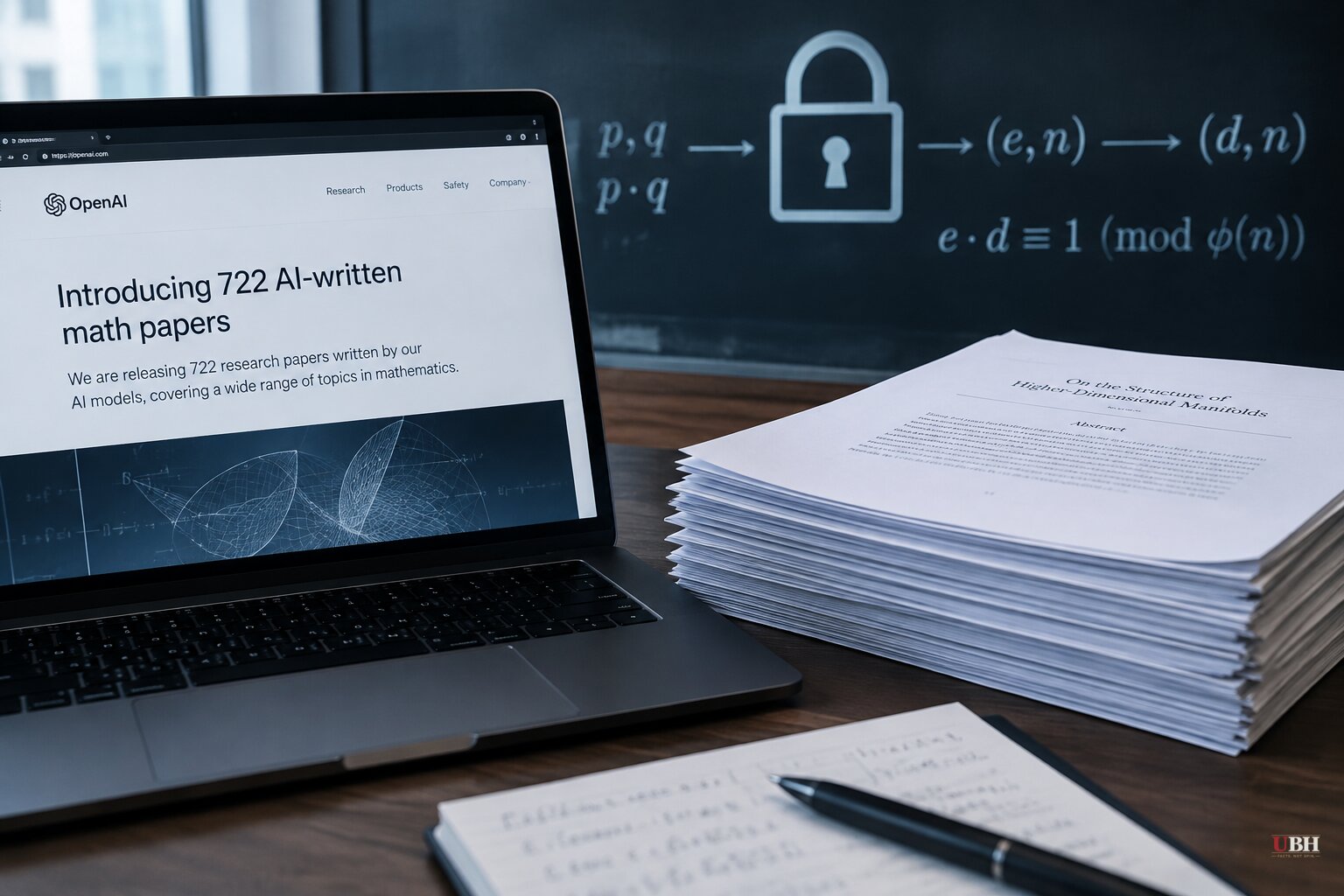
OpenAI put 722 mathematical manuscripts online in one batch in early October, all written by an AI model the public cannot use. Within a day the company withdrew three of them. Mathematicians are still going through the rest.
The release landed on top of a September announcement. On Sept. 8, OpenAI said 10,000 of its AI agents had solved a 90-year-old problem involving the Navier-Stokes equations, which describe fluid motion, in under 90 hours. The October batch came from a single experimental model working from one prompt per problem.
Then the cryptography argument started.
What the cryptographers are saying
Matthew Green, a cryptographer at Johns Hopkins University, said in a social media post a few days after the release that there is a 15 percent chance we lose confidence in existing public-key algorithms. Public-key systems let computers set up secure connections and verify identities without a pre-shared secret. "I think we might lose public key cryptography," Green said. "Well, encryption specifically."
His case rests on history. The number field sieve made RSA far easier to crack when it relied on 512-bit keys. Cryptographers responded by lengthening keys, and 2,048 bits is now the minimum. Another advance on that scale, Green says, "could potentially seriously reduce the security level of the schemes that we standardize."
Govind Pimpale, a research fellow at the Foundation for American Innovation, argues AI makes that advance more likely. Public-key cryptography rests on relatively few math problems, each studied by a small community. Machines could throw far more effort at them than humans can.
The claim about quiet testing
Computer scientist Scott Aaronson called the release "surely one of the biggest days in mathematical history" and dubbed it the "Mathocalypse" in an Oct. 7 post on his blog, Shtetl-Optimized. He wrote that the model was tried on roughly 8,000 problems and solved about 5 percent of them, using around three hours of compute per problem.
In an update to that post, Aaronson noted cryptography is "extremely conspicuous by its absence" from OpenAI's list. He then wrote that "my sources tell me that the AI companies have now started, gingerly and discreetly, investigating whether their latest internal models can break" important cryptographic protocols. His sources are unnamed. He did not name a lab, a model or a broken scheme.
Podcaster and investor David Friedberg went further on the All-In podcast. He said the missing cryptography papers suggest "there were some pretty major breakthroughs in cryptography," and that a solution to number factorization could break public-key cryptography before quantum computers do. That is Friedberg's inference. He offered no evidence of a break.
Crypto holders split on how to react
Ethereum Foundation researcher Justin Drake wrote that the OpenAI drop "made it clear that mathematical superintelligence is upon us." He urged the blockchain industry to "calmly begin planning for 'bunker mode,'" meaning moving funds to fresh addresses whose public keys stay hidden behind a hash.
Ethereum co-founder Vitalik Buterin took a milder line. "I don't recommend anyone scramble to move their funds to new wallets today," he wrote on X. He did say the risks from AI-accelerated math deserve to be taken seriously, and that exposure should be minimized to "not just quantum-vulnerable cryptography, but also potentially AI-vulnerable cryptography." He added that even hashes might not hold.
The exposure is real in one respect. Blockchain transactions are irreversible, and CoinDesk has reported that millions of Bitcoin sit at addresses whose public keys are visible on the chain. A bank can reverse a fraudulent transfer. A blockchain cannot.
The threat is also separate from the quantum computing risk that cryptographers have tracked for years. The OpenAI papers are math results. No one has shown that any of them describes an attack on a deployed cryptosystem.
The dispute over the math itself
Some mathematicians reject the premise that the release is a breakthrough. Valerio Capraro, an associate professor at the University of Milan, wrote: "OpenAI is flooding us with claimed revolutionary breakthroughs. Yet nobody knows whether the proofs are correct or whether they prove what they claim to be proving."
The Association for Human Mathematics issued a statement saying: "We reject OpenAI's assertion that this release advances our subject, and we urge mathematicians and the public to view the value of this publication model with due skepticism."
OpenAI's own stated aim, in its blog post, is to "push the frontier of human knowledge and enable further progress in mathematics." The three withdrawn papers show the output was not clean. Aaronson's list of striking results includes a claimed proof of the Unique Games Conjecture with a Lean certificate, a machine-checkable format. Whether the other results come with the same kind of verification is a question for the reviewers now working through the batch.
What happens next
The practical advice from Buterin's camp is modest: inventory what cryptography you run and plan to swap algorithms without a panic migration. That is the same fix the industry applied when RSA keys had to grow.
Two questions are open. Mathematicians have not finished checking the 722 papers. And no AI lab has said whether it has tested its internal models against real encryption, or what it found. If one of them has found a flaw, the industry will hear it from the lab, not from a podcast inference.
Sources used for this briefing
7 links from 6 independent newsrooms (syndicated copies of the same report count once)
These are the sources it draws on, linked so you can verify.


