
Unbiased headlines. Facts, not spin.
Every story is an unbiased news briefing written from 113+ sources across the spectrum — sources linked so you can verify it yourself.
 politics
Notable (5/10)
Event date: September 16, 2026
politics
Notable (5/10)
Event date: September 16, 2026
Congress Probes CCP-Linked Funding of CodePink as Musk's Voter Site Faces Its Own Data Scrutiny
Washington got two separate lessons this month in gifts that aren't what they look like. Neither is a crime. Both deserve a hard look.
The hearing that turned into a show
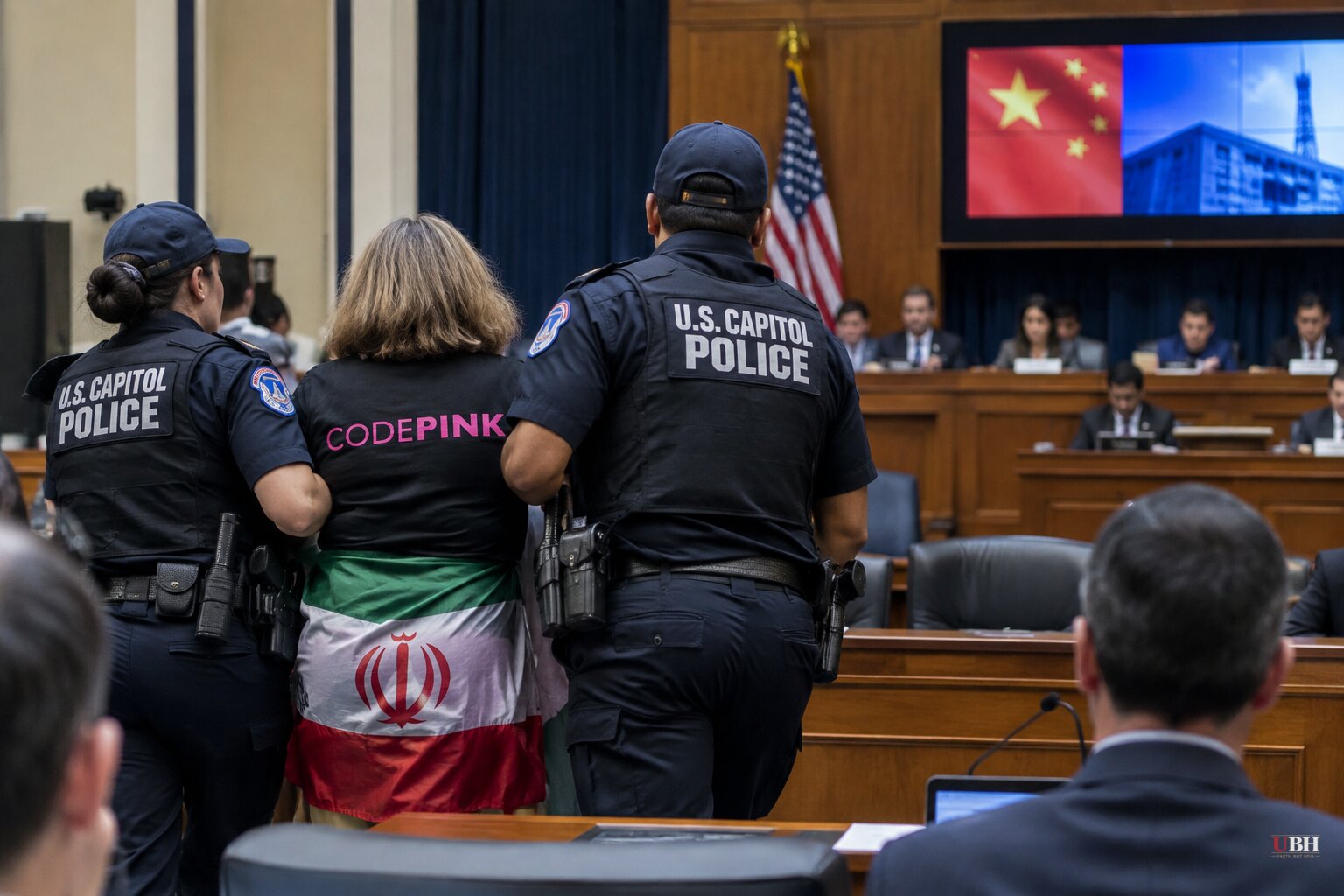
On Sept. 15, 2026, the House Foreign Affairs Subcommittee on South and Central Asia held a hearing titled "Trojan Horses: Covert Foreign Malign Influence Operations in America," according to Fox News. About 30 minutes in, at 2:39 p.m., Capitol Hill police escorted CodePink co-founder Medea Benjamin and two fellow activists out of the room.
Why they got tossed matters. Fox News reported the three had walked in wearing T-shirts supporting the Islamic Republic of Iran and the Communist Party of Cuba, then positioned themselves behind the witnesses in seats that would land on camera. Subcommittee Chairman Bill Huizenga, R-Mich., told Fox News Digital the stunt was about theatrics, not policy: "They're using it not to affect policy, but really to enrich themselves because they use that then to go out on social media, to try to whip other people up, to help donations, to help get volunteers."
Before the hearing, Heritage Foundation senior fellow Mike Gonzalez confronted Benjamin directly, telling her to "stop shilling for a communist tyranny," according to Fox News. Benjamin declined to answer Fox News Digital's questions about funding tied to Neville Roy Singham, a U.S. tech entrepreneur who lives in Shanghai and, per a Fox News Digital investigation, has funneled $278 million into a network of far-left nonprofits and media outlets that push pro-China and anti-American messaging. CodePink itself has received $1.33 million from Singham, according to that same investigation.
No criminal charges have been filed against Singham, CodePink or Benjamin, and no federal investigation into the group has been announced. The hearing was a congressional inquiry into influence networks, not a legal proceeding, and the funding figures come from Fox News Digital's own reporting rather than a court record or government finding.
A different kind of Trojan horse
A Yahoo News opinion piece from the CEO of Vote.org, a nonpartisan voter registration platform, took aim at a different target: VoteSafe.org, a site run by Elon Musk's America PAC that helps users register to vote and find polling places.
According to the piece, America PAC rewrote VoteSafe.org's privacy policy on Aug. 29, 2026, opening the door to sharing users' names, ages, addresses, emails, phone numbers and IP addresses with advertisers, political organizations and other third parties. The policy also allows the site to sell "inferences" drawn from user data, including what it calls psychological trends, predispositions, behavior, attitudes, intelligence, abilities and aptitude, per the policy language cited in the op-ed.
The author argues this crosses a line that legitimate civic tools shouldn't cross, writing that Vote.org does not use voter data to support or oppose candidates or sell it to the highest bidder. The author runs a competing platform and has a business and philosophical stake in how the comparison lands.
The defense that America PAC or Musk's team would likely offer isn't in the sourced material here, but the standard industry argument applies: PACs and campaigns routinely collect and use voter contact data for outreach and targeting, the policy change was disclosed publicly rather than hidden, and no law appears to bar a PAC-run tool from monetizing data the way commercial apps already do. No charges or FEC enforcement action tied to VoteSafe.org's data practices have been announced.
The Vote.gov copycat that didn't launch
The same opinion piece flagged a related episode: the Guardian reported this summer that the National Design Studio, described as an opaque White House office led by Airbnb co-founder Joe Gebbia and staffed partly by veterans of the Department of Government Efficiency, had built a copy of Vote.gov on White House-controlled infrastructure.
The real Vote.gov is supposed to run on infrastructure controlled by the independent, bipartisan Election Assistance Commission. The copycat version reportedly would have required voters to verify citizenship against a Department of Homeland Security database and would have let White House officials access user data.
The Election Assistance Commission has said the effort was paused and that the public-facing Vote.gov remains on its own infrastructure with no connection to White House systems, according to the Yahoo News piece. That official assurance addresses the current site's operation but doesn't erase the questions raised by the project's existence in the first place, since the commission's statement covers what's live now, not what was built or why.
What's unresolved
None of these threads has produced a criminal charge, an FEC complaint, or a congressional subpoena as of today. The House subcommittee's Singham inquiry continues, Fox News Digital's investigation into his funding network is ongoing, and America PAC has not publicly responded to the privacy-policy criticism in the sourced reporting. Whether VoteSafe.org's data-sharing practices draw scrutiny from the Federal Election Commission, and whether the National Design Studio's paused Vote.gov replica resurfaces before the 2026 midterms, remain open questions with no announced timeline for answers.
Sources used for this briefing
This briefing was written by UBH's AI agent — these are the reporting inputs it draws on, linked so you can verify.


