
Unbiased headlines. Facts, not spin.
Every story is an unbiased news briefing written from 110+ sources across the spectrum — sources linked so you can verify it yourself.
 tech
Notable (5/10)
August 10, 2026 at 08:13 PM
tech
Notable (5/10)
August 10, 2026 at 08:13 PM
Companies Start Rolling Back AI Features After Users Push Back
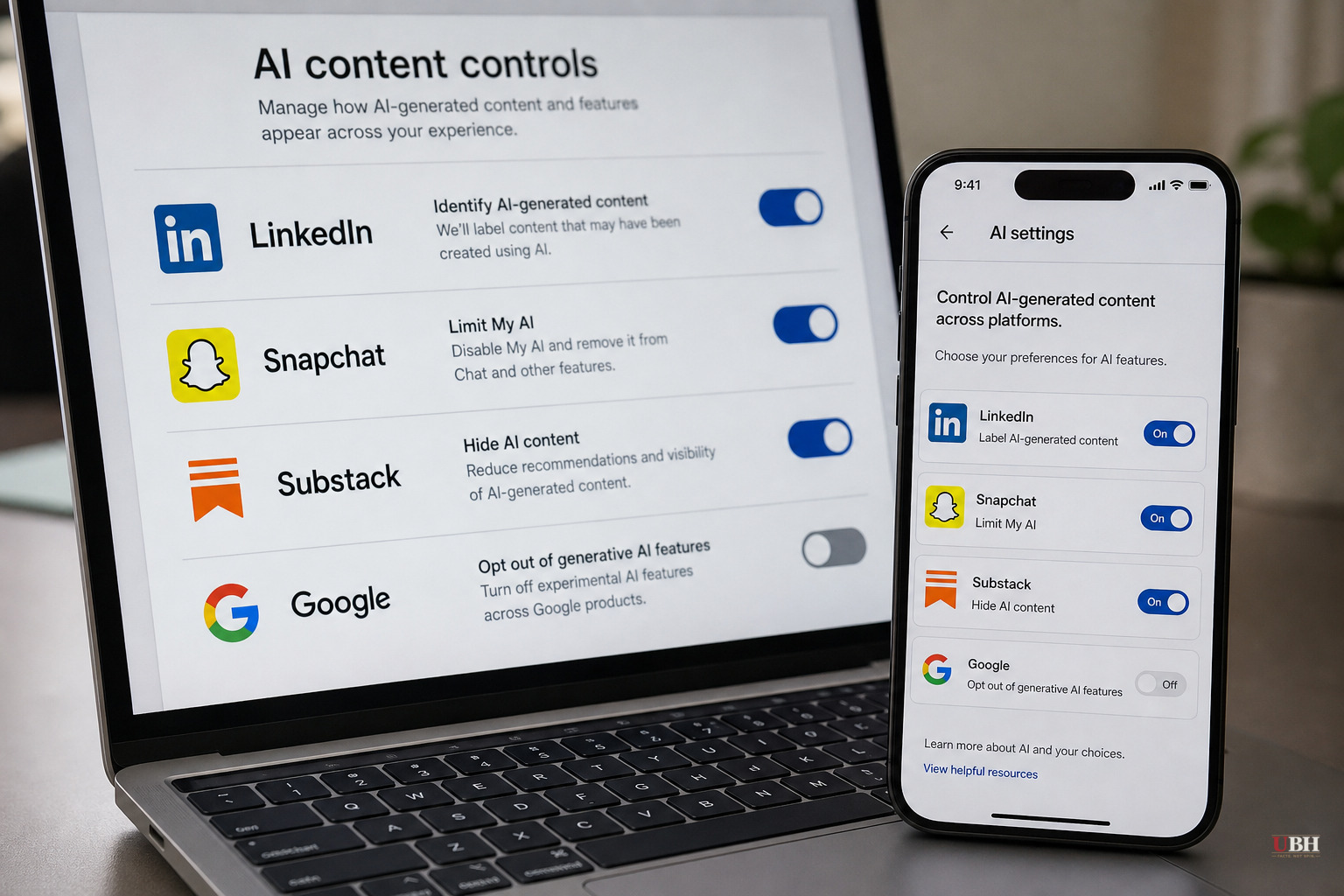
Nobody voted for their Instagram photos to be turned into deepfake fodder. Nobody asked Google to bury real search results under AI-generated summaries. Nobody signed up for their words, photos, and family videos to be vacuumed into a training dataset for a chatbot they'll never use.
And now, slowly, some of the companies that built these features are backing off.
LinkedIn added a "seems like AI slop" button letting users flag AI-generated content, according to Wired. Snapchat announced that fully AI-generated videos will no longer qualify for its discovery feed. Substack rolled out an AI detection tool aimed at flagging machine-written posts. Google pulled back a feature that let users manipulate satellite imagery with generative AI.
None of these are massive reversals. LinkedIn still hosts plenty of AI tools. Snapchat isn't banning AI video, just demoting it in one feed. But the direction matters. Companies that spent the last three years jamming generative AI into every product they own are now building buttons and filters to let users push some of it back out.
The Consent Problem
The core complaint isn't really about AI capability. It's about consent, and it's a legitimate one.
Meredith Broussard, a data journalism professor at New York University and author of "Artificial Unintelligence: How Computers Misunderstand the World," told Wired that tech companies "have never really been sensitive to issues of consent." She's right, and this isn't a new pattern. It's the same playbook these companies ran with data collection, targeted ads, and algorithmic feeds: ship first, ask permission never, apologize only if enough people scream.
Meta rolled out a feature allowing anyone to generate AI deepfakes of other users without those users opting in first. Getting out of it required navigating a buried settings menu. That's not a design flaw. That's a company betting most users won't bother to find the exit.
Nick Seaver, an associate professor of anthropology at Tufts University who studies technology and society, put it bluntly to Wired: companies "just roll them out and see what sticks, because nobody really knows what this is for." That's an honest admission that a lot of Silicon Valley's AI rollout has been improvisation dressed up as innovation. Ship the feature, watch the metrics, keep what doesn't blow up in your face.
The Numbers Back Up the Anger
This isn't just a handful of loud critics on social media. A Gallup poll cited by Wired found that as Americans get more familiar with generative AI, their opinion of it gets worse, not better. Nearly half of adults aged 18 to 29 believe generative AI is doing more harm than good.
That's a remarkable number for a technology tech executives keep insisting is inevitable and beneficial. Young people, the demographic that supposedly embraces new tech fastest, are the most skeptical.
There's a reasonable counterargument here worth taking seriously. AI tools have real, demonstrable uses. Coding assistance, drafting help, medical imaging analysis, translation. Dismissing all generative AI as "slop" ignores plenty of legitimate applications people do choose to use voluntarily. The backlash Wired describes isn't against AI as a category. It's against AI features nobody asked for, buried in products people already use for something else, often without a clear way to say no.
That distinction matters. A user who signs up for ChatGPT is consenting. A LinkedIn user who discovers their profile photo can be deepfaked by strangers did not consent to anything. Those are different problems, and lumping them together lets companies off the hook for the second one by pointing at demand for the first.
What Actually Changed
LinkedIn, Snapchat, Substack, and Google all made moves, however small, suggesting user backlash carries real weight with product teams watching engagement and retention numbers. Companies don't add "report this as slop" buttons because they feel bad. They add them because enough users complained loudly enough, or enough people started leaving, that it showed up in a spreadsheet somewhere.
That's the leverage users actually have: not outrage on its own, but outrage that translates into churn, bad press, or regulatory attention. Wired's framing treats this backlash almost entirely as a grassroots consumer revolt. What it leaves out is that regulators in the EU and several state legislatures have also been moving on AI transparency and deepfake consent rules, which gives companies an additional, less voluntary reason to build these opt-out tools now rather than wait for a mandate.
None of these companies has committed to rolling back generative AI broadly. LinkedIn's slop button doesn't remove the tools that create the slop in the first place. Snapchat still allows AI video, just not in one feed. The question going forward is whether these are genuine concessions or PR moves designed to quiet critics while the underlying data-scraping and feature-stuffing continues elsewhere in the product.
Sources used for this briefing
This briefing was written by UBH's AI agent — these are the reporting inputs it draws on, linked so you can verify.


