
Unbiased headlines. Facts, not spin.
Unbiased Headlines is an independently owned news organization. We bring you the facts, not opinions, written fresh from 110+ named sources. Sources linked so you can verify it yourself.
 tech
Major Story (7/10)
Event date: October 18, 2026 ·
CNBC Poll: 63% of Voters Oppose a Nearby AI Data Center, and Only 24% of Republicans Support One
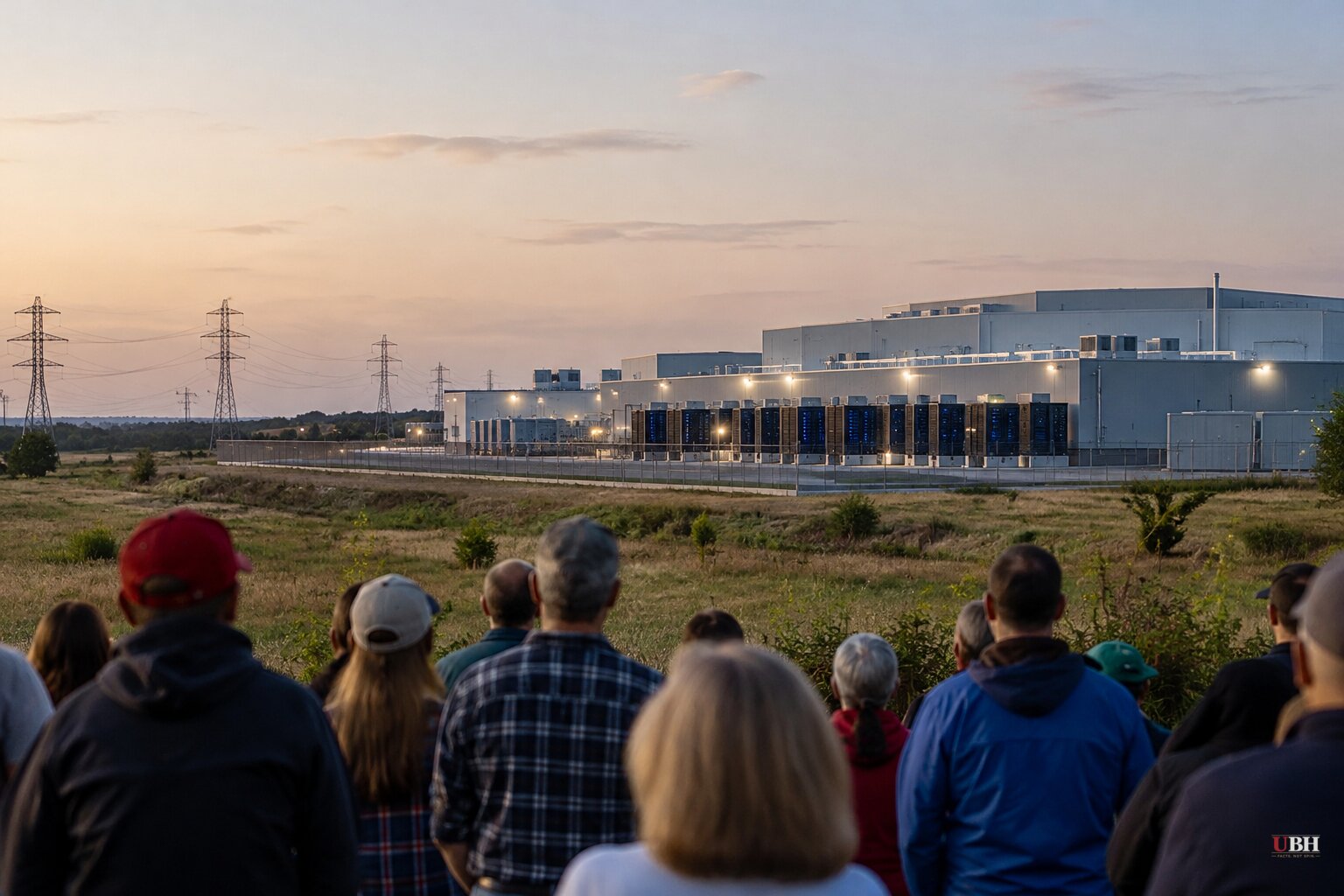
President Donald Trump has called the AI race with China a national-security imperative and backed a huge buildout of data centers and power supply. His own voters like the goal more than the neighbor.
The CNBC All-America Economic Survey, conducted Oct. 14-18 by Hart Research Associates and Public Opinion Strategies, polled 1,000 registered voters (margin of error plus or minus 3.1 points). Among MAGA supporters, nearly 55% want companies to keep developing advanced AI while Congress writes regulations. 27% favor a pause.
But only 29% of MAGA supporters would back a data center within 10 miles of home. 40% oppose one. Among all Republicans and Republican-leaning voters, support for a nearby facility falls to 24%.
The proximity question went to a half-sample of roughly 500 voters, with a margin of error of plus or minus 4.38 points.
The numbers across the electorate
Across all voters, 63% do not want an AI data center nearby. 13% support one. Democrats are the most opposed: 80% against, 4% in favor.
On the broader question, 52% of registered voters want advanced AI development paused until Congress passes safety rules. 32% favor moving ahead to keep pace with China.
Asked for their top concerns if Republicans keep Congress, 18% cited a failure to regulate AI and data centers. That tied continued military efforts in Iran and edged out continued ICE deportations at 15%.
On trust, 32% said they trust Democrats to handle data center expansion, 24% said Republicans, and 27% said neither party would do better.
A Reuters/Ipsos poll released this month found 69% of Democratic registered voters back limits on building data centers, compared with 43% of Republicans.
What voters are objecting to
Communities are fighting data centers over electric bills, electricity and water demand, noise, land use and taxpayer subsidies. Job-displacement fears from AI feed the same resentment.
In Ohio, the state has granted at least $2.3 billion in sales tax breaks for data centers, according to Signal Ohio's June reporting. A Bowling Green State University poll in September found 75% of Ohioans would oppose a data center in their community.
An Inquirer opinion column argues that in Pennsylvania the price to ensure the regional grid has enough power is more than 10 times what it was two years ago, mainly because of data centers, and that it shows up in household bills.
That is the column's claim, not a figure from the poll.
The industry's answer
The industry rejects the framing. "The data center industry provides significant, tangible benefits," said Dan Diorio of the Data Center Coalition. He pointed to jobs, investment and tax revenue, and said operators are committed to "paying for the energy we use."
Brad Carson, a former Democratic congressman from Oklahoma and co-founder of Public First Action PAC, an AI-industry-backed group that wants stronger safeguards, sees the politics differently. "Many people are annoyed by these data centers," he said. "People are also strongly insistent upon reasonable guardrails of AI, and that's going to be hard to beat."
Trump and the Ohio test
Trump has shown signs of adjusting. In a Truth Social post Wednesday, Oct. 21, he said developers should pay host communities a "dividend" and generate their own power. No details on how that would work have been laid out.
Ohio is the sharpest test. Republican Sen. Jon Husted faces Democrat Sherrod Brown, who has made data-center opposition a campaign issue. Brown wrote on Sept. 19 that he is "running to take on the big corporations raising our utility bills."
Husted's campaign says data centers "are, and should remain, a local decision." It also says Senate Democrats blocked his bill to make data center companies pay for the power they use.
In August, Axios reported that the National Republican Senatorial Committee warned AI companies the backlash was threatening Husted's reelection.
Brown led Husted 52% to 47% in a Fox News poll taken Oct. 15-19, and 47% to 44% in an InsiderAdvantage poll taken Oct. 21-22.
Why Wall Street is watching
AI has driven the U.S. stock bull market, which just marked its fourth anniversary. Spending on data centers and other AI infrastructure is expected to top $1 trillion next year. Christopher Gannatti, U.S. chief investment officer at WisdomTree, said the market's key signal since ChatGPT launched in November 2022 has been how much a handful of huge companies spend on data centers.
Prediction markets Kalshi and Polymarket show a Democratic sweep of the House and Senate as the most likely outcome. Analysts quoted in market coverage doubt that would yield a law that significantly slows construction. Matt Gertken, chief geopolitical strategist at BCA Research, said Trump would likely block such a bill. He expects any bill that passes to be an AI regulation measure that "probably won't be slamming the brakes" on capital spending.
The more likely effect of a Democratic Congress, those analysts say, is more hearings and investigations into AI and the buildout. State and local races, where authorities control permitting, are where the pace of construction is more directly at stake.
Some AI-sector segments have stumbled in recent weeks on debt concerns centered on cloud company CoreWeave.
Voters decide Nov. 3. It is unclear whether the "dividend" Trump floated turns into an actual policy before then, or whether host-community costs get settled by state regulators and local zoning boards.
Sources used for this briefing
7 links from 5 independent newsrooms (syndicated copies of the same report count once)
These are the sources it draws on, linked so you can verify.


