
Unbiased headlines. Facts, not spin.
Unbiased Headlines is an independently owned news organization. We bring you the facts, not opinions, written fresh from 110+ named sources. Sources linked so you can verify it yourself.
 finance
Major Story (7/10)
Event date: November 6, 2026 ·
Citi Cuts Global Tech to Neutral as Nasdaq Valuation Falls to March 2020 Levels
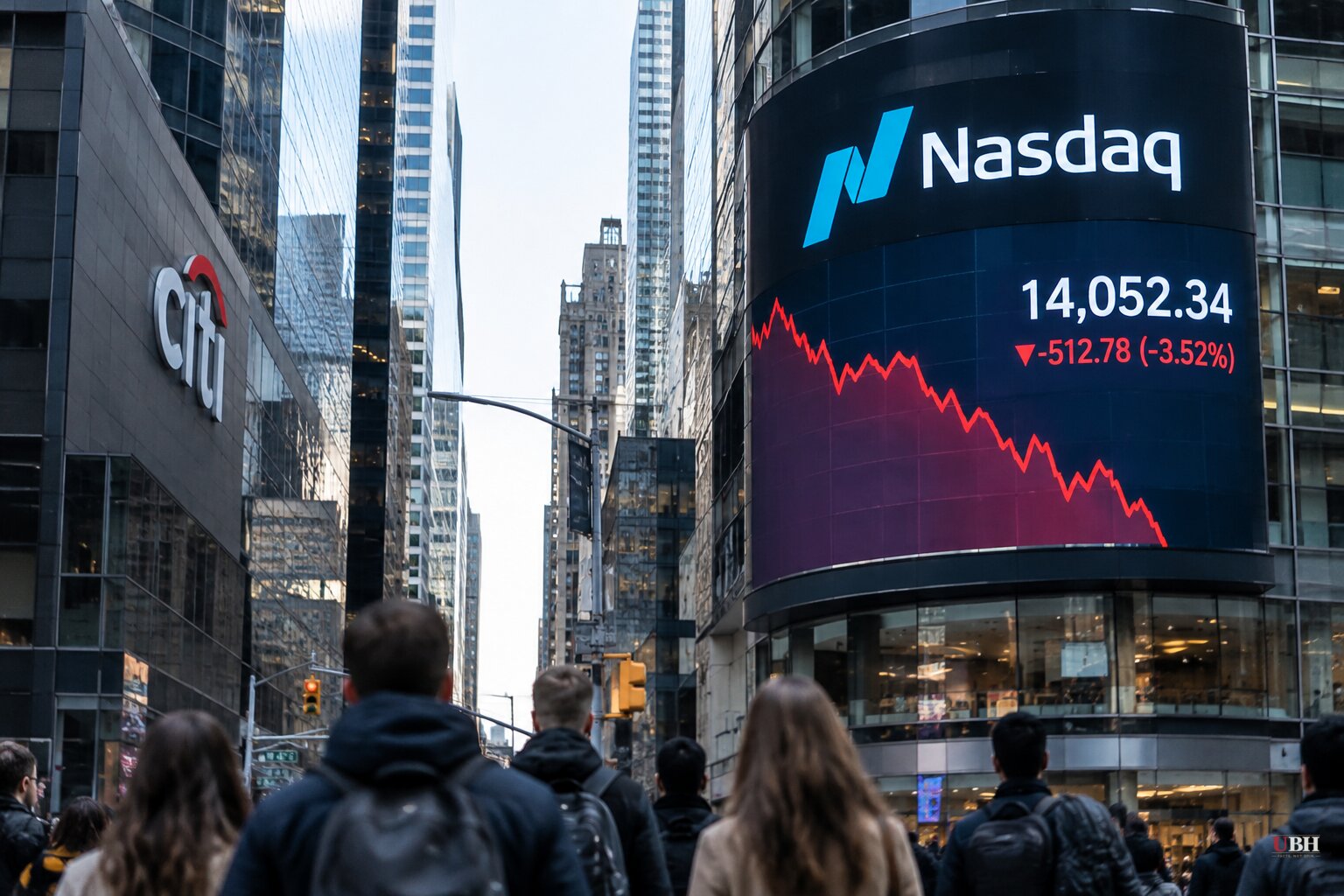
Citi's global strategy team cut technology stocks to neutral on Monday, Nov. 9, in the middle of the sharpest AI-linked slide in more than a year.
Strategists Beata Manthey, David Groman and Nikhil Jadhav downgraded tech globally, in the U.S. and in Europe. They lifted Europe ex-U.K. and healthcare to overweight.
The note says the selloff has pushed the Nasdaq 100 to a forward earnings multiple last seen in March 2020, at the height of pandemic fear.
A week of hard losses
Thursday, Nov. 5, was the damage. The Nasdaq fell 5.5%, its worst day since April 2025, when President Trump unveiled sweeping tariffs. Nvidia and SpaceX each dropped roughly 9%. Nvidia had its worst session since January 2025. ASML, Europe's largest AI-linked company, fell 6.6%.
CNN put the loss in U.S. market value at roughly $2.5 trillion.
Friday brought a partial bounce. The Nasdaq rose 1.1% and the S&P 500 gained 0.3%. The Dow fell about 0.5%. Nvidia recovered 2.8% and SpaceX 8.6%.
The S&P 500 still finished the week down about 2.7%, its worst week since April 2025.
Asia took the worst of Friday. South Korea's Kospi and Japan's Nikkei 225 each closed down 6%. Taiwan's Taiex fell 4.5%. In Europe, the Stoxx 600 lost 1%, France's CAC 40 fell 0.8% and Germany's DAX dropped 1.9%.
What drove it
The cause is disputed, and the explanations differ.
CNN reported that investors are uneasy about what the midterm results mean for AI spending. Democrats won the House and the Senate. Backlash over the environmental and community impact of data centers became a campaign issue. Many investors worry that Democratic lawmakers could block or slow new AI infrastructure, CNN said.
The stakes are large. A Columbia Business School study estimates that AI-related infrastructure investment drove nearly all observed U.S. GDP growth by the end of last year.
Citi reads it differently. In a Friday note to clients, the bank said: "the pullback ahead of the midterms was not mostly due to the election, but due to AI financing worries, and oil."
Citi still expects data centers to get built because of strong demand for computing power. It said their location, design and pace of construction may change after the Democratic gains. "This is far from ideal for the picks and shovels, including semis," the bank wrote.
Those are two different diagnoses. One points to politics and policy. The other points to how AI buildouts get paid for, and to energy prices.
Citi's positioning
The Monday note describes what Manthey calls "steady market, violent rotation." Defensive sectors have outperformed cyclicals by 15% over the past month.
Citi argues that risks to equities are now more evenly balanced. Earnings forecasts for 2027 have held steady while stocks corrected, and the drop in oil may offer support.
The bank is not calling a bottom. Its analysts said they want tech to turn "properly negative" before recommending the sector, and they want sentiment toward AI stocks to improve. They said that sentiment plunged after the midterms.
Citi's "Generals" index tracks how many of the seven largest S&P 500 stocks trade below their 200-day moving averages. It is close to triggering a cautionary signal, the Friday note said.
The bank recommends a barbell of cyclicals balanced by defensives. It prefers European equities because they carry less tech exposure. It also argues the large drop in oil should help Europe more than the U.S., and may lead to a more dovish European Central Bank.
For 2027, Citi's research finds that in years when earnings-per-share growth is positive but slowing, global stocks rise modestly, about 4% on average. Those years tend to favor quality stocks and defensives.
Iran and the calendar
Citi said the election has not clearly changed the trajectory of the Iran war. It does not see renewed escalation as imminent. A third U.S. aircraft carrier is not due in the Gulf until mid- to late November.
That gives investors a date to watch alongside the AI question.
Seasonal patterns offer a counterweight. Citi's analysis shows markets usually pull back before midterms and rally afterward, with typical November-December S&P 500 returns of 3% to 4%. Whether this year follows that pattern depends on whether the AI selloff is a pause or the start of something longer. Citi's own answer is to wait for the sector to get worse before getting back in.
Sources used for this briefing
6 links from 6 independent newsrooms (syndicated copies of the same report count once)
These are the sources it draws on, linked so you can verify.


