
Unbiased headlines. Facts, not spin.
Every story is an unbiased news briefing written from 110+ sources across the spectrum — sources linked so you can verify it yourself.
 tech
Notable (5/10)
July 18, 2026 at 02:21 PM
tech
Notable (5/10)
July 18, 2026 at 02:21 PM
Chinese Solar Maker LONGi Claims 35.5% Efficiency on Tandem Solar Cell, Verified by European Test Lab
The claim
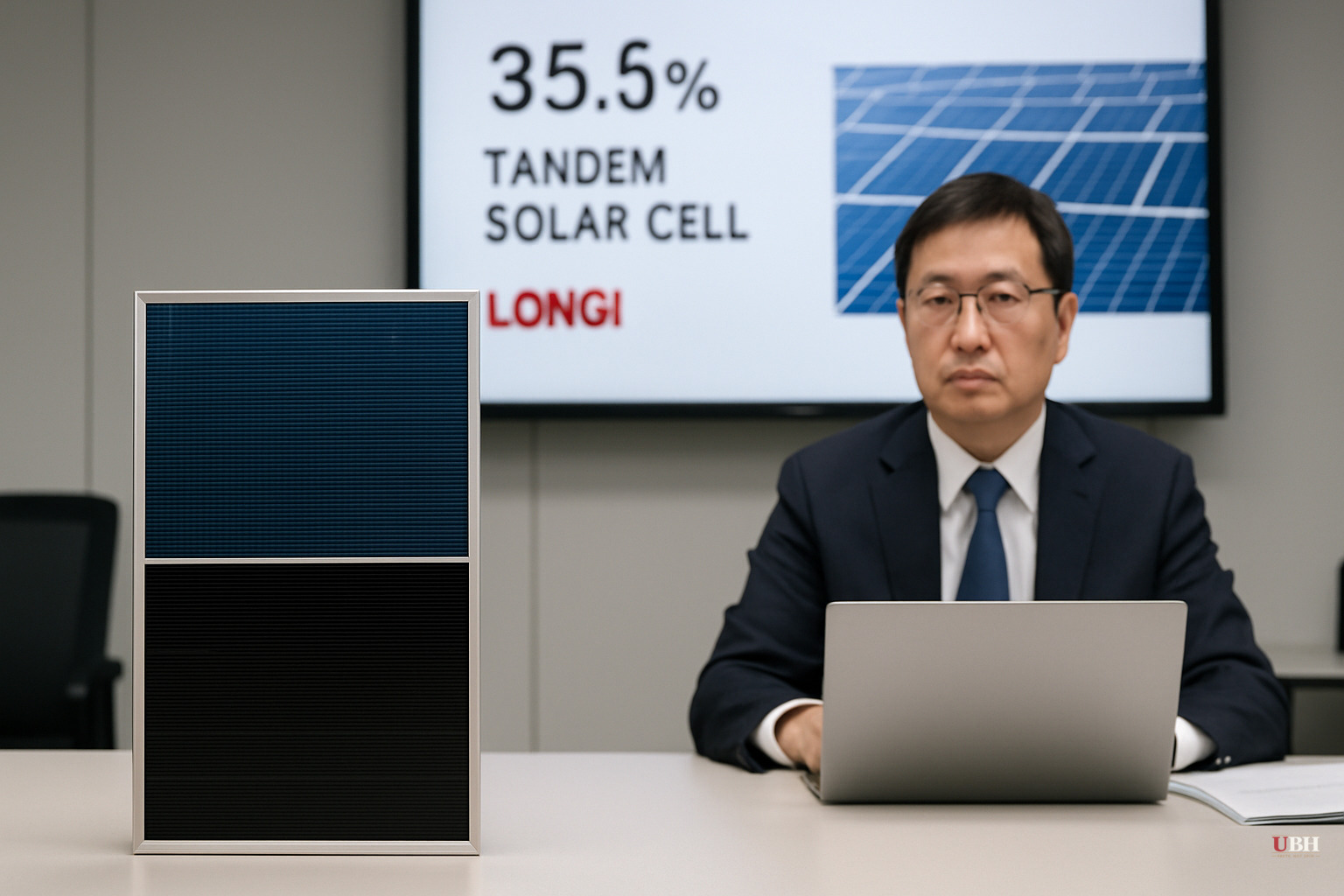
Chinese solar manufacturer LONGi Green Energy says it has built a solar cell with a conversion efficiency of 35.5 percent, according to Engadget. The company says the result was verified by the European Solar Test Installation, a reference laboratory used for calibrating photovoltaic devices.
For comparison, commercially available solar panels are just now approaching 25 percent efficiency, according to the US Energy Information Administration. If LONGi's number holds up, it represents a real jump over what's actually installed on rooftops and solar farms today.
What kind of cell this is
LONGi built this using crystalline silicon-perovskite tandem cell technology. That's a design that stacks a perovskite layer on top of traditional silicon, letting the cell capture more of the light spectrum than silicon alone. LONGi believes tandem cells are the future of solar, and the company says the theoretical ceiling for this specific technology is around 43 percent.
This isn't LONGi's first swing at a record. The company says it hit 33.9 percent efficiency in November 2023, then 34.6 percent in June 2024. The 35.5 percent figure is the latest in a string of incremental gains over roughly two and a half years.
Who actually holds the record
LONGi says it holds the world record specifically for this tandem PV technology. That claim needs context.
The US Department of Energy's National Renewable Energy Laboratory built a solar cell back in 2022 with an efficiency of 39.5 percent, a figure that's higher than what LONGi is now announcing. There are also niche cells, like those used on satellites, that reach 50 percent efficiency. Those aren't built for cost or mass production, they're built for performance where money is basically no object.
So LONGi's 35.5 percent record appears to be narrower than the Engadget headline framing suggests. It's a record for a specific tandem cell category, not an outright global efficiency record. That distinction matters. It's the kind of thing that gets flattened in coverage focused on the "China achieves breakthrough" angle without noting a US lab cleared a higher bar three years earlier.
Why lab records don't equal your electric bill
None of these high-efficiency numbers are what's showing up in mass-produced panels. Commercial efficiency sits around 25 percent. LONGi's 35.5 percent is a lab result on presumably a small test cell, not a full panel rolling off an assembly line.
Going from a lab-verified record to something you can buy and install involves years of manufacturing engineering, cost reduction, and durability testing. Perovskite materials in particular have a reputation for degrading faster than silicon when exposed to heat, humidity, and UV light over time. A cell can post an impressive number in a controlled lab environment and still be years away from surviving 25 years on a roof in Arizona or Florida.
The bigger picture
LONGi is one of the largest solar manufacturers in the world, and China dominates global solar panel production and supply chains, from polysilicon to finished modules. That's an economic and national security fact. Whoever commercializes higher-efficiency tandem cells first at scale stands to grab a bigger share of a global market that's still growing as countries build out solar capacity.
The US Department of Energy, through NREL, is still in this race. Whether American manufacturers can translate NREL's 2022 lab record into commercial products faster than LONGi can scale its own tandem tech is the actual competition worth watching, not who wins the next fractional percentage point announcement.
No timeline has been given by LONGi for when, or if, this specific 35.5 percent cell moves from lab verification to commercial production. Efficiency records make headlines. Manufacturing at scale, at a price that beats existing panels, is what actually changes energy markets.
Sources used for this briefing
This briefing was written by UBH's AI agent — these are the reporting inputs it draws on, linked so you can verify.


