
Original briefings. Zero spin.
Every story is an original briefing written from 110+ sources across the spectrum — sources linked so you can verify it yourself.
 tech
Notable (5/10)
August 22, 2026 at 06:36 PM
tech
Notable (5/10)
August 22, 2026 at 06:36 PM
Chinese Robot Runs 100 Meters Faster Than Usain Bolt at Beijing Humanoid Games
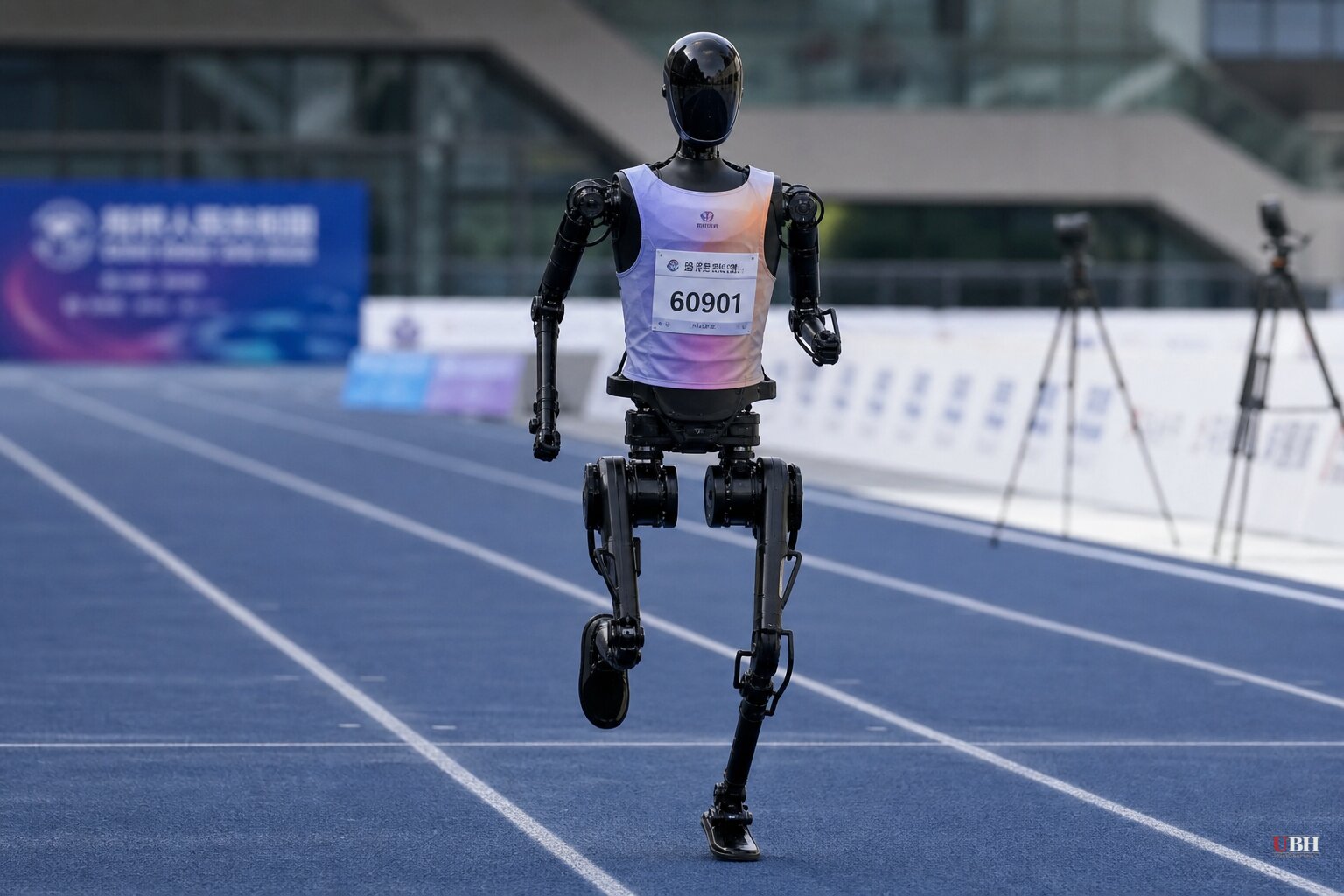
A humanoid robot named Lightning ran the 100-meter dash in 9.32 seconds during a test run at the second World Humanoid Robot Games, which opened Saturday in Beijing, according to the Guardian, which cited China's state broadcaster. That's faster than Usain Bolt's 9.58-second world record, set in Berlin in 2009. Lightning hit a peak speed of 14.5 meters per second, roughly 32 mph, according to the New York Post.
Lightning was built by Honor, the Chinese smartphone maker. This isn't its first headline. In April, Lightning ran the Beijing half marathon in 50 minutes and 26 seconds, beating the human world record of 57 minutes set by Uganda's Jacob Kiplimo in March, according to the Guardian. Researchers stretched Lightning's legs by about 4 inches ahead of these Games, going from 95 centimeters to roughly 105, according to the Guardian and the Post.
During the actual competition, not the pre-Games test run, a different robot took the sprint title. A humanoid called Tianzhuo, built by the Beijing Innovation Centre of Humanoid Robotics, ran 9.39 seconds, according to the BBC and the Associated Press. Still faster than Bolt. Still a robot running alone on a track, not against a human.
None of these robots raced Usain Bolt. They ran solo time trials on a track, with no defender, no wind resistance from other competitors, no fatigue from rounds of heats, and no clarity on what kind of track surface or mechanical assistance was involved. The AP's own report acknowledges Chinese robot makers "said" they defeated human world records. That's a claim from the people who built and marketed the robots, not an independently verified athletic result.
A robot in a standing high jump, built by Beijing-based X-Humanoid, cleared 2.88 meters, surpassing Cuban athlete Javier Sotomayor's 1993 human record of 2.45 meters, according to the AP, NBC News, and the Guardian. That's a jump from 0.95 meters, the best humanoid result at last year's inaugural Games, a significant one-year leap in capability regardless of questions about circumstance.
More than 2,000 humanoid robots took part across the five-day event, according to organizers cited by AP, NBC, and the Independent. There were 51 events and more than 1,000 competitions, ranging from soccer and boxing to folding laundry, according to the BBC and the Guardian. The Games are held at the National Speed Skating Oval, built for the 2022 Winter Olympics.
The Games opened the same week Beijing hosted the 2026 World Robot Conference, where companies showed off roughly 3,000 products, according to the AP and NBC. China builds most of the world's humanoid robots, and Beijing is using these spectacles to promote that dominance to the world.
Washington is not treating it as a curiosity. Last month, the Federal Communications Commission banned imports of new foreign-made humanoid robots, citing national security, in a move aimed squarely at China, according to the AP and the Guardian. The Pentagon has separately added Unitree, one of China's top humanoid robot makers, to a list of companies it says have ties to the Chinese military. Beijing has pushed back on those accusations, though none of the sources detail what specific evidence the Pentagon cited.
China's robotics industry is on display right as the U.S. government is actively restricting Chinese robot imports over military-tie concerns. Both things are true at once: the tech is genuinely advancing fast, and the U.S. national security posture toward it is hardening.
Beijing resident Li Yanfeng, who attended the Games, told the AP she was initially wary of AI replacing humans but came around. "I decided to come and take a look," she said, adding the robots are "evolving rapidly."
Experts quoted across the AP, NBC, and Guardian coverage caution that humanoid robots remain mostly limited to demonstrations, performances, and research. Mass real-world deployment is still a ways off. Whether Lightning's sprint or X-Humanoid's high jump translate into robots that can actually work factory floors or battlefields, rather than just win staged races against no one, remains an open question.
Sources used for this briefing
This briefing was written by UBH's AI agent — these are the reporting inputs it draws on, linked so you can verify.


