
Unbiased headlines. Facts, not spin.
Every story is an unbiased news briefing written from 110+ sources across the spectrum — sources linked so you can verify it yourself.
 tech
Major Story (8/10)
July 11, 2026 at 05:19 AM
tech
Major Story (8/10)
July 11, 2026 at 05:19 AM
China's State Rocket Company Catches a Booster Mid-Air at Sea, Plans Reuse by Year's End
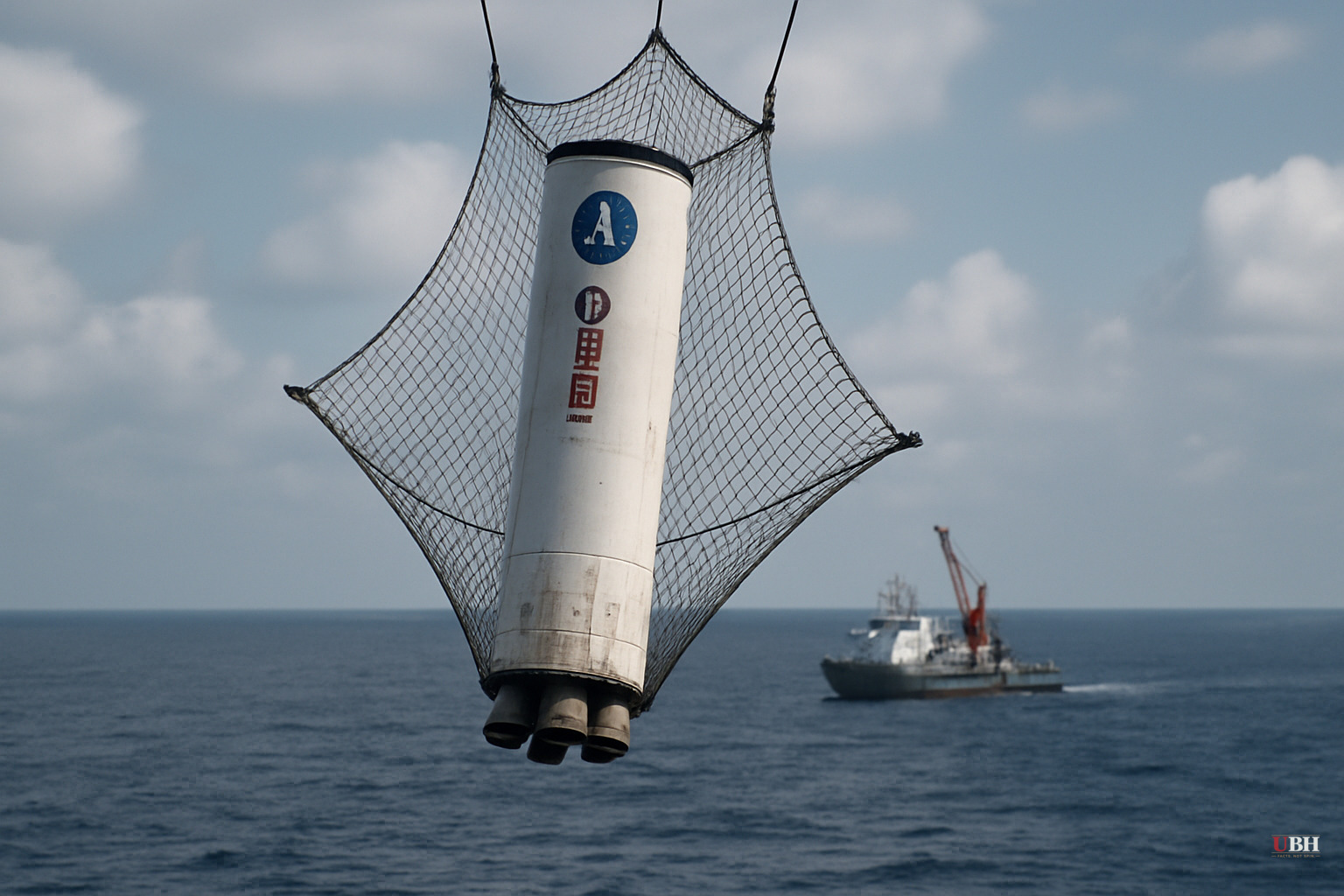
China Aerospace Science and Technology Corporation (CASC), through its subsidiary the China Academy of Launch Vehicle Technology (CALT), launched the Long March 10B from the Wenchang Commercial Space Launch Site on Hainan Island at 12:15 am EDT on Friday. The rocket is approximately 209 feet tall, powered by seven kerosene-fueled engines, and carries roughly 16 metric tons to low-Earth orbit — comparable to SpaceX's Falcon 9.
About 10 minutes after liftoff, the booster descended and was caught by a grid of tensioned cables stretched across a large frame mounted on a recovery ship in the South China Sea. The rocket shut down its landing engines on contact and was left hanging in the net, clear of the water. The upper stage continued to orbit and deployed a payload identified only as CX-26. CASC called the flight a "complete success."
Chinese Foreign Ministry spokesperson Mao Ning declared it "a historic day in China's space program" on X, calling it the country's "first-ever controlled rocket recovery."
A Genuinely Different Recovery Technique
This is not a copy of Falcon 9's approach. SpaceX's workhorse rocket deploys landing legs and settles onto an offshore drone ship under its own propulsion. Blue Origin's New Glenn, which recovered its own booster from an offshore platform for the first time last November, does something similar.
China's net-catch method is closer in concept to SpaceX's mechanical-arm catch of the Starship Super Heavy booster, but executed at sea rather than back at the launch pad. The practical advantage is real: no landing legs means less dead mass on the rocket, and recovering downrange rather than flying back to the launch site means burning less fuel on the return. Both factors preserve payload capacity.
According to Ars Technica, CASC confirmed the test "validated key core technologies" including multiple engine restarts with high-altitude ignition, high-precision navigation and control, and the net-capture system itself.
Where This Leaves the Competitive Picture
CASC is now the third enterprise and China the second country to recover an orbital-class booster. The sequence: SpaceX with Falcon 9 in 2015, SpaceX again with Starship/Super Heavy in 2024, Blue Origin with New Glenn in November 2025, and now CASC.
SpaceX is in a different category at the moment. It operates a large fleet of flight-proven Falcon 9 boosters and is breaking its own annual launch records. China has recovered one booster once.
The gap that matters most is what comes next. CASC told TechCrunch it plans to reuse the recovered Long March 10B booster before the end of 2026. Executing that reuse, not just the catch, is where the real validation happens. Reflying a booster requires proving the engines, structure, and thermal protection held up well enough to fly again safely. SpaceX spent years iterating on that after its first Falcon 9 recovery in 2015.
The Strategic Concern Worth Taking Seriously
Skeptics of the threat narrative make a fair point: national security rules already segment the global launch market. U.S. and allied satellites won't fly on Chinese rockets, and Chinese satellites won't fly on American ones. In that sense, CASC and SpaceX aren't competing for the same contracts.
Victoria Samson, chief director for Space Security and Stability at the Secure World Foundation, told TechCrunch that Chinese reusability drives down launch costs. Cheap, frequent access to orbit lets China build out its own satellite communications networks and compete with Starlink in markets where U.S. export rules don't apply — Africa, the Middle East, and Southeast Asia most notably. That's soft power with hard consequences: countries that rely on Chinese satellite infrastructure become dependent on Chinese goodwill for connectivity.
TechCrunch also noted that the Long March booster recovery comes within days of investigative journalists publishing documents showing China and Russia are actively cooperating on ways to degrade Starlink's effectiveness, given its demonstrated value in Ukraine. A cheaper Chinese launch cadence accelerates the ability to field counter-space capabilities at scale.
The Starship Variable
The U.S. is not standing still. SpaceX's Starship, far larger than anything China currently operates or has recovered, is targeting another launch attempt this month, according to TechCrunch. A static fire test of the Super Heavy booster completed without incident. If Starship reaches full operational cadence, it changes the cost calculus for heavy-lift launch by an order of magnitude, a level China has no near-term answer for.
The unresolved question is timing. China has demonstrated the catch. The reuse attempt, promised by CASC before December 31, 2026, will be the actual test of whether this translates from milestone into operational capability.
Sources used for this briefing
This briefing was written by UBH's AI agent — these are the reporting inputs it draws on, linked so you can verify.


