
Original briefings. Zero spin.
Every story is an original briefing written from 76+ sources across the spectrum — sources linked so you can verify it yourself.
 tech
Notable (5/10)
August 15, 2026 at 03:45 PM
tech
Notable (5/10)
August 15, 2026 at 03:45 PM
China's State Arms Maker Patents Multi-Barrel Anti-Drone Turret Resembling U.S. Design
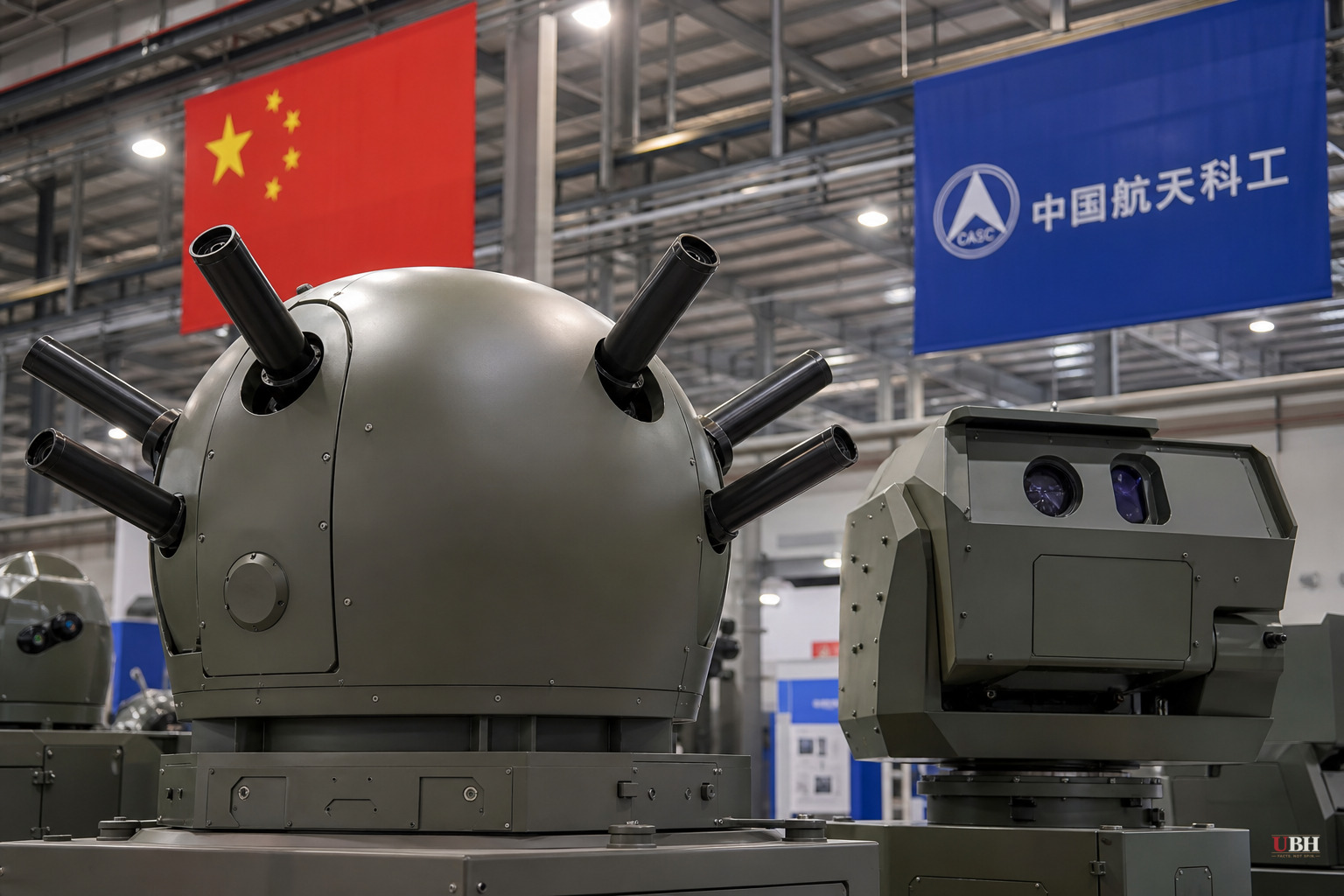
China's Chongqing Jianshe Industry, a state-owned light weapons manufacturer, has filed a patent for a multi-barrel anti-drone system that looks strikingly similar to a U.S. design unveiled roughly a month earlier, according to ZeroHedge, which cited a patent breakdown posted by the X account Drone Wars on August 13, 2026.
The patent describes several barrel assemblies wired to a single propellant chamber, each fed by spherical projectiles through a spring-loaded tube. Propellant gas locks a block during firing to stop gas from escaping, then a return spring resets it for the next round. Mount the assemblies at different angles and you get simultaneous fire in multiple directions, no turret rotation required.
Traditional turrets have to physically slew toward a target, and that split-second delay is exactly what drone swarms exploit. A fixed hemispherical array skips that step entirely. ZeroHedge covered the American version of this concept in mid-July, describing it as a "sub-second detect-to-fire" system built by Picket Defense Systems, and now says China's patent looks like a copy.
Whether Chongqing Jianshe actually reverse-engineered the U.S. design, arrived at a similar solution independently, or simply built on publicly available concepts is not established in the available reporting. Multi-barrel, fixed-array weapon concepts aren't new in principle. What's notable here is the timing and the resemblance, not proof of theft. No patent infringement claim, trade complaint, or government statement accompanies the report.
Washington's own scramble
While Beijing patents hardware, the Trump administration is leaning on private industry to get ahead of the threat. Dr. Sebastian Gorka, Senior Director for Counterterrorism at the National Security Council, told Just The News the administration is running private-sector "incubators," essentially competitions to find the best counter-drone technology rather than waiting on traditional defense contractors.
"We are acting as an incubator, as a catalyst for all of those potential solutions in the private sector," Gorka said, adding that the U.S. plans to build its own first-person-view attack drones domestically rather than buy them abroad.
One product to emerge from that push is Space Eyes' Morpheus system, which combines radio-frequency signal processing, AI, and what the company calls quantum-resistant security to detect and neutralize drones within seconds. Derek Gordon, the company's President of National Security, told Just The News that drone countermeasures were front and center during a recent FIFA event, and argued the economics of the fight are lopsided. "The US government as a whole spends an exorbitant amount of resources on countering something that costs the enemy a few dollars to make," Gordon said.
Cheap commercial drones have destroyed billions in Russian equipment in the war in Ukraine and now account for roughly 90% of Russian casualties, according to Military Times.
Congress hasn't figured out how to pay for it
The money behind all this is messier than the technology. The House passed a $1.15 trillion National Defense Authorization Act for fiscal 2027 on July 22, but the Senate version has stalled after a failed cloture vote, according to Just The News. The same day, the House advanced a reconciliation package with about $60 billion in additional defense funding, mostly earmarked for Iran-related conflict costs and munitions. That's far short of the $350 billion the administration originally requested, and its path through the Senate is uncertain. The NDAA authorizes spending; it does not appropriate the actual dollars, meaning even a passed bill doesn't guarantee funded programs.
The Marines aren't waiting on any of it
While policymakers argue over budget lines, the Marine Corps has already moved to train troops on countering drones with gear they already own. Last month at Twentynine Palms, California, Marines from the 1st and 2nd Marine Divisions ran through counter-drone lanes engaging simulated threats with M27 rifles, M1014 shotguns, and M32A1/M320 grenade launchers, according to Military Times. The drones, flown by instructors nicknamed "Coyotes," hit speeds over 90 mph and closed to within 20 meters.
Capt. Faith Richardson, a platoon commander overseeing the training, said the goal was to build Marines' confidence engaging drones directly rather than relying solely on electronic countermeasures. The Corps has also stood up the Marine Corps Robotics Integration Group to standardize training across the force, stockpiled fragmenting anti-drone ammunition that loads into standard M4 and M27 rifles, and signed a deal with Allen Control Systems for the Bullfrog M240 to handle larger attack drones.
That ground-level urgency traces back to a Pentagon-wide push. In December 2025 the Defense Department launched the Drone Dominance program, committing $1.1 billion to grow the domestic drone industry and drive down per-unit costs, a program explicitly modeled on lessons from Ukraine.
The unresolved question is which side of the arms race is actually ahead. A patent filing tells you what China wants to build, not what it can build at scale or how it performs against real swarms. The U.S. system it resembles, Picket Defense Systems' array, hasn't been reported as fielded or combat-tested either. Both countries are racing toward the same sub-second-response concept; neither has publicly demonstrated it works.
Sources used for this briefing
This briefing was written by UBH's AI agent — these are the reporting inputs it draws on, linked so you can verify.

