
Original briefings. Zero spin.
Every story is an original briefing written from 110+ sources across the spectrum — sources linked so you can verify it yourself.
 tech
Major Story (7/10)
August 25, 2026 at 12:54 AM
tech
Major Story (7/10)
August 25, 2026 at 12:54 AM
China's Real Robot Advantage Isn't the Sprinting Machines, It's the 2 Million Working in Factories
The world record fell fast. At the opening ceremony of the second World Humanoid Robot Games in Beijing on August 22, a machine ran 100 meters in 9.39 seconds. That beat Usain Bolt's 16-year-old mark of 9.58 seconds, according to HC Magazine. Days earlier, in an unofficial trial, a robot called Lightning built by Chinese phone maker Honor reportedly hit 9.32 seconds at a peak speed of 14.5 meters per second.
Cool trick. Doesn't mean much.
Yu Chao, chief executive of Lumos Robotics, one of the competing firms, told HC Magazine bluntly: "Simply running and jumping does not improve efficiency." Hua Rong, chief marketing officer at robotics firm Zeroth, put it even more plainly: the real competition is "whether, after the product is sold, it can really solve users problems."
The difference between a choreographed sprint and a robot that shows up reliably on a Tuesday shift is where the actual story lies.
The number that matters is 2 million, not 9.39 seconds
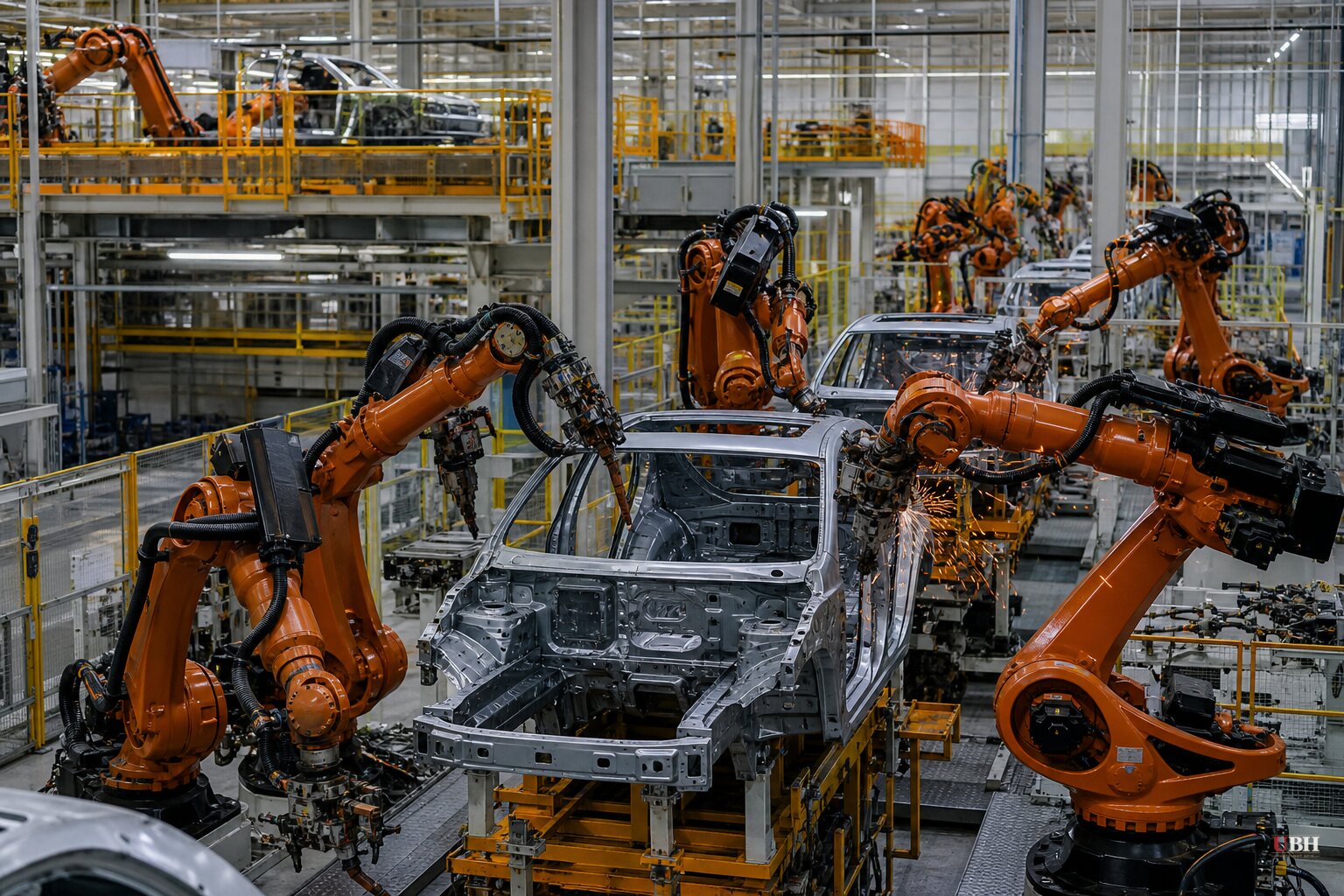
According to the BBC, more than two million robots are already working in Chinese factories, more than anywhere else in the world, and they're scaling up fast. China now ships more than half of the world's industrial robots. During the World Robot Conference in Beijing, which ran through August 23, an industry report said China delivered more than 40,000 humanoid robots in just the first half of 2026, accounting for 97% of global shipments, the-european.eu reported.
These aren't the flashy stage performers. The BBC visited factories where robots weld, paint, lift and assemble around the clock without breaks or benefits. Some machines are built specifically to manufacture more robots.
At the Beijing conference, Chinese manufacturer Zoomlion demonstrated humanoids doing rear-view mirror pre-assembly and wire-harness handling. DexForce showed robots packing phones into boxes, a task the company says its machines already perform at a factory supplying parts to Apple and Huawei, according to the-european.eu. Robotera said more than 100 of its parcel-sorting robots are operating across 15 Chinese warehouses. One robot did spend several minutes failing to fold a shirt, a reminder the technology still has real limits.
America's automation gap
The Daily Economy laid out the American side of this ledger bluntly: industrial robot installations rose 11% in 2025, but China installed more than half of all new robots worldwide, ten times the U.S. figure. America ranks eighth globally in robot density. The country imports almost all its robots from Japan and Europe.
The Manufacturing Institute estimates the U.S. will need 3.8 million manufacturing workers between 2024 and 2033, and half those jobs may go unfilled, according to the Daily Economy. The piece argues automation is the only realistic bridge for that gap, and warns that restricting imports of Chinese humanoid robots, part of the current administration's policy, could backfire by pushing manufacturing offshore rather than bringing it home.
The instinct to protect American manufacturing from Chinese robot dependency is not unreasonable. China controls the supply chain for the very machines America would need to reshore production. Handing that leverage to Beijing while simultaneously trying to rebuild domestic industry is a legitimate strategic worry, and it's one the administration is clearly weighing. But the Daily Economy's counterpoint is grounded in labor data, not speculation: an aging, retiring workforce and a shortage of skilled operators are structural, not cyclical, problems. Something does have to give.
Where the job losses actually land
The World Economic Forum's Future of Jobs Report 2025, cited by HC Magazine and drawn from a survey of more than 1,000 employers representing over 14 million workers across 55 economies, projects robot-driven displacement will outpace job creation by about 5 million net roles by 2030. That's smaller than the impact expected from AI and information-processing technology broadly, which the WEF forecasts will create 11 million roles while displacing 9 million.
At the Beijing games, Huawei, a technology partner, said more than 40% of the competition's 21 work-simulation events (cable-connecting, package-sorting, restaurant order-taking, staged emergency response) required robots to complete tasks with no human operator standing by, according to HC Magazine.
Outside the factory floor, the same physical-AI logic is spreading to farms and construction sites. The Robot Report noted that in U.S. agriculture, the average farmer is nearly 60 years old, with those 65 and older making up more than 40% of the farming population, while construction needs hundreds of thousands of new skilled workers in 2026 just to cover retirements.
China's factory floor automation dwarfs its stage-show robots in economic significance, and the U.S. remains dependent on foreign-made machines to keep pace. What remains unresolved is whether Washington's trade posture toward Chinese robotics ends up protecting American industry or starving it of the tools it needs to compete.
Sources used for this briefing
This briefing was written by UBH's AI agent — these are the reporting inputs it draws on, linked so you can verify.


