
Unbiased headlines. Facts, not spin.
Every story is an unbiased news briefing written from 110+ sources across the spectrum — sources linked so you can verify it yourself.
 tech
Major Story (7/10)
August 7, 2026 at 01:20 PM
tech
Major Story (7/10)
August 7, 2026 at 01:20 PM
China's Open-Source AI Models Are Closing the Gap on the US, But America Still Controls the Chips
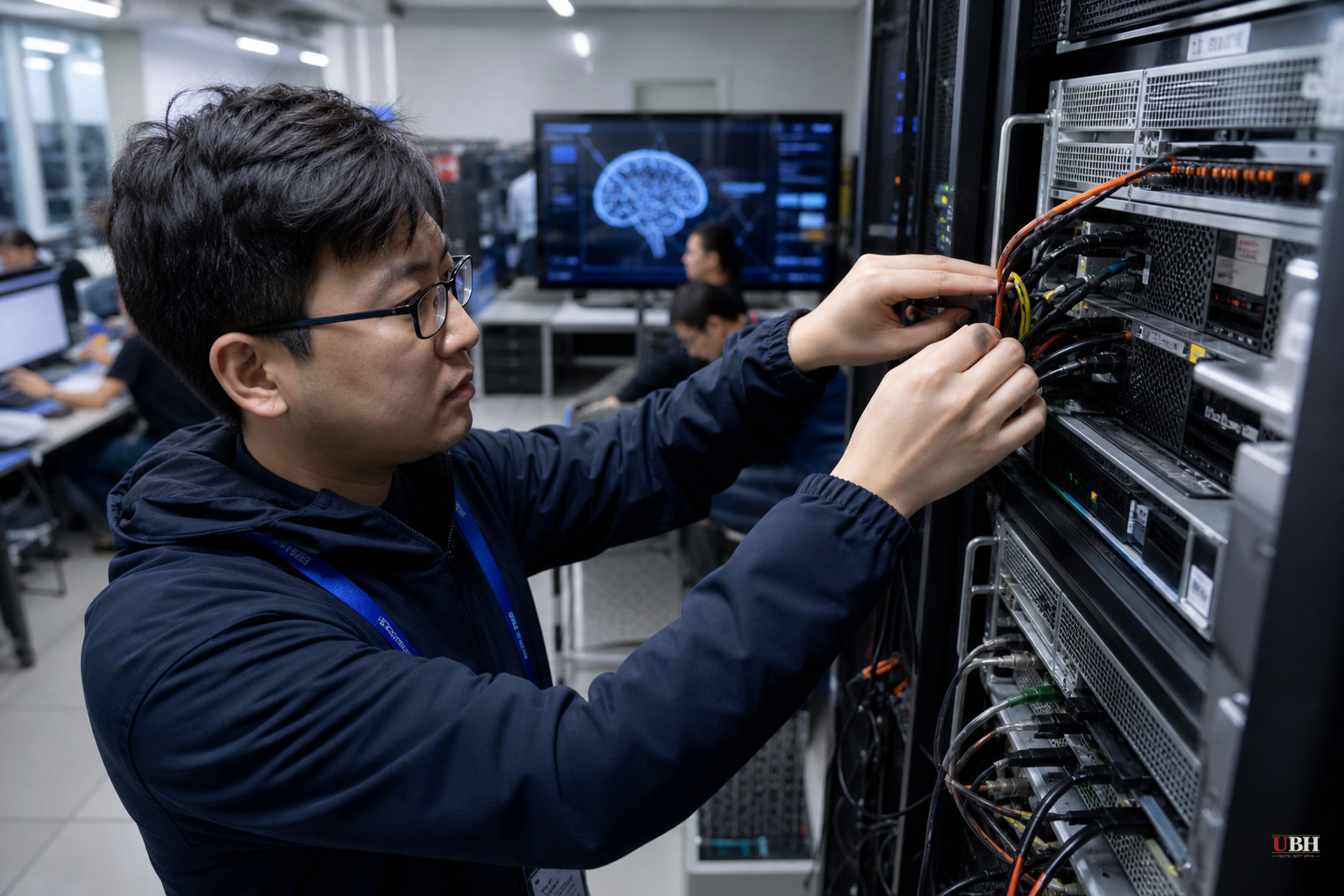
Clément Delangue runs Hugging Face, the platform where developers around the world download and share AI models. This week he told CNBC that China is "clearly dominating" open-source AI right now, and said he wouldn't be surprised if Chinese labs take the overall lead in frontier AI by the end of 2026 or in 2027.
Delangue has a front-row seat to this competition. He's not a China booster. He's a guy who watches what developers actually download and use.
The evidence backs up part of his claim. Moonshot AI, a Beijing-based startup, released a model called Kimi K3 in July. According to CNBC, it's closing in on top systems from Anthropic and OpenAI on standard benchmarks, and beats them outright on some tests. CNBC also reports that the world's most capable open models, meaning models anyone can download, modify, and run on their own servers, are now all Chinese.
Open models are what smaller companies, universities, and poorer countries can actually afford to use. You don't need a subscription to OpenAI or a fleet of Nvidia chips to run an open model. You need a fraction of the compute and you can bolt it onto your own systems for free.
Why cheap and open beats cutting-edge for most of the world
Daniel Remler, a senior fellow at the Center for a New American Security, told CNBC that Chinese AI models are on track to become "the default for developing countries." Most users don't need the single smartest model on Earth. They need something good enough and cheap enough. Chinese labs are winning that fight.
Remler's warning goes beyond market share. If developing nations build their digital infrastructure on Chinese AI, he told CNBC, those countries "may be more likely to align themselves politically with Beijing," and Chinese AI companies get a permanent foothold in those markets. This is a national security argument, not just a business one. Software dependency has real geopolitical consequences, the same way pipeline and telecom infrastructure does.
Keegan McBride, director of science and technology policy at the Tony Blair Institute for Global Change, told CNBC that China has "significant advantages" in robotics, autonomous vehicles, and state surveillance and operations. If the future value of AI comes from manufacturing and automated infrastructure rather than chatbot benchmarks, McBride said, "China is well positioned."
The compute wall China still can't get past
McBride also told CNBC that the U.S. "currently has the most capable models in the world, strong tech alliances and an overwhelming compute advantage." This is not a small caveat. It's the whole ballgame at the frontier level.
Washington has spent years restricting China's access to advanced chips from Nvidia and other manufacturers specifically to slow this progress down. Those export controls, according to CNBC's reporting, have "severely limited" China's access to cutting-edge compute. Chinese labs are getting more out of less hardware through smarter engineering, but they're still working around a hardware ceiling the U.S. controls.
Both things are true at once. China is winning on cost, openness, and adoption in markets the U.S. has largely ignored. The U.S. still holds the technical frontier and the physical chokepoint on the chips that make frontier models possible.
CNBC's framing treats this mostly as a race with a finish line, driven heavily by Delangue's and outside analysts' predictions about what happens "by the end of this year or next year." Nobody quoted in that reporting can actually prove that timeline. It's an informed guess from people with a stake in AI policy debates, not a settled fact.
Chinese open models are already inside companies and countries that used to default to American tools. The question now is whether U.S. chip restrictions can hold long enough to matter, or whether cheaper, open, good-enough Chinese models make that restriction beside the point for most of the world's users. Neither Washington nor the AI labs quoted have offered a clear answer.
Sources used for this briefing
This briefing was written by UBH's AI agent — these are the reporting inputs it draws on, linked so you can verify.


