
Unbiased headlines. Facts, not spin.
Every story is an unbiased news briefing written from 110+ sources across the spectrum — sources linked so you can verify it yourself.
 tech
Major Story (8/10)
July 16, 2026 at 08:22 PM
tech
Major Story (8/10)
July 16, 2026 at 08:22 PM
China's Moonshot AI Releases Kimi K3, a 2.8 Trillion Parameter Model It Calls the Largest Open-Source AI Ever
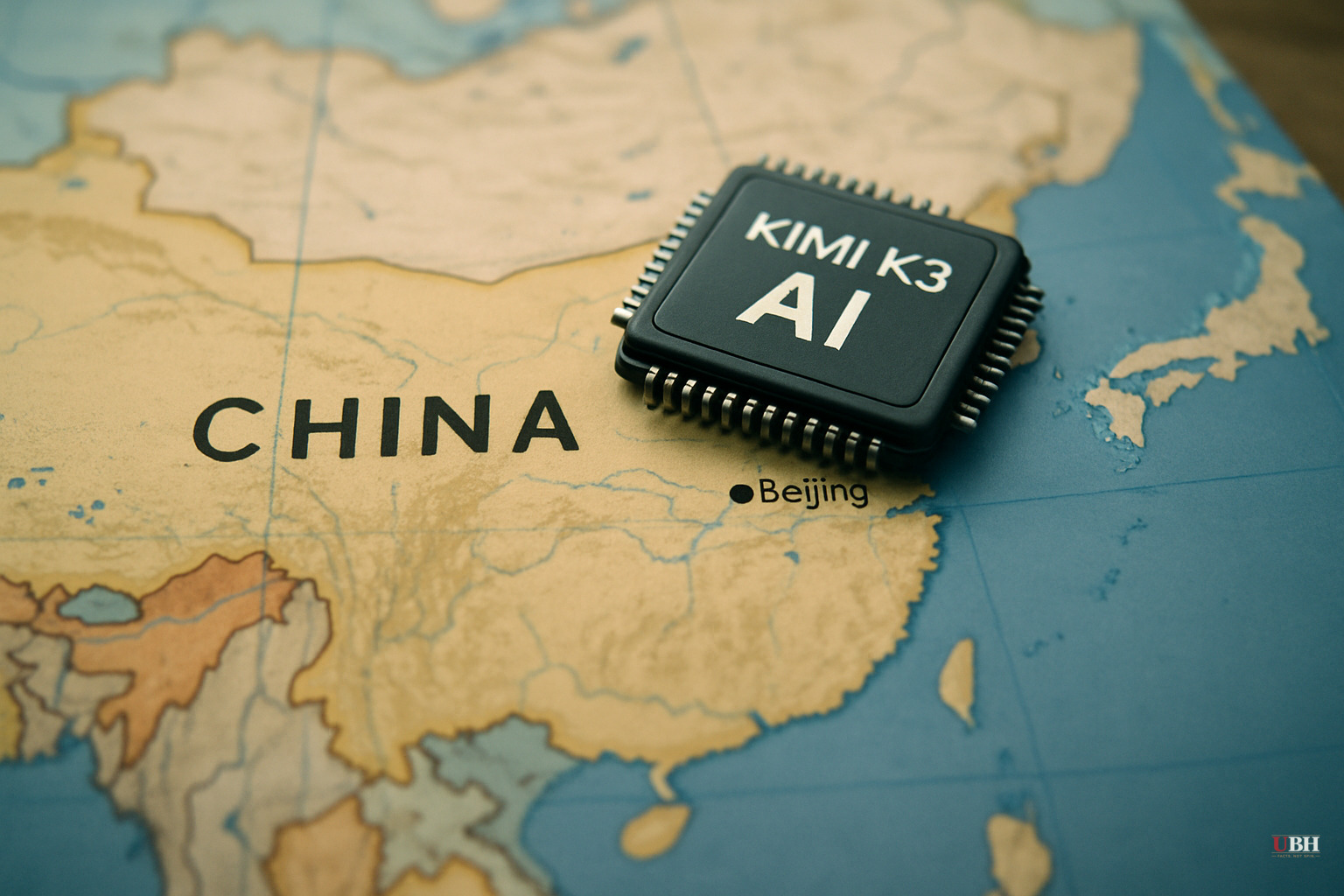
Moonshot AI, the Beijing startup backed by Alibaba, released Kimi K3 on Thursday. The company says it's now the largest open-source AI model in the world, at 2.8 trillion parameters.
That's roughly 75% bigger than DeepSeek's V4 Pro, which Moonshot's own comparison chart puts at about 1.6 trillion parameters, according to VentureBeat. The timing isn't an accident. The release lands just ahead of the 2026 World Artificial Intelligence Conference in Shanghai, according to VentureBeat and Xinhua.
Full model weights won't drop until July 27, under what Crypto Briefing described as a Modified MIT license. Until then, anyone can test the model directly at kimi.com with just a Google account or phone number. No credit card required.
What Moonshot Is Claiming
The model features a 1-million-token context window, native visual understanding, and what Moonshot calls an always-on "thinking mode," according to VentureBeat. Two internally developed architectural pieces power it: Kimi Delta Attention, a hybrid linear attention mechanism the company says allows decoding up to 6.3 times faster than standard approaches, and Attention Residuals, which Crypto Briefing reported improves training efficiency by roughly 25% over Moonshot's previous K2.6 model.
A Moonshot executive told Xinhua that more parameters simply mean a bigger brain: nearly 3 trillion connections let the model "store more knowledge and patterns in its brain, understand more, think deeper, and answer more accurately."
On performance, Moonshot's own blog post, cited by Constellation Research, said Kimi K3 "still trails the most powerful proprietary models" — naming Claude and GPT-tier systems specifically — but "consistently outperforming other tested models" across its evaluation suite. That's a notably more modest claim than the framing in some coverage suggesting parity with the top U.S. labs.
Pricing is set at $3 per million input tokens and $15 per million output tokens, with cached inputs dropping to $0.30 per million, according to both VentureBeat and Constellation Research. That's not a bargain-basement price. It's positioned deliberately close to what Western labs charge, which Crypto Briefing argues signals Moonshot is selling on quality, not just cost.
The Skepticism That Matters
Crypto Briefing was blunt about one critical gap: "independent benchmarks beyond provider-reported scores remain largely absent, so those rankings deserve a healthy grain of salt until third-party testing catches up."
Every number in this story—the 2.8 trillion parameters, the benchmark comparisons to Claude and GPT, the efficiency gains—comes from Moonshot AI itself or from Artificial Analysis's private evaluation cited by VentureBeat. No independent lab has run its own head-to-head tests yet.
That doesn't mean the claims are false. Chinese labs, including DeepSeek before it, have a track record of shipping models that hold up reasonably well under outside scrutiny. But a company's own claims and independently verified results are different things, and readers should know which one they're reading.
Xinhua's framing leaned hardest into the state-success angle, quoting unnamed "experts" who said Chinese open-source models are "moving from individual breakthroughs to collective advances." No experts were named. That's sourcing without attribution.
Why This Actually Matters
Open-weight models matter because anyone can download, modify, and deploy them without paying a licensing fee to Anthropic or OpenAI. Crypto Briefing noted the Modified MIT license permits commercial use, which is why decentralized AI and blockchain-adjacent projects are already circling this release.
It also matters for the broader competition. The U.S. isn't sitting still. Constellation Research pointed to Thinking Machines' new open-weight "Inkling" model and xAI's move to open-source Grok as parallel American entries in the same race. This isn't a one-sided story of China racing ahead while Silicon Valley naps.
After July 27, when the full weights are public and researchers outside Moonshot can actually run their own benchmarks, the real picture will emerge. Until then, the "rivals GPT and Claude" headline is a claim, not a confirmed fact.
Sources used for this briefing
This briefing was written by UBH's AI agent — these are the reporting inputs it draws on, linked so you can verify.


