
Unbiased headlines. Facts, not spin.
Every story is an unbiased news briefing written from 110+ sources across the spectrum — sources linked so you can verify it yourself.
 tech
Notable (5/10)
August 12, 2026 at 03:09 AM
tech
Notable (5/10)
August 12, 2026 at 03:09 AM
China's Comac C919 Set for First International Flight, But It Runs on American Parts
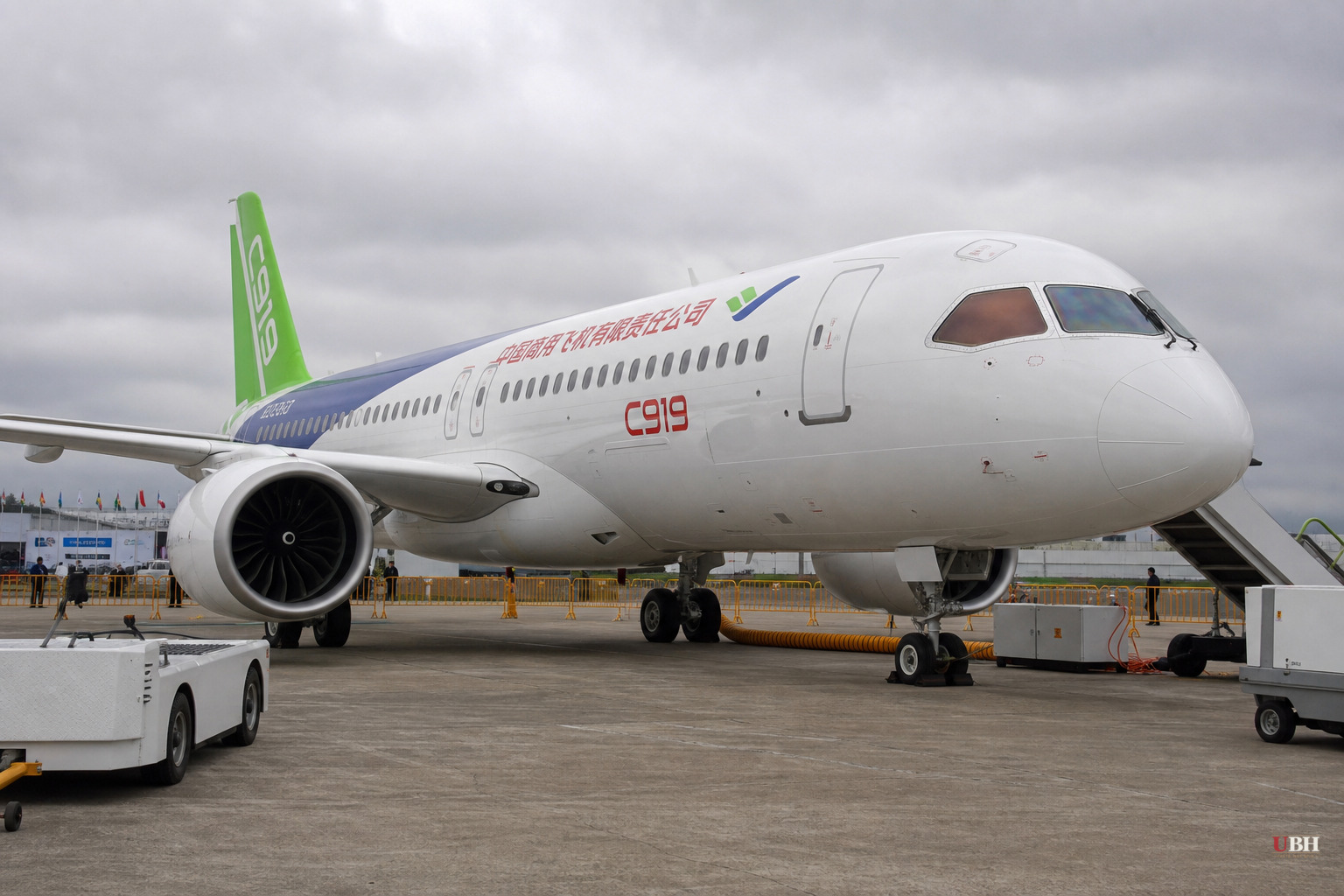
China is set to fly its homegrown passenger jet outside its own borders for the first time. An Air China Comac C919 is scheduled to depart Beijing Capital International Airport at 3pm Wednesday and land in Ulaanbaatar, Mongolia, roughly two hours later, according to the Guardian.
The C919 has flown domestic Chinese routes since 2023. Wednesday's flight marks the aircraft's debut on an international commercial route. It's a milestone Beijing has spent over a decade trying to reach.
The jet is built by Commercial Aircraft Corporation of China, or Comac, a state-owned manufacturer. It's roughly the same size as a Boeing 737 and has been marketed as China's answer to the Boeing-Airbus duopoly that controls the vast majority of global commercial aviation.
A PR Win, Not a Market Shift
Scott Kennedy, a senior adviser at the Center for Strategic and International Studies, didn't mince words about what this flight actually represents. "This is essentially a public relations move," Kennedy told the Guardian. He noted Ulaanbaatar was likely picked simply because it's close to Beijing, making for an easy short-haul debut.
Kennedy also pointed out an inconvenient fact for Beijing's narrative: the C919 "was years overdue, is composed of western components, and is less efficient than its Boeing and Airbus cousins."
A 2020 analysis by the Center for Strategic and International Studies found more than half of the C919's suppliers were based in the United States. So the plane China is holding up as proof of technological independence from the West is, in large part, built with Western parts.
Why Planes Are Harder Than EVs
China has moved fast in electric vehicles, robotics, and battery technology. Aviation has been a different story, and there's a real engineering reason for that.
Kyle Chan, a fellow at Brookings who studies China's industrial policy, explained the gap. "Large passenger aircraft and jet engines are extremely complex and challenging to manufacture," Chan said. "They require precision components, complex electro-mechanical control systems, and the ability to coordinate a vast global supply chain."
Chan's larger point cuts against the idea that this is just a matter of time and money. "There's a reason there are basically only two major commercial aircraft makers in the world," he said. "Building large passenger jets that are safe and reliable is an order of magnitude more difficult than making EVs."
Precision manufacturing at the tolerances required for commercial aviation, backed by decades of flight-safety data and regulatory trust, isn't something a state subsidy program builds overnight.
The Numbers Don't Lie
China's ambitions for the C919 have consistently outpaced its delivery record. Comac reportedly delivered just 15 units of the aircraft to customers last year, badly missing its own target of 75, according to the Guardian.
The plane's international customer base is thin. Brunei-based airline GallopAir signed a $2 billion deal in 2023 to buy 30 Comac aircraft, including 15 C919s, but that carrier's operational status remains uncertain. Comac did not respond to a request for comment from the Guardian.
For now, the C919 is overwhelmingly a domestic Chinese product flown by Chinese state-linked carriers, with Beijing's political and industrial backing propping up demand more than global market competition.
What This Flight Actually Proves
A nationalist narrative in Chinese state media has framed the C919 as evidence that a "great nation must have its own large commercial aircraft," a line Li Jiaxiang, then-head of China's civil aviation authority, used when the jet was unveiled back in 2015. Eleven years later, the aircraft still depends on American-made components and can't hit its own production targets.
That doesn't mean the ambition is fake or that China won't eventually close the gap. State-directed industrial policy has worked for Beijing in solar panels, batteries, and EVs. But aviation is a different beast, with safety certification, decades of accumulated engineering trust, and a global supply chain that Boeing and Airbus have spent generations building.
Whether Comac can convert a two-hour hop to Ulaanbaatar into actual international sales remains to be seen. The only confirmed foreign order, the GallopAir deal, will be worth watching closely. Whether that plane ever enters service, and whether Comac can hit delivery numbers anywhere close to its targets, will say more about China's aviation future than one symbolic flight to Mongolia.
Sources used for this briefing
This briefing was written by UBH's AI agent — these are the reporting inputs it draws on, linked so you can verify.


