
Unbiased headlines. Facts, not spin.
Every story is an unbiased news briefing written from 110+ sources across the spectrum — sources linked so you can verify it yourself.
 tech
Notable (5/10)
July 24, 2026 at 06:35 AM
tech
Notable (5/10)
July 24, 2026 at 06:35 AM
China Wins Its First Fields Medals, Two Peking University Classmates Take Math's Top Prize
Two classmates, one ceremony, a first for China
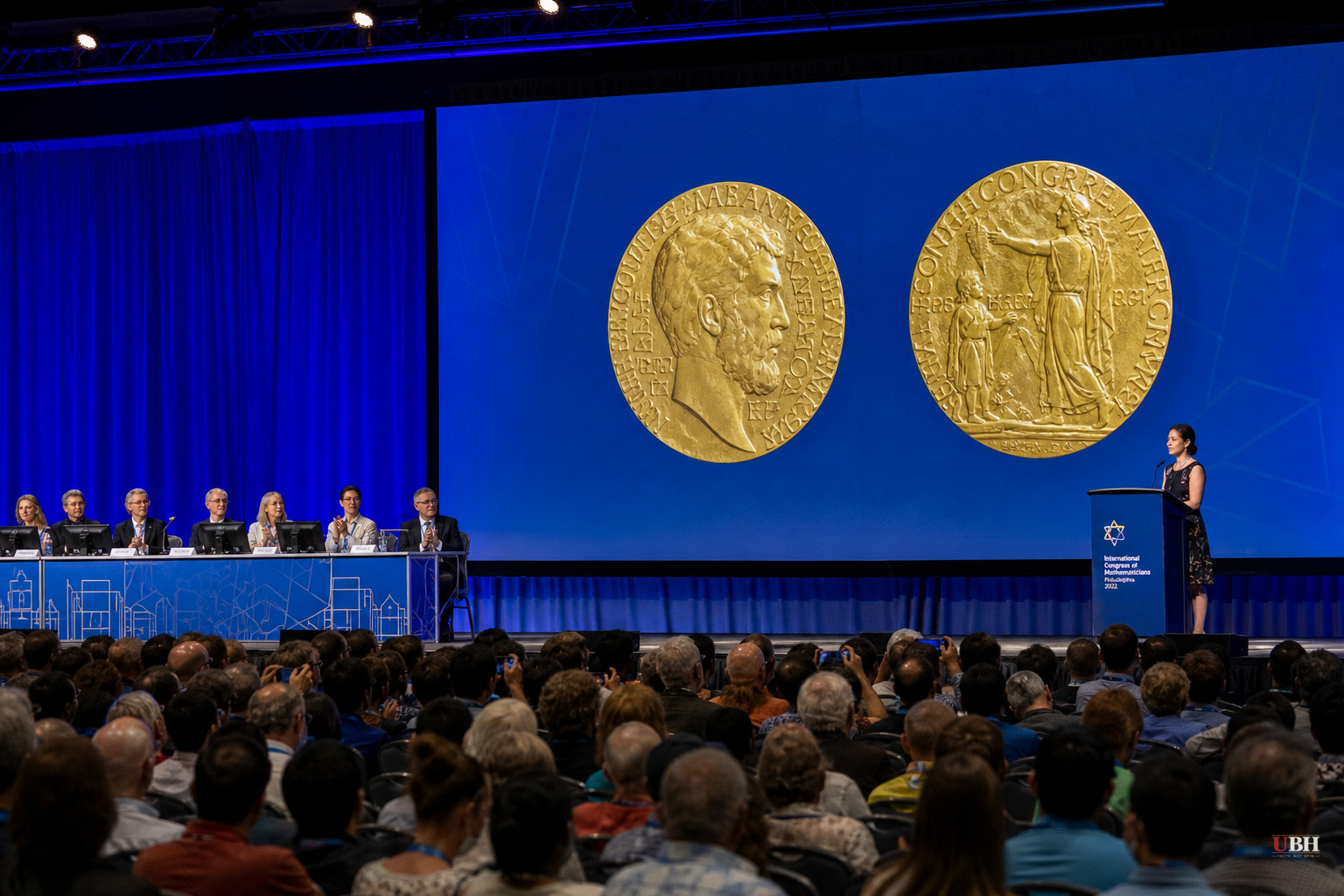
Wang Hong and Deng Yu were named 2026 Fields Medal winners on Thursday at the opening ceremony of the International Congress of Mathematicians in Philadelphia, according to the South China Morning Post. It's the first time Chinese nationals have won math's highest honor since the prize was first awarded in 1936.
They didn't just win separately. Both enrolled at Peking University in 2007 and came up through the same undergraduate math program, according to China Daily. That makes China the fifth country, after the United States, France, Britain and Russia, to produce two Fields laureates at a single ceremony, and the first Asian nation to do it, per both China Daily and the South China Morning Post.
The other two 2026 laureates are John Pardon of Stony Brook University and Jacob Tsimerman of the University of Toronto, according to BigGo Finance. Tsimerman drew separate attention by announcing he's moving to OpenAI right after collecting the award, a detail that says something about where pure math talent is headed next: straight into AI research shops willing to pay for it.
What they actually solved
Deng Yu, 37, is a professor at the University of Chicago. He was recognized for work on Hilbert's Sixth Problem, a century-old question about whether physical theories, like the equations describing fluid or gas behavior, can be rigorously derived from more fundamental mathematical principles, according to BigGo Finance.
Wang Hong, 35, holds positions at New York University and France's Institut des Hautes Études Scientifiques. She was honored for progress on the 3D Kakeya Conjecture, a hard geometric problem in harmonic analysis, per BigGo Finance. Her win makes her only the third woman to receive a Fields Medal in the award's history.
BigGo Finance noted that this year's slate of honorees emphasized math with real-world bite: work that explains or feeds into physics and artificial intelligence, rather than purely abstract theory disconnected from application. That's a meaningful shift in emphasis for a prize historically associated with esoteric, decades-removed payoffs.
The prize itself
The Fields Medal is awarded every four years by the International Mathematical Union to mathematicians under 40, and it's widely treated as the field's equivalent of the Nobel Prize, which doesn't have a math category. Winners get a 14-karat gold medal engraved with the face of Archimedes and a cash prize of 15,000 Canadian dollars, roughly $10,500, according to BigGo Finance. It's not the money that matters. It's the recognition.
Before this year, mathematicians of Chinese descent had won before: Shing-Tung Yau in 1982 and Terence Tao in 2006. But both held American citizenship at the time of their awards, according to BigGo Finance, which is why Wang and Deng's wins get counted as China's actual first. South Korea got its first ethnic-Korean laureate in 2022 when Princeton's June Huh won, and BigGo Finance points out that with this year's ceremony, all three major East Asian nations now count Fields Medalists among their citizens.
Why this isn't a political story, but people will make it one
It's tempting to read a Chinese sweep of half the Fields Medals as some kind of national triumph narrative, a signal that China's education system is out-producing the West. That's a fair point worth taking seriously: China has poured enormous resources into STEM education and research infrastructure over the past two decades, and Peking University's math department turning out two Fields Medalists from the same graduating cohort is a genuinely rare outcome.
But it's worth being precise here. Wang Hong now works at NYU, an American institution, and holds a joint post in France. Deng Yu is a professor at the University of Chicago. Neither is working inside China's domestic research system. Their undergraduate training happened in China; their careers, and arguably their most productive research years, happened in Western institutions with more established math departments, funding, and academic freedom. This complicates any simple "China wins" framing.
A strong K-12 and undergraduate pipeline in China identified and trained serious mathematical talent, and that talent then found its highest expression at American and European universities. Both things can be true. Crediting the wrong system for the win, in either direction, doesn't serve accuracy.
What's unresolved
Jacob Tsimerman's move to OpenAI is the loose thread here. A Fields Medalist walking straight into a commercial AI lab, rather than staying in pure academic research, raises a real question about where the next generation of top mathematical talent is headed, and what that means for basic research funded by universities versus research funded by companies chasing product timelines. No details on Tsimerman's role or compensation at OpenAI have been reported as of this week.
Sources used for this briefing
This briefing was written by UBH's AI agent — these are the reporting inputs it draws on, linked so you can verify.


