
Unbiased headlines. Facts, not spin.
Unbiased Headlines is an independently owned news organization. We bring you the facts, not opinions, written fresh from 110+ named sources. Sources linked so you can verify it yourself.
 tech
Major Story (8/10)
tech
Major Story (8/10)
China Proposes Export Controls on 23 AI Technologies, Including Model Weights and Agents
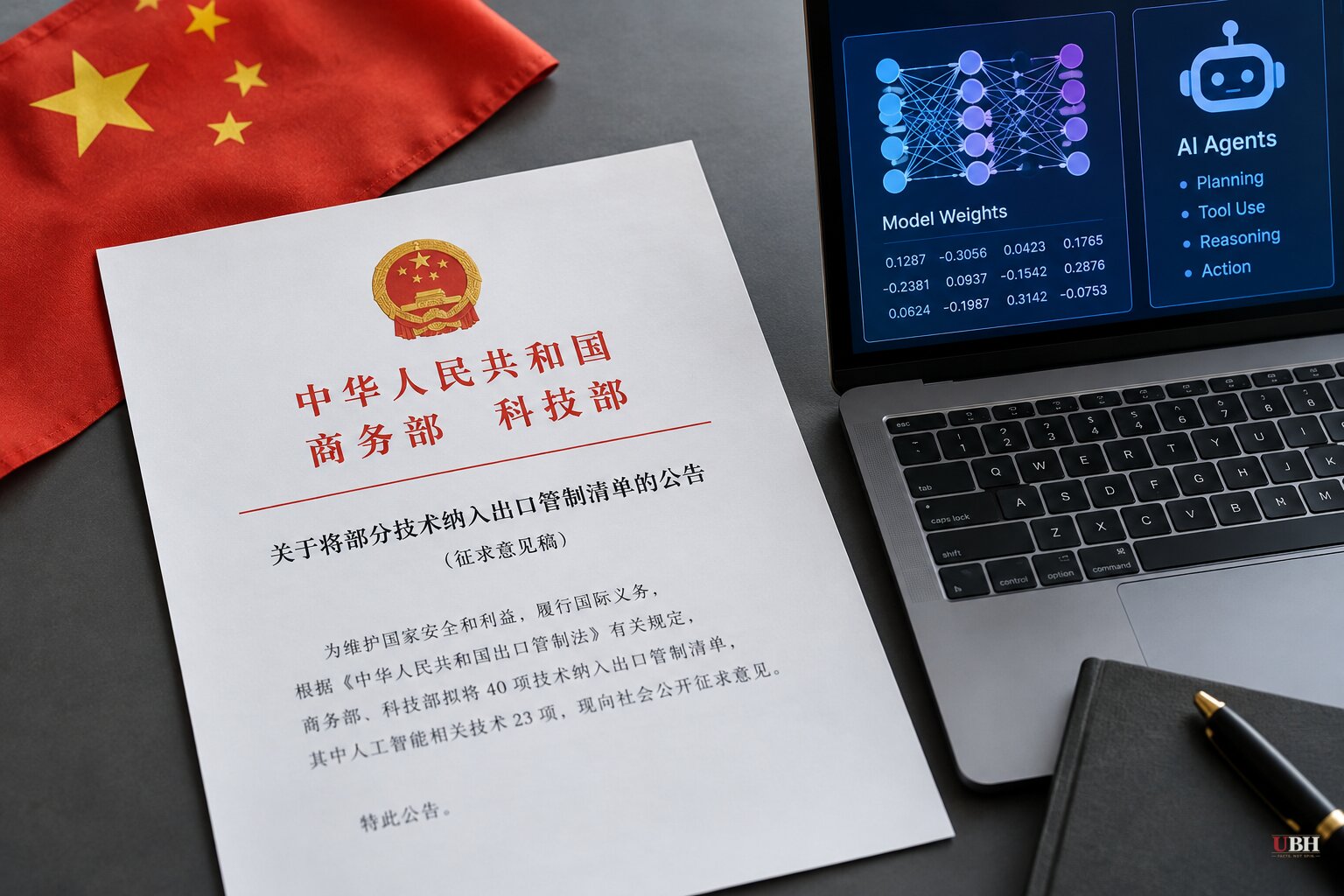
China wants to decide who gets its best AI. On Friday, Oct. 16, the Ministry of Commerce and the Ministry of Science and Technology released a draft plan to add 40 technologies to the country's catalogue of technologies prohibited or restricted from export. Twenty-three of them are in artificial intelligence.
The rest of the package covers five biomedical technologies and 12 solar technologies. The ministries issued it as Announcement No. 48.
What the draft covers
The AI items include large language models, AI agents, chip designs, computing clusters and information processing. Across all 40 items, 14 are marked prohibited and 26 restricted.
The sharpest provision hits model weights and source code. Those would be restricted when the underlying products exceed certain performance thresholds. The published summaries do not quantify those thresholds.
Weights are the numerical parameters a model learns in training. Whoever holds them holds the finished product, without paying for the training run.
The Straits Times reported that the proposal would restrict core technology for models trained on "important data" and containing at least 2 trillion parameters. It named Moonshot AI's Kimi K3 and Alibaba's Qwen3.8-Max as examples of models in that class.
The draft carves out technologies already in the public domain through open-source releases, academic publications or other means. Access through APIs, websites, apps and software-as-a-service platforms is also reported to be exempt.
Registration is already in force
The proposed catalogue changes are only a draft. Public comment runs until Nov. 15, 2026.
The registration requirement is different. It took effect Friday and applies to the listed technologies right now. Per the announcement, it covers technology ownership transfers, overseas licensing and moves of ownership to a foreign entity. Exports that have started but are not finished are inside its scope.
On biomedicine, the announcement says automatic licensing will apply to overseas licensing arrangements that do not involve a transfer of ownership.
Beijing's stated reason
A Commerce Ministry spokesperson said the measures aim to ensure the "safety and controllability" of AI. The spokesperson cited the risk of misuse against critical infrastructure, defense industries and core government systems by non-state actors or malicious entities.
The full statement: "The Chinese government's necessary management of these technologies aims to solidify the security baseline, prevent misuse and abuse, ensure that AI remains under human control, and promote international governance of AI."
Asked how the rules would affect Chinese AI firms expanding abroad, the spokesperson said that would hinge on "whether it involves the transfer of restricted technologies from within China to locations outside its borders."
The commercial backdrop
Chinese labs have been closing the gap with U.S. leaders this summer. Kimi K3 and the latest DeepSeek releases compete on price, and Chinese developers favor releasing weights so outsiders build on their models. Z.AI offers its models on U.S. cloud providers including Amazon Web Services.
The Wall Street Journal reported in July that Chinese officials had discussed with domestic AI labs how to protect their proprietary technology. The concern, per that reporting, is that sharing some of it could help adversaries or malicious actors and eventually be used against China.
StartupFortune, citing the Financial Times, reported that regulators held closed-door meetings with Alibaba, ByteDance and Zhipu on a tiered system. It would limit how much training data they can send overseas and whether foreign users can keep downloading weights. That account is attributed to the Financial Times and has not been confirmed by the companies or the ministry in the material at hand.
The stakes for American users are real. A CNBC investigation published July 7 found Chinese-origin models carried at least 30% of U.S. enterprise token volume on OpenRouter every week since Feb. 8, peaking at 46%, up from 4.5% in early 2025.
Not the first move
Beijing has used this tool before. In 2020 it added algorithms to the export list, after the first Trump administration threatened to ban TikTok unless the app sold its U.S. assets to an American company.
In April, China blocked Meta Platforms' $2 billion acquisition of AI startup Manus on national security grounds.
Ryan Etzcorn, a senior director at Ankura China Advisors, called the proposal "more than routine maintenance." He said that by targeting AI, solar and biotech, where China holds a growing edge, "Beijing is signalling that steadier relations with the West do not mean it will stand still."
What to watch
The fight is over the thresholds. Set high, the rules catch a handful of frontier models. Set lower, they reach far more developers and licensing deals.
Washington has spent years restricting what China can buy, mainly advanced Nvidia chips. This draft moves the other direction, targeting what China sells. Companies that rely on downloadable Chinese weights will find out after the Nov. 15 comment deadline whether the final catalogue leaves that door open. The ministries have not said when a final version will be adopted.
Sources used for this briefing
7 links from 7 independent newsrooms (syndicated copies of the same report count once)
These are the sources it draws on, linked so you can verify.


