
Unbiased headlines. Facts, not spin.
Every story is an unbiased news briefing written from 110+ sources across the spectrum — sources linked so you can verify it yourself.
 tech
Notable (6/10)
July 24, 2026 at 12:43 PM
tech
Notable (6/10)
July 24, 2026 at 12:43 PM
China Plans to Slam a Spacecraft Into an Asteroid at Mach 26, Beating NASA's DART on Speed and Ambition
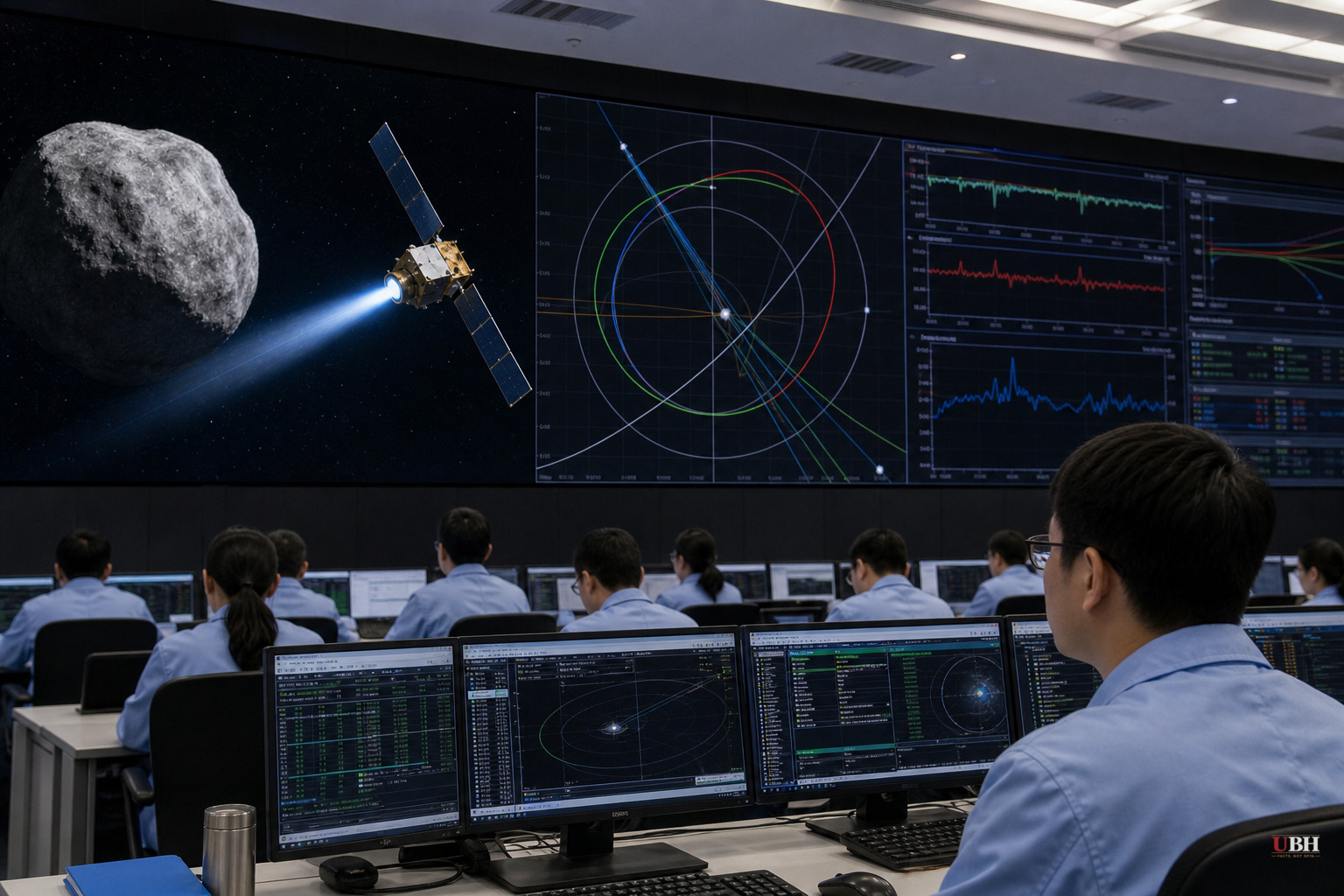
China wants to hit an asteroid harder and faster than NASA ever did, and this time the goal is to prove it can actually save the planet, not just prove a concept.
A team led by Li Mingtao, chief scientist for planetary defense at the China National Space Administration, published a paper under peer review by the Chinese-language Journal of Deep Space Exploration outlining the plan, according to the South China Morning Post. The target is 2015 XF261, a near-Earth asteroid roughly 30 meters wide. The mission window is 2029 or 2030.
Faster Than DART, and a Different Goal Entirely
NASA's Double Asteroid Redirection Test slammed a spacecraft into the asteroid Dimorphos in 2022 at 6.1 kilometers per second, or about Mach 18. That mission proved a kinetic impactor could nudge an asteroid's orbit around a companion asteroid. It worked. It also had a limitation.
"Dart was the first to demonstrate asteroid deflection by kinetic impact in space, but it did not directly change an asteroid's orbit around the sun relative to Earth, making it different from a real planetary-defense scenario," Li's team wrote, according to the South China Morning Post.
China's plan calls for hitting 2015 XF261 at more than 9 kilometers per second, over 26 times the speed of sound at sea level and nearly 50% faster than DART's impact speed, the South China Morning Post reported. The Independent reports the mission aims to directly alter the asteroid's orbit around the Sun and potentially break its structure, targeting a solid asteroid rather than a loosely bound "rubble pile" like Dimorphos.
That distinction matters. A solid asteroid responds to impact differently than a rubble pile. If China can prove a kinetic impactor works against a solid target and change its actual orbit around the Sun, that's a more direct rehearsal for the scenario planetary defense actually exists to prevent.
Two Spacecraft, a Venus Flyby, and a Truck-Sized Punch
The mission design calls for two spacecraft, according to the South China Morning Post: one interceptor, one observer. The observation craft would use a Venus gravity assist before rendezvousing with the target, then deploy a small probe to monitor the collision and measure changes to the asteroid's orbit, shape, surface, and internal structure.
The Times of India reported additional detail from Wu Weiren, chief designer of China's lunar exploration program, who described the strategy at the third Deep Space Exploration Tiandu International Conference in Hefei. Chinese scientists are calling their approach the "Assembled Kinetic Impactor," or AKI. Instead of jettisoning the rocket's upper stage before impact, engineers would keep a roughly 6.5-tonne piece of rocket booster attached to the spacecraft, according to the Times of India. More mass at the same velocity means more kinetic energy transferred on impact.
The Independent adds that the observation probe will carry cameras, spectrometers, and dust detectors, intended to build the most detailed picture ever made of a small asteroid's internal structure and composition.
Why Speed Is the Whole Point
Kinetic energy scales with the square of velocity, not linearly. That's why Chinese scientists are pushing for 9 km/s instead of matching DART's 6.1 km/s. A modest speed increase translates into a much larger energy transfer, and a much bigger nudge to the asteroid's path.
The mission is expected to happen during a close approach when 2015 XF261 passes within about 7 million kilometers of Earth, according to the South China Morning Post.
What's Proven, What's Still a Plan
None of this has happened yet. The paper is still under peer review. No launch date has been set beyond the "before 2030" target window cited by the researchers. Mission architecture, spacecraft mass, and the assembled kinetic impactor concept are current engineering proposals, not hardware sitting on a launch pad.
This is China's stated intent, backed by named scientists at a national space agency, not a launch happening this year.
Meanwhile, NASA's own detection capability is set to improve. SpaceX is scheduled to launch the NEO Surveyor asteroid-detection telescope no earlier than September 2027, according to ZeroHedge, which will scan for potentially hazardous asteroids and comets within 30 million miles of Earth's orbit. Detection and deflection are two different problems, and right now China is the one publishing detailed deflection mission plans while America's contribution centers on the DART precedent and improved detection.
The open question is whether China's AKI approach actually performs better than DART did against a solid asteroid target, and whether Beijing will coordinate results with NASA and the international planetary-defense community the way DART's findings were shared globally. Neither the Chinese paper nor the conference remarks cited by the Times of India address international data-sharing plans.
Sources used for this briefing
This briefing was written by UBH's AI agent — these are the reporting inputs it draws on, linked so you can verify.


