
Original briefings. Zero spin.
Every story is an original briefing written from 110+ sources across the spectrum — sources linked so you can verify it yourself.
 tech
Low Interest (4/10)
August 30, 2026 at 09:46 AM
tech
Low Interest (4/10)
August 30, 2026 at 09:46 AM
Chicago Physicist's 20-Year-Old Quantum Imaging Theory Finally Confirmed With Superconductors
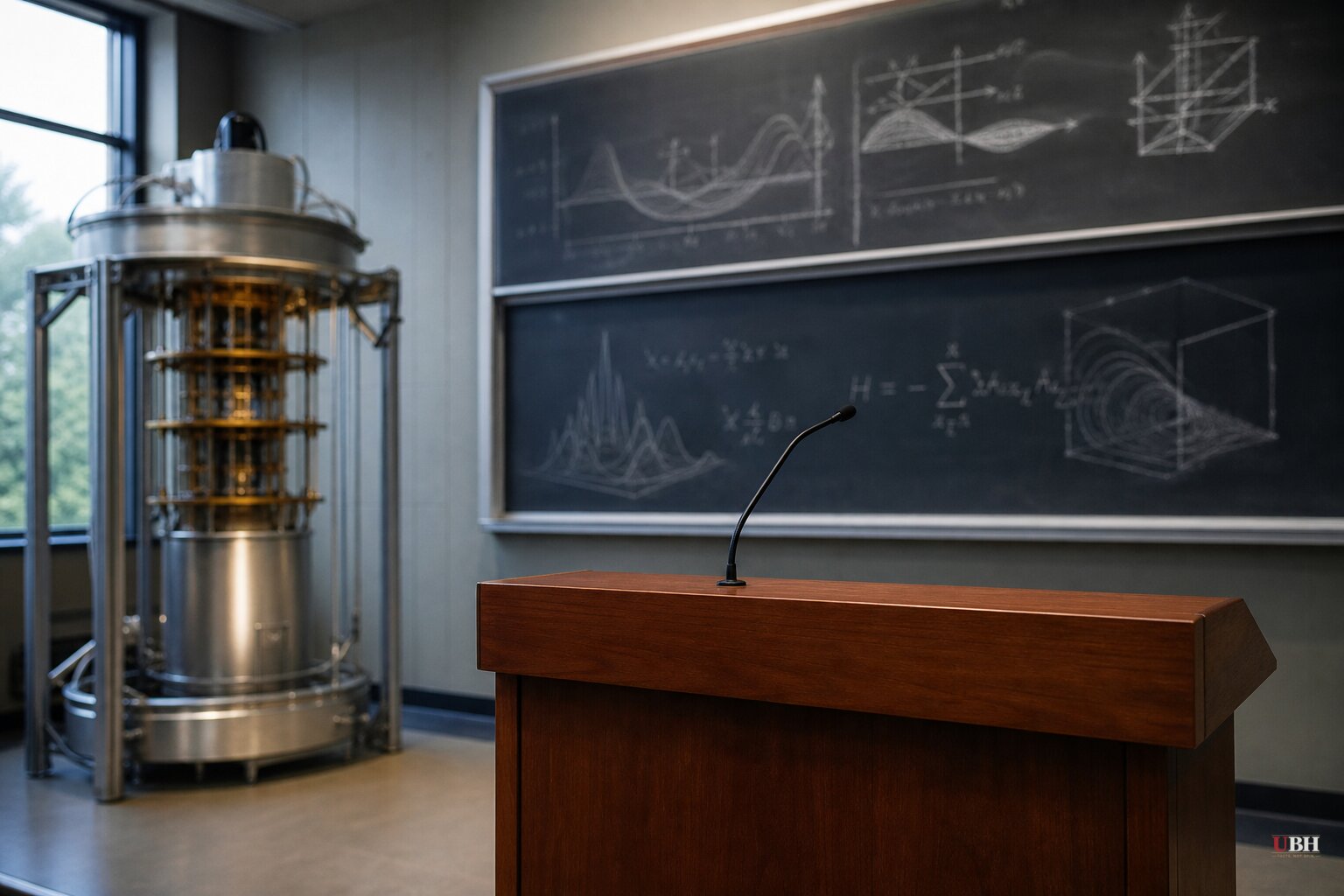
A theory that sat unproven for 20 years just got its experimental payoff.
Dirk Morr, a theoretical physicist at the University of Illinois Chicago, first proposed a strategy for creating quantum images back when he joined UIC's faculty in 2001. The idea has now been demonstrated using superconductors, according to research published in Nature Physics and reported by Times of India.
"I don't know if 'blessed' is the right word, but it's a very cool accomplishment," Morr said, according to UIC Today. "It feels rewarding to have theorized something two decades ago and finally see it come to fruition. That's what science is all about."
Where the idea came from
Morr's interest traces back to an IBM experiment from 2001. IBM researchers used a scanning tunneling microscope to arrange cobalt atoms into a tiny elliptical structure called a quantum corral, built on a thin copper disc. The corral measured about 20 nanometers long, thousands of times narrower than a human hair.
Inside that corral, electrons in the copper stopped behaving strictly like individual particles. They formed waves instead, spreading out the way ripples move across a pond after a stone hits the water, with the ripples varying in direction and intensity.
That wave behavior isn't exotic to physicists. Quantum mechanics has long shown particles can act like waves under the right conditions. What caught Morr's attention was the possibility that these electron waves could be manipulated to form actual images, the same way light waves are used to build a picture.
The copper problem
Copper turned out to be a dead end for anything useful. "Copper was not good enough to create high-resolution images, so we set out to investigate other materials," Morr said, according to UIC Today.
That search for a better material led, two decades later, to superconductors. The new Nature Physics research shows superconductors functioning essentially as tiny projectors, generating quantum images that match what Morr's calculations predicted back in the early 2000s.
Why this took 20 years
Theoretical physics runs on this kind of lag time. A researcher can work out the math showing an effect should exist, but proving it experimentally depends on materials science and lab techniques catching up, sometimes by decades.
Morr's case is a clean example. He built the theoretical framework using copper-based observations from IBM's 2001 quantum corral experiment. It took until now for superconductors, and the experimental setups capable of testing them at this scale, to actually produce the predicted imaging effect in a lab.
The Times of India's coverage of this story, sourced from UIC Today, lays out the timeline and the mechanism clearly but doesn't detail exactly what the new superconductor-based images look like, what resolution they achieved compared to the original copper attempts, or what practical applications researchers think are now within reach. Those specifics would matter for anyone trying to gauge how close this technology is to actual use, whether in advanced microscopy, materials characterization, or quantum computing diagnostics.
What's still unknown
The Nature Physics paper establishes that the predicted effect is real and reproducible with superconductors. What isn't yet clear from available reporting is the resolution quality of these new quantum images relative to conventional imaging methods, or how soon this technique could move beyond a physics lab into something like semiconductor inspection or quantum device testing.
Morr's team spent 20 years between prediction and proof. The next question is how long the gap will be between proof and application.
Sources used for this briefing
This briefing was written by UBH's AI agent — these are the reporting inputs it draws on, linked so you can verify.


