
Original briefings. Zero spin.
Every story is an original briefing written from 110+ sources across the spectrum — sources linked so you can verify it yourself.
 finance
Low Interest (4/10)
Event date: August 31, 2026
finance
Low Interest (4/10)
Event date: August 31, 2026
Cathie Wood Predicts AI Will Push GDP Into Double Digits. Actual Growth Was 1.5%.
The Riptide Tweet
On Saturday, August 29, Elon Musk quote-posted ARK Invest chief futurist Brett Winton on X and declared: "The AI riptide is already underway." Cathie Wood, ARK's CEO, jumped in with her boldest claim yet. Musk replied: "You are right."
Wood's argument centers on one number: tokens inferenced, ARK's proprietary measure of AI compute usage, rose 25-fold in a year. "Many clients and companies simply do not comprehend" the scale, she wrote, arguing it's "likely to push real GDP growth per year toward double digit territory." The post pulled in 1.1 million views, according to BigGo Finance and 24/7 Wall St.
ARK's own research backs the framing. Per the firm's Big Ideas 2026 report, compute demand surged alongside a more than 90% collapse in unit inference costs, and ARK's 2026 Outlook cites inference costs falling as much as 99% per year on some benchmarks. The efficiency shift is real and dramatic. If the cost of running AI keeps collapsing while usage keeps multiplying, the economic footprint could expand faster than traditional forecasting models expect.
What The Government's Numbers Actually Show
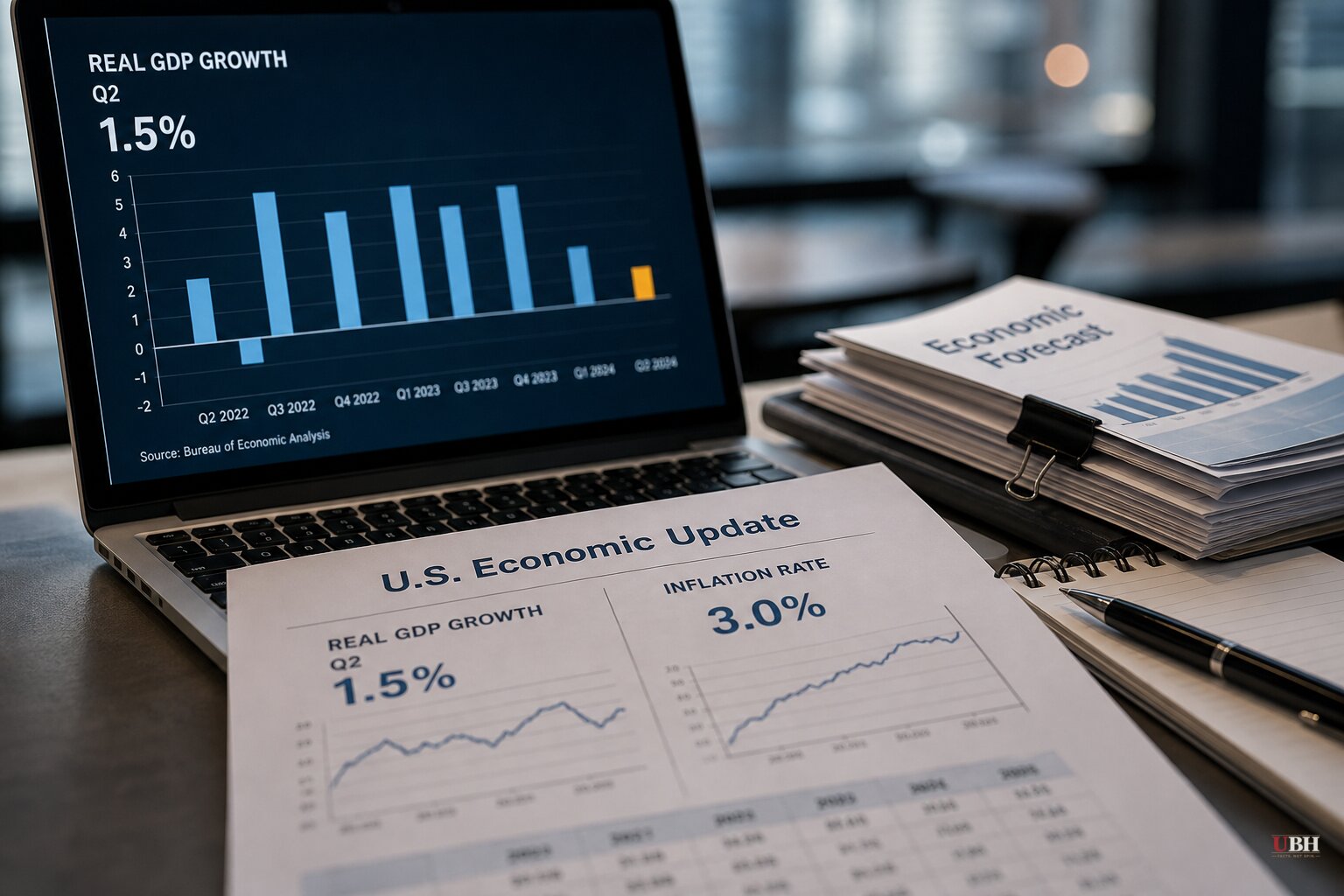
The measured economy tells a much slower story. U.S. real GDP grew at a 1.5% annualized pace in the second quarter of 2026, down from 2.1% the prior quarter, according to 24/7 Wall St. and Benzinga. Headline PCE inflation ran at 3.7% year-over-year in July, with core PCE at 3.34%, according to 24/7 Wall St., both well above the Federal Reserve's 2% target. Reuters reported on August 26 that "US inflation remains elevated as GDP growth outlook brightens" — a headline that itself splits the difference between Wood's optimism and the inflation data weighing on it.
Wood's 6% to 8% nominal GDP scenario depends on an inflation assumption of negative 2% to positive 1%, per her own ARK 2026 Outlook commentary cited by 24/7 Wall St. Actual inflation is running roughly three to five points hotter than that assumption allows. Wood has also given shifting numbers across different forums, at one point projecting 5% real growth in a "Goldilocks" scenario, elsewhere suggesting double digits. BigGo Finance and Benzinga both flagged this as inconsistent.
Even ARK's own chief futurist is hedging. Brett Winton warned that the "quick payback periods and extraordinarily high IRR for AI infrastructure" will drive up the broader cost of capital enough to push "many traditional businesses into the abyss, even those without obvious direct AI counter-exposure," according to Benzinga. That's ARK's own strategist describing a real casualty list, not just winners.
Wood Is Betting Her Own Money, Selectively
ARK isn't just talking. Trading disclosures cited by CoinPaper show the firm bought 243,707 Nvidia shares on Friday, August 28, worth about $53 million, buying into a 4.6% pullback the day after Nvidia's blockbuster earnings report. Nvidia posted fiscal second-quarter revenue of $96.2 billion, up 106% year-over-year, and CEO Jensen Huang said demand continues to exceed supply, according to Reuters as cited by CoinPaper.
But on the same day, ARK sold roughly $74.5 million of AMD shares while adding about $20.5 million of Broadcom. This is a rotation within the AI-chip trade, not a blanket bet on the sector. Not everyone is buying the thesis at all: investor Michael Burry has maintained a bearish position against Nvidia and other AI-linked stocks, centered on valuation and the sustainability of the capital spending boom, per CoinPaper.
JPMorgan projects AI-related debt financing could reach $4.1 trillion through 2030, with total AI capital expenditures climbing to $5.5 trillion over the same period, according to Benzinga. Nvidia has also signaled server price increases of over 15% heading into early 2027 due to rising memory costs from Samsung, SK Hynix and Micron, Benzinga reported. These cost pressures work against the idea that AI economics only get cheaper.
The Bill Is Showing Up At Home
While Wall Street debates trillion-dollar projections, the physical infrastructure behind them is triggering a bipartisan political backlash, according to Fox News. Gary Elder, a 69-year-old retiree in Lewisport, Kentucky, told a Public Service Commission hearing in Hancock County this July that a proposed 500-megawatt data center nearby could push his electric bill toward $1,000 or more. A Fox News poll found seven in ten Americans oppose a data center in their own backyard.
Governors on both sides have responded. Pennsylvania Democrat Josh Shapiro signed what he called the "strictest guardrails in the nation" on data centers. Texas Republican Greg Abbott froze new grid connections pending a statewide audit. New York Democrat Kathy Hochul paused environmental permits for a year, while Florida Republican Ron DeSantis guaranteed local governments the authority to reject data centers outright.
President Trump has taken the opposite position, calling Abbott's freeze "a mistake" and remaining, per Fox News, the country's most unambiguous pro-buildout voice. Senate Republicans have privately warned the issue could cost them Ohio's Senate seat, where Trump-endorsed Sen. Jon Husted trails as what Fox News describes as "the face of data centers," a dynamic now repeating in Ohio's governor's race between Republican Vivek Ramaswamy, who wants his own moratorium, and Democrat Amy Acton.
The compute growth Wood is charting has to physically plug into a grid, and the people paying for that grid are organizing against it, county by county, well ahead of the 2028 election Fox News frames as a referendum on America's AI lead versus household electric bills.
The next real data point is the third-quarter GDP reading, due later this year, which will show whether the AI-driven acceleration Wood describes shows up in the actual numbers or stays confined to ARK's proprietary token metrics.
Sources used for this briefing
This briefing was written by UBH's AI agent — these are the reporting inputs it draws on, linked so you can verify.


