
Unbiased headlines. Facts, not spin.
Unbiased Headlines is an independently owned news organization. We bring you the facts, not opinions, written fresh from 110+ named sources. Sources linked so you can verify it yourself.
 economy
Major Story (7/10)
Carney and Sheinbaum Both Meet Trump at APEC in Shenzhen, No USMCA Deal Announced
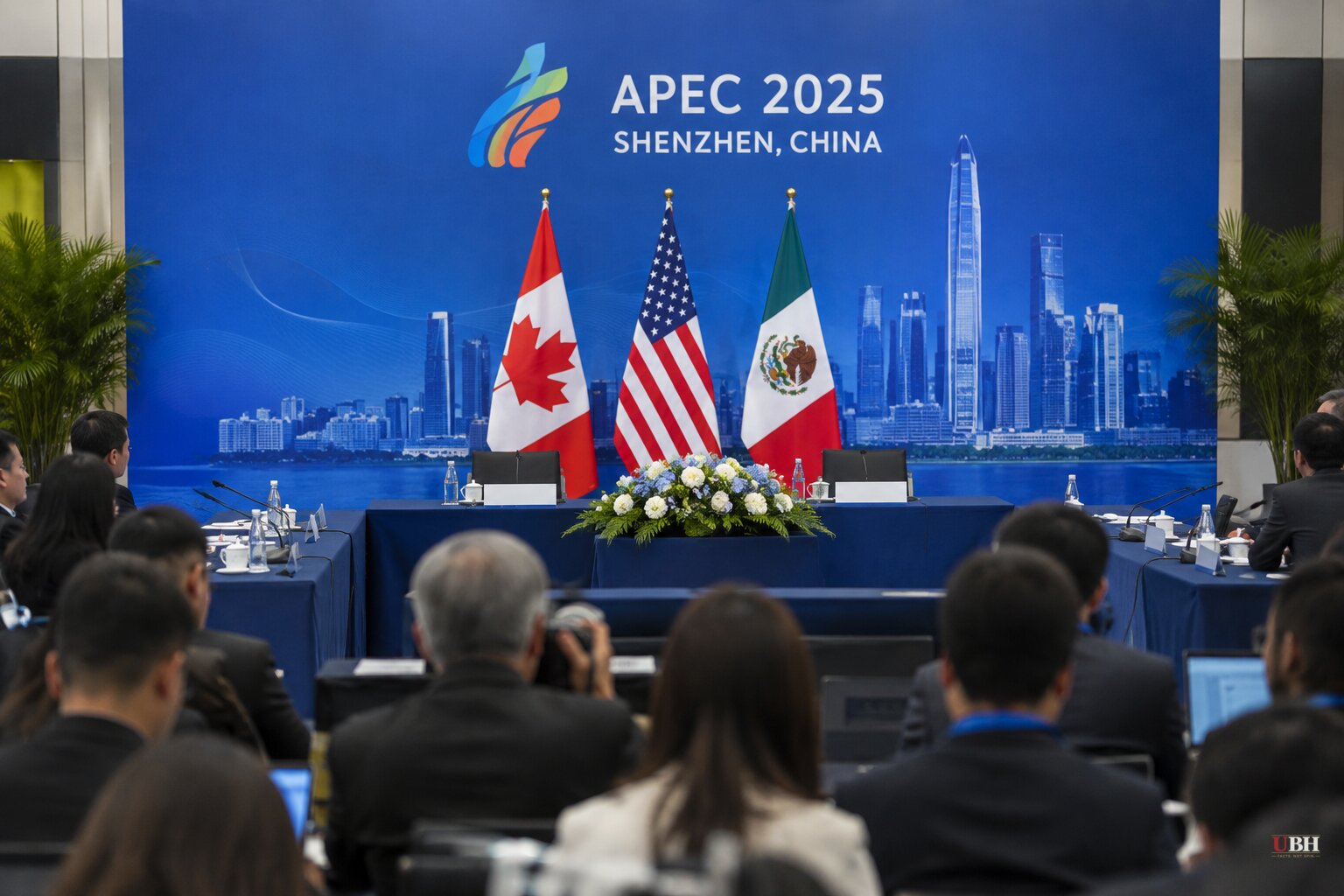
Since Carney and Xi Jinping agreed this week to ease tariffs on Canadian pork and seafood and on certain Chinese steel and aluminum goods, the question has been how Washington would respond. On Wednesday, Nov. 18, Trump met both North American leaders on the sidelines of the APEC summit in Shenzhen. Neither meeting produced an announced deal.
A 20-minute meeting with Carney
Carney's spokesperson said the Trump meeting lasted just under 20 minutes. U.S. Trade Representative Jamieson Greer and Commerce Secretary Howard Lutnick took part, along with Trump's chief of staff Stephen Miller and Secretary of State Marco Rubio. Carney brought chief of staff Marc-André Blanchard and Foreign Affairs Minister Anita Anand.
Carney's team again pressed for renewal of the agreement and for a separate bilateral trade deal with Ottawa, Newsweek reported.
At a press conference in Shenzhen, Carney described the talks as "two steps forward, one step back." He said Canada would not sign something just to end the dispute.
"The United States fundamentally changed its trade objectives and we are focused on getting the right deal for Canadians," he said. "We will do what's necessary in order to achieve that deal, but only that deal that is in the interests of Canadians."
Sheinbaum calls it 'very good'
Sheinbaum met Trump separately and posted on X that the meeting was "very good" and that "we continue to make progress on our shared agenda." She disclosed no specific agreements.
She said Trump had been briefed on talks between Mexico's economy ministry and U.S. counterparts, and that negotiators were "very far along." Economy Secretary Marcelo Ebrard has led much of Mexico's side, covering autos, steel and aluminum. Sheinbaum said she expects to meet Trump again at the G20 summit in Miami in December.
The friction has not gone away. Ahead of the summit, Trump again threatened higher tariffs on Mexico if the government did not stop new migrant caravans heading north. Washington also keeps sector-specific duties on Mexican autos, steel and aluminum.
Carney and Sheinbaum met on Nov. 17. Carney's office said both "reaffirmed their commitment to renewing" the agreement, which Canada calls CUSMA.
What Canada's negotiator says she can get
The day before, Canada's chief U.S. trade negotiator, Janice Charette, gave MPs on the international trade committee a blunt read of the table. The goal, she said, is to get "as close as we can to tariff-free trade."
"We'd very much like to get back to that position, but I think we have to prepare ourselves for a world that, like other countries, that's not an arrangement that we are able to arrive at with the United States," Charette said.
She said the U.S. has shown "an unwillingness to enter into any arrangement in which there is full, tariff-free trade." Her proposal is the lowest tariff rate on the narrowest basket of goods, with the most preferential access for Canadian workers and businesses.
Where the agreement stands
In July, Washington declined to extend the agreement for another 16-year term. The pact now has to be reviewed annually. Newsweek puts the commerce it underpins at nearly $2 trillion a year. Businesses face uncertainty on investment and hiring decisions as a result.
The U.S. side has not offered a public account of the Shenzhen meetings. Trump adviser Peter Navarro, however, has been openly critical of Ottawa's moves toward Beijing. He called Carney's remark that Canada could turn to Chinese automakers if U.S. talks fail "offensive."
Carney has described the China arrangements as building on earlier agreements covering electric vehicles and agricultural products including canola.
A congressional lever
A separate pressure point sits in Congress. The Atlantic Council argues that once the new Congress is sworn in, there may be enough bipartisan support to repeal Section 338 of the Tariff Act of 1930 and override a Trump veto.
Trump invoked that authority against Canada in August, the first use of the provision to impose tariffs. According to the Atlantic Council's analysis, it placed 50 percent tariffs on roughly $20 billion in Canadian goods. Canada retaliated.
The Atlantic Council says the average tariff rate on tariffed Canadian goods rose from about 1.7 percent in July to 33.0 percent in September. U.S. importers paid about $385 million in duties on those goods in September, up from $33 million in July.
The think tank also notes that repeal would not restore the pre-2025 baseline. The average tariff rate on Canada was 0.1 percent in January 2025. Section 232 and Section 301 tariffs would remain, and a bill that would provide refunds has no firm timeline.
Whether Congress moves on Section 338 when it reconvenes, and what Trump and Sheinbaum settle on in Miami, are the next open questions.
Sources used for this briefing
7 links from 7 independent newsrooms (syndicated copies of the same report count once)
These are the sources it draws on, linked so you can verify.


