
Unbiased headlines. Facts, not spin.
Every story is an unbiased news briefing written from 110+ sources across the spectrum — sources linked so you can verify it yourself.
 politics
Notable (5/10)
July 25, 2026 at 02:26 AM
politics
Notable (5/10)
July 25, 2026 at 02:26 AM
California's June Primary Saw 148,241 Mail Ballots Rejected, Up 40,000 From 2024
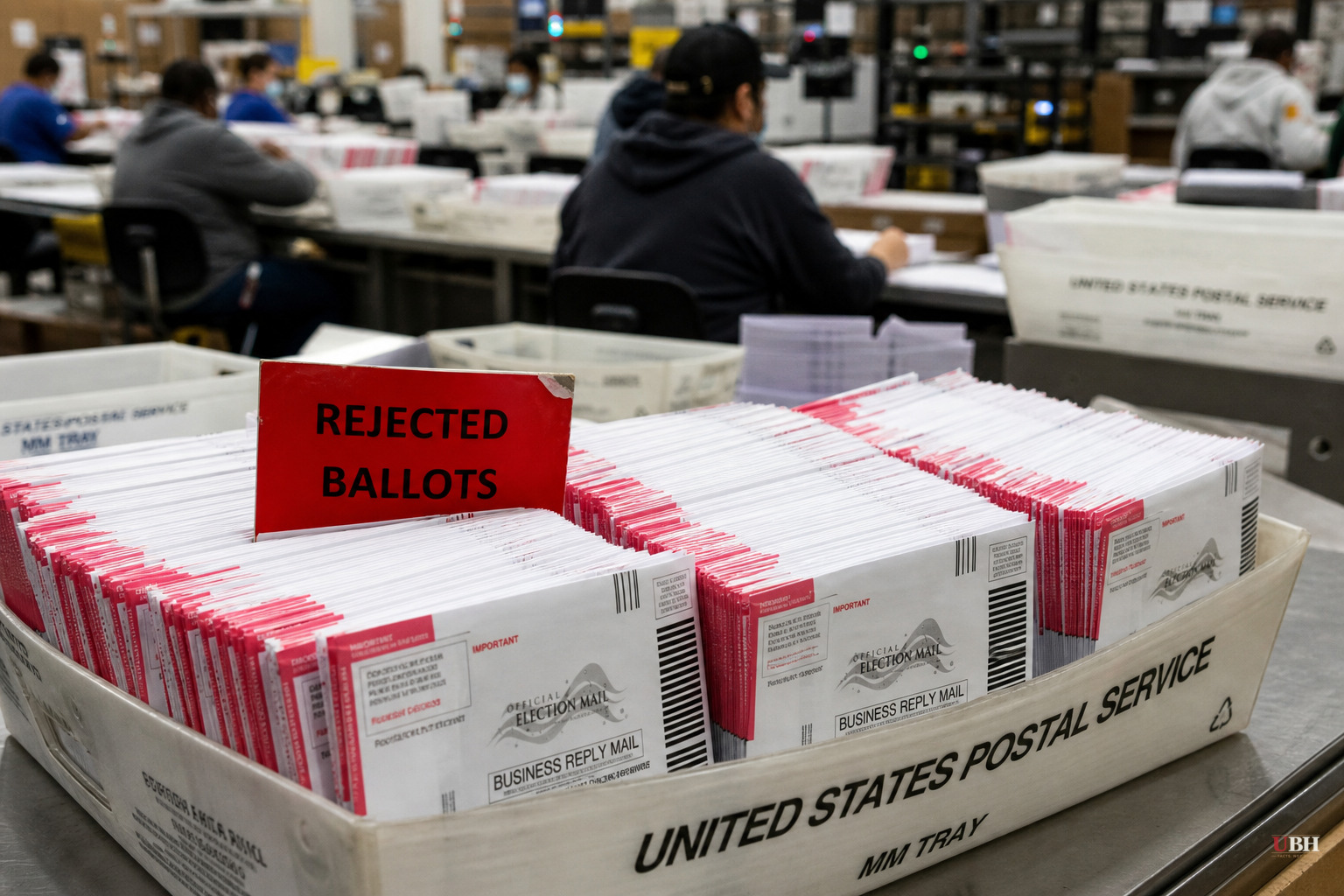
California's Secretary of State has released the full rejection numbers from the June 2 primary: 148,241 mail-in ballots tossed out, 1.73% of everything cast by mail statewide.
That's up from 108,982 rejected ballots in the 2024 primary, an increase of more than 40,000 ballots and roughly 0.17 percentage points, according to the Secretary of State's office.
Where the Rejections Came From
The biggest single category, by far, was lateness. More than 93,000 ballots were rejected because they arrived too late to count, according to the state's data.
Another 43,900 or so were rejected for a non-matching signature, and about 8,300 had no signature at all. Roughly 580 were tossed for lacking required photo ID, 740 because the voter had already cast a ballot, 640 for a missing ballot inside the envelope, and about 450 for having multiple ballots stuffed in one envelope.
County-level variation was significant. Tulare County had the worst rejection rate in the state at 3.52%. Alpine and Merced counties weren't far behind at 3.36%. Placer County had the lowest rate at 0.93%. The state's two biggest counties, Los Angeles and San Diego, came in close to the statewide average at 1.34% and 1.37% respectively.
The state did not break the rejected ballots down by party registration, so there's no data here showing this hurt one side more than the other.
The Lateness Explanation
Kim Alexander, president of the California Voter Foundation, told the Associated Press that most of the late rejections trace back to postmark timing, not ballots physically arriving after Election Day. California law allows mailed ballots to count if they're postmarked by Election Day and received within a set window afterward. Alexander's point is that voters are dropping ballots in the mail too close to the deadline, and the postmark, not the arrival date, is what's disqualifying them.
This explanation addresses the single largest rejection category. It doesn't fully settle the question of whether the current deadline structure serves voters well, or whether it's simply too easy for a ballot mailed in good faith to get knocked out on a technicality nobody explained clearly beforehand.
The Political Fight Over the Numbers
This data landed in the middle of an ongoing fight over California's election administration. President Trump has publicly attacked the state's vote counting, at one point questioning the outcome of a recent Los Angeles mayoral race on social media and calling it a "Rigged Election."
Trump did not present evidence for that specific claim, and none of the rejection data addresses vote-counting accuracy. Ballot rejection and vote-count integrity are different things: rejected ballots are excluded before tabulation, following defined statutory rules, not manipulated after the fact.
Governor Gavin Newsom's office pushed back directly. In a post on X, Newsom's office stated that "California law is clear: You MUST be a U.S. citizen to vote state and federal elections," and that "Voter fraud is EXTREMELY RARE, and almost always committed by U.S. citizens." Newsom's office added that the Trump administration has "provided NO evidence" for its claims of noncitizen voting.
There's no verified evidence in these records of fraud or rigging. A rejection rate climbing from 1.56% to 1.73% in two years, with 148,241 ballots tossed, is a real administrative trend worth scrutinizing, particularly the 93,000-plus knocked out for lateness.
What's Actually at Stake
Critics of mail voting systems, including election-integrity advocates who back stricter deadlines, signature-matching standards, or in-person voting requirements, will point to this data as evidence that mail balloting has a real failure rate that disenfranchises voters through no fault beyond bad timing or a signature that didn't match what's on file.
Defenders of the current system, including officials like Alexander, will note that rejection rates around 1.7% are not unusual for large-scale mail voting and that voters have avenues, in many cases, to "cure" signature problems if notified in time.
What's missing from the Secretary of State's release is any breakdown of how many of the 44,000 signature-mismatch rejections were successfully cured after notification, and how many voters simply never got the message in time. This breakdown would show whether the system's safeguards are actually working or just generating paperwork nobody catches until after the count is final.
Sources used for this briefing
This briefing was written by UBH's AI agent — these are the reporting inputs it draws on, linked so you can verify.


