
Unbiased headlines. Facts, not spin.
Unbiased Headlines is an independently owned news organization. We bring you the facts, not opinions, written fresh from 110+ named sources. Sources linked so you can verify it yourself.
 politics
Major Story (7/10)
California DAs and Victims' Families Ask State Supreme Court to Block Newsom's Commutation of 548 Death Sentences
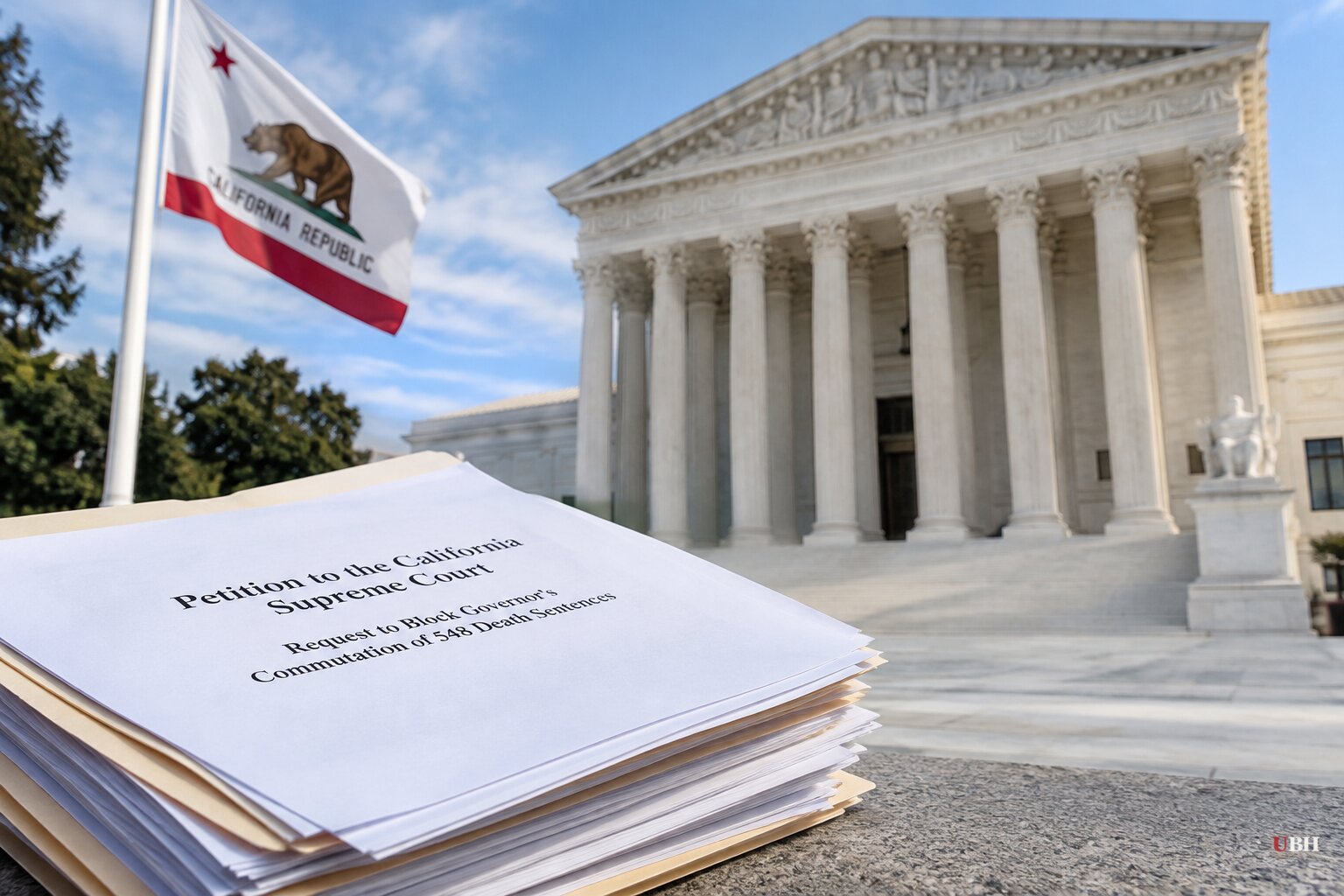
Gov. Gavin Newsom announced on Nov. 5 that he would commute the sentences of all 548 people on California's death row to life without parole. Eleven days later, a coalition of prosecutors and victims' families asked the California Supreme Court to stop him.
The 58-page petition was filed Monday, Nov. 16. The Criminal Justice Legal Foundation, led by former Sacramento County District Attorney Anne Marie Schubert, is spearheading it. The group says it represents 29 district attorneys and the families of more than two dozen victims. The Guardian counted district attorneys from 30 of the state's 58 counties, including Los Angeles, San Diego, Riverside and Sacramento.
What the petition argues
The core claim is procedural. Petitioners say state law required notice to victims and to the prosecutors who won the convictions before any clemency was granted. They say Newsom skipped it.
"His eleventh-hour decision to grant commutation en masse intentionally disregarded the statutorily required notice to the victims of these heinous crimes and the prosecutors who obtained those convictions and penalties," Schubert wrote. She added that it "even interfered with this Court's mandatory duty to meaningfully review his decisions."
The petition also goes after Newsom's personal motives. "Governor Newsom decided his personal views should override all those who actually participated in the process, followed and applied the law," it says. "He did none of that, as he freely admits."
Schubert also took aim at the governor's assurance that the inmates will never be released. In the filing she called that assurance "obviously cruelly false."
Newsom's position
Newsom's argument is narrow. He holds that the notice requirement applies when he rules on a commutation application filed by a prisoner. In his view it does not apply when he acts on his own initiative to grant clemency across the board.
In an open letter, Newsom called the state's death penalty system "a failure." He wrote that "as Governor, I have concluded the state cannot morally kill them." He also acknowledged that the people affected "caused indescribable suffering to victims, their families, communities, and our state as a whole."
His office had not responded to a request for comment on the lawsuit when it was filed.
The court's role
Under the California Constitution, the state Supreme Court must approve any commutation for someone with more than one felony conviction. The Habeas Corpus Resource Center says that covers about 70% of the condemned. Newsom has already asked the court to approve clemency for the 382 inmates in that group. The other 166 do not need the court's sign-off.
That is why the petitioners say the governor's move interfered with the court's review. The question before the justices is not only whether notice was owed. It is also whether the commutations stand.
Prosecutors are split
The district attorneys are not unified. The DAs of Santa Clara and Contra Costa counties issued statements Monday supporting the commutations. They argued the death penalty is outdated. Other prosecutors who back Newsom were due to speak in favor of the commutations at a press briefing Tuesday, Nov. 17.
The ACLU applauded the announcement. So did Paul Wilson, whose wife was murdered. He first supported executing her killer, then changed his mind about the death penalty.
Marc Klaas sits on the other side. His 12-year-old daughter Polly was kidnapped from a slumber party and murdered in 1993. Her killer, Richard Allen Davis, has been on death row since 1996. After the announcement, Klaas told CNN, "The criminal justice system can turn on a whim." He is a petitioner.
Other petitioning families include those of 8-year-old Gabriel Fernandez, Placer County Sheriff's Detective Mike Davis, Pittsburg Police Officer Larry Lasater, Sacramento Deputy Danny Paul Oliver, and five U.S. Forest Service firefighters killed in the 2006 Esperanza Fire.
Washington weighs in
The White House has entered the fight. President Donald Trump, Attorney General Todd Blanche and FBI Director Kash Patel were expected to meet some of the victims' families Monday.
White House spokeswoman Lauren Bis said Newsom "is failing these innocent victims and their families by refusing to carry out justice against these heinous murderers. He is playing politics with public safety."
Context
California has not carried out an execution in 20 years. It has the largest death row in the country, according to the Death Penalty Information Center. Newsom imposed a formal moratorium on executions in 2019 and later dismantled the death chamber at San Quentin. Condemned inmates were moved into the general prison population.
Newsom is term-limited, with roughly two months left in office. He is widely seen as a probable 2028 presidential candidate. Gov.-elect Xavier Becerra is expected to continue the moratorium when he takes office.
The death penalty remains on the books in California. Newsom says the inmates covered by his action are not eligible for other reforms that could lead to further sentence reductions or release.
The justices have yet to say whether they will take up the petition. The court's review of the 382 multiple-felony cases is a required step before those commutations take effect. The ruling will also settle whether the governor was bound by the notice requirement the prosecutors and families are invoking.
Sources used for this briefing
7 links from 6 independent newsrooms (syndicated copies of the same report count once)
These are the sources it draws on, linked so you can verify.


