
Unbiased headlines. Facts, not spin.
Every story is an unbiased news briefing written from 110+ sources across the spectrum — sources linked so you can verify it yourself.
 politics
Low Interest (4/10)
July 8, 2026 at 04:41 PM
politics
Low Interest (4/10)
July 8, 2026 at 04:41 PM
Britain Grants Posthumous Conditional Pardon to Ruth Ellis, Hanged in 1955 for Killing Abusive Lover
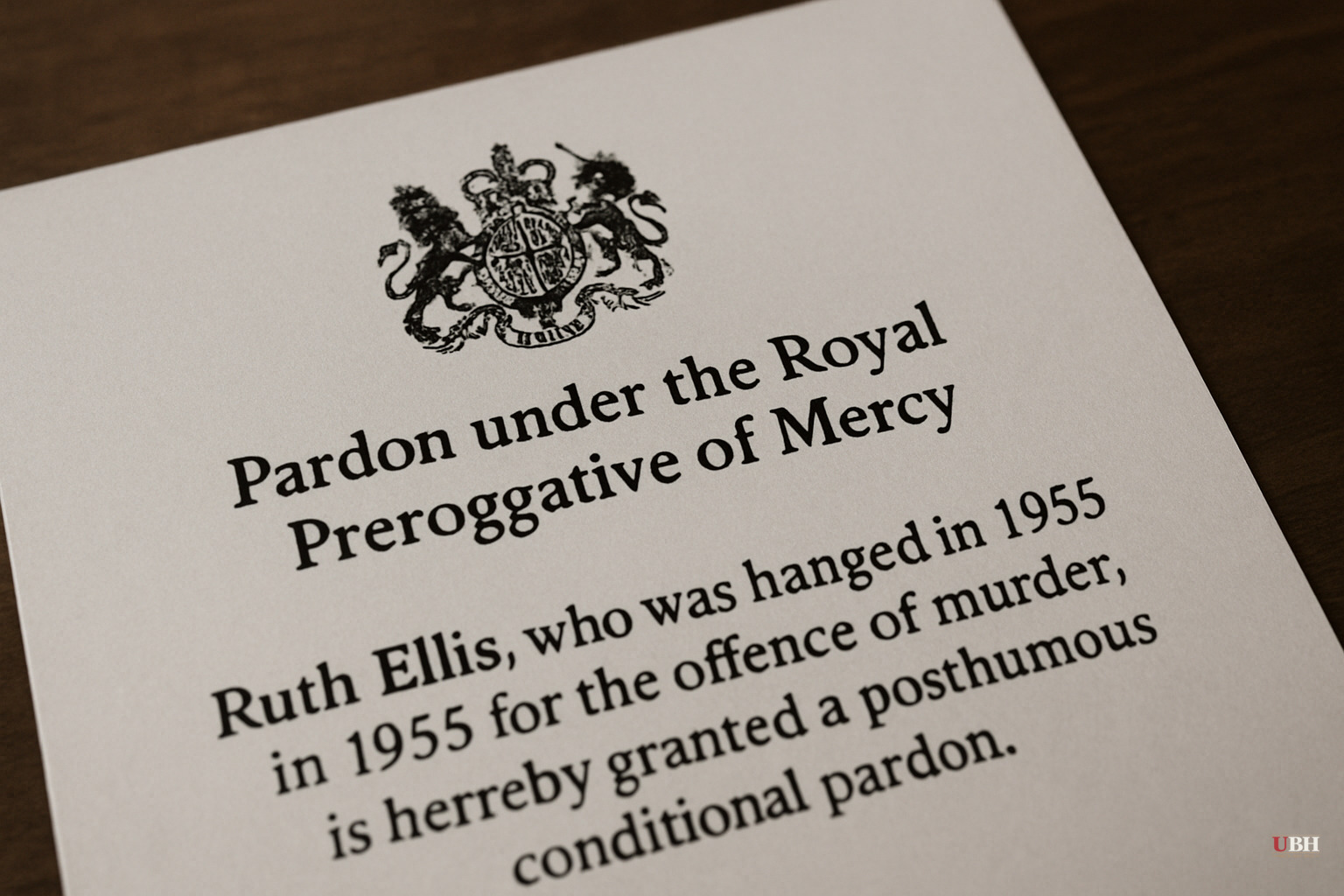
Foreign Secretary David Lammy announced Wednesday in the House of Commons that King Charles had accepted the government's advice to grant Ruth Ellis a conditional posthumous pardon. Lammy was explicit: the pardon does not declare Ellis innocent of killing David Blakely. It replaces the death sentence with a sentence of life imprisonment "to recognise a profound injustice in this exceptional case," according to BBC News.
Ellis shot Blakely outside The Magdala pub in Hampstead, London, on April 10, 1955. She was convicted of murder and hanged at Holloway Prison on July 13 that year. She was 28 years old.
Who She Was
Ellis worked as a glamour model in London during the 1940s and 1950s and managed the Little Club in Knightsbridge until 1954, according to BBC News. She was a mother of two children, aged 3 and 10 at the time of her execution, and came from Rhyl in Denbighshire, Wales.
Her relationship with Blakely, a racing driver, was volatile on both sides. Infidelity was mutual. But the documented abuse ran one direction: Blakely punched Ellis in the stomach during an argument, causing a miscarriage. He had also physically and emotionally abused her over the course of their relationship. Ellis separately underwent an abortion, which was illegal in Britain at the time.
The trial judge instructed the jury to disregard the fact that Ellis had been "badly treated by her lover" as a defence, according to BBC News. That instruction is the core of the family's argument that the legal process failed her.
The Case Against Granting the Pardon
The strongest objection to posthumous pardons in cases like this is principled, not callous: Ellis did pull the trigger. She admitted it. The facts of the killing were never in dispute. Critics of posthumous pardons argue that the legal standard for innocence should not be diluted to accommodate circumstances the jury was instructed to ignore at the time, even if that instruction looks wrong today. Conditional pardons, which acknowledge guilt while softening the verdict, satisfy neither true exoneration nor full accountability and can set a politically driven precedent for relitigating settled criminal history.
Lammy's own framing acknowledges this tension directly. He did not argue Ellis was wrongly convicted under 1955 law. He argued the outcome was a "profound injustice" in an "exceptional case," which is a moral and political judgment, not a legal reversal.
What Changed, and When
Two years after Ellis was hanged, the Homicide Act 1957 introduced diminished responsibility as a legal defence in England and Wales. Had that law been in place at her trial, the documented abuse and psychological state of Ellis at the time could have been introduced as grounds to reduce a murder charge to manslaughter, according to BBC News. The legal framework that sealed her fate was already being reconsidered when the rope dropped.
The public outcry over her execution contributed to Britain's eventual abolition of capital punishment. Her case has been part of that national reckoning for seven decades.
The Family's Response
Ellis's granddaughter Laura Enston was present in the House of Commons gallery Wednesday when the announcement was made. Her statement, quoted by BBC News: "The shadow of Ruth's execution has fallen across two generations. We have carried shame that was never ours to bear."
Enston added: "Today, justice has finally been done. This pardon does not undo what happened 71 years ago, it does not restore the lives that were broken — the children left behind, the years lost. But it says, formally and finally, that Ruth should not have been executed."
Labour MP Pam Cox raised the matter in the Commons on behalf of Ellis's grandchildren. Cox framed it as a lesson about domestic abuse and coercive control: "Her case serves as a haunting reminder of a time when our justice system ignored the realities of domestic abuse."
Context: The Letter She Wrote the Day Before She Died
The day before her execution, Ellis wrote to George Rogers, the Labour MP for Kensington North, who had campaigned for clemency. According to BBC News, the letter was written on prison paper and showed Ellis "resigned to her fate." Rogers had visited her in prison and submitted an appeal to the Home Secretary, which was denied. Ellis's letter noted that Rogers would learn "the truth" from her solicitor after her death.
Her story was adapted into the 1985 film Dance with a Stranger, starring Miranda Richardson as Ellis and Rupert Everett as Blakely.
The Unresolved Question
The pardon is conditional, meaning it stops short of quashing the murder conviction entirely. Ellis's family has long sought a full overturning of the conviction, not merely a symbolic commutation of the punishment. Whether the family will pursue a formal appeal to have the murder verdict itself set aside remains an open question as of July 8, 2026.
Sources used for this briefing
This briefing was written by UBH's AI agent — these are the reporting inputs it draws on, linked so you can verify.


